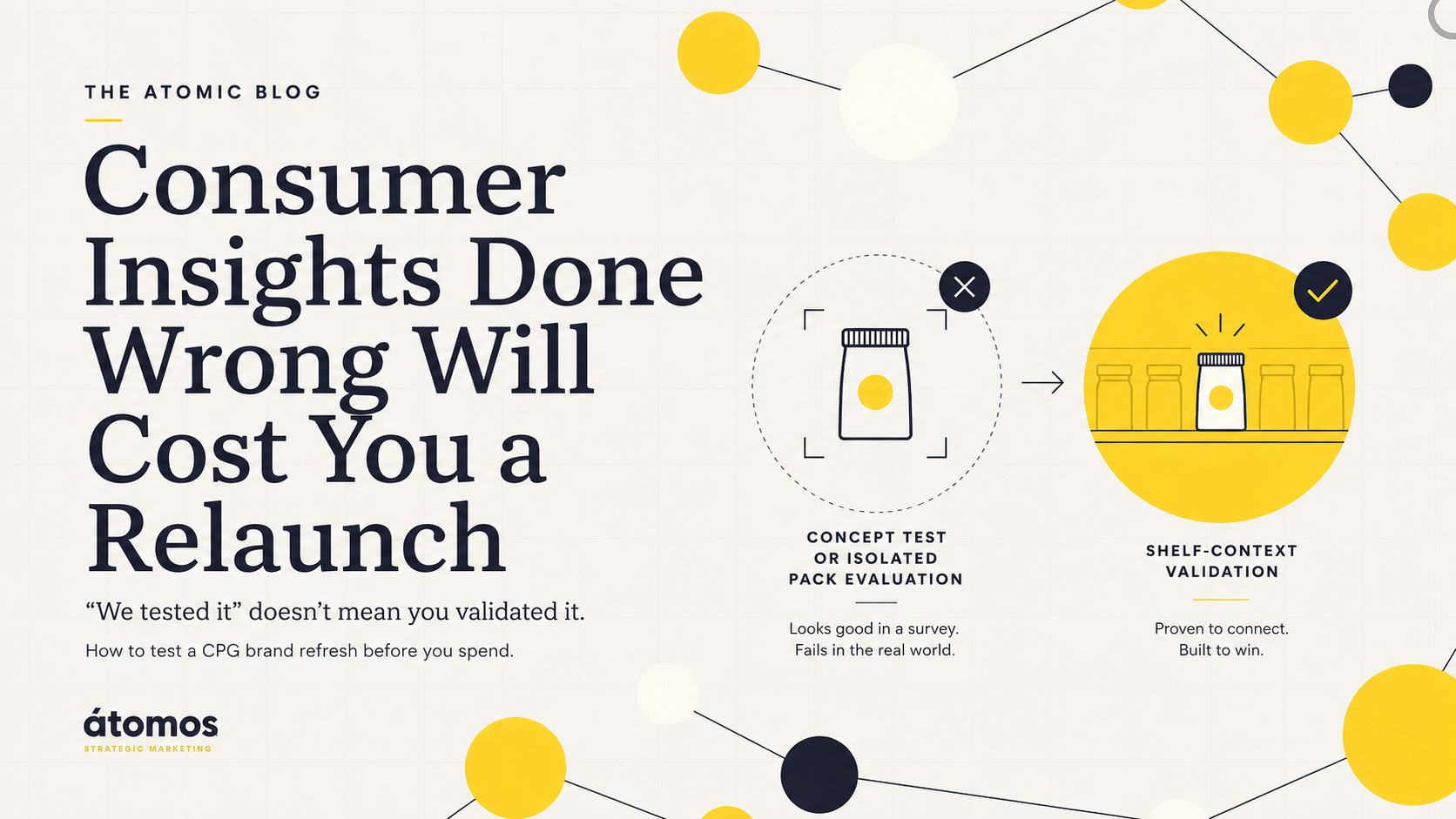
In brand reviews, there is a familiar moment when a redesign gets rubber-stamped. Someone puts up a slide that says "we tested it," the room nods, and the conversation moves to production timelines. The phrase sounds like risk has been retired. But unless the study was designed around the decision the shopper and the business will actually face, that confidence may be premature.
That sentence — "we tested it" — is doing more work than it deserves. It sounds like risk has been retired. Usually it hasn't. It's just been relocated, from the design phase to the P&L, where it shows up six months later as avelocity declinenobody can fully explain.
Here's the distinction that matters: consumer feedback is not the same as consumer insight. Feedback captures what people say or how they react in a specific research setting. Insight becomes useful when the method matches the behavior and business decision you are trying to predict. Sometimes that means qualitative depth. Sometimes it means stated response. Sometimes it means observed choice in a realistic shelf. The rigor is not in choosing one method over another; it is in using the right method for the decision. A test reduces risk only when it is designed to answer the question the business will actually face.
Why a redesign can pass every test and still fail on shelf
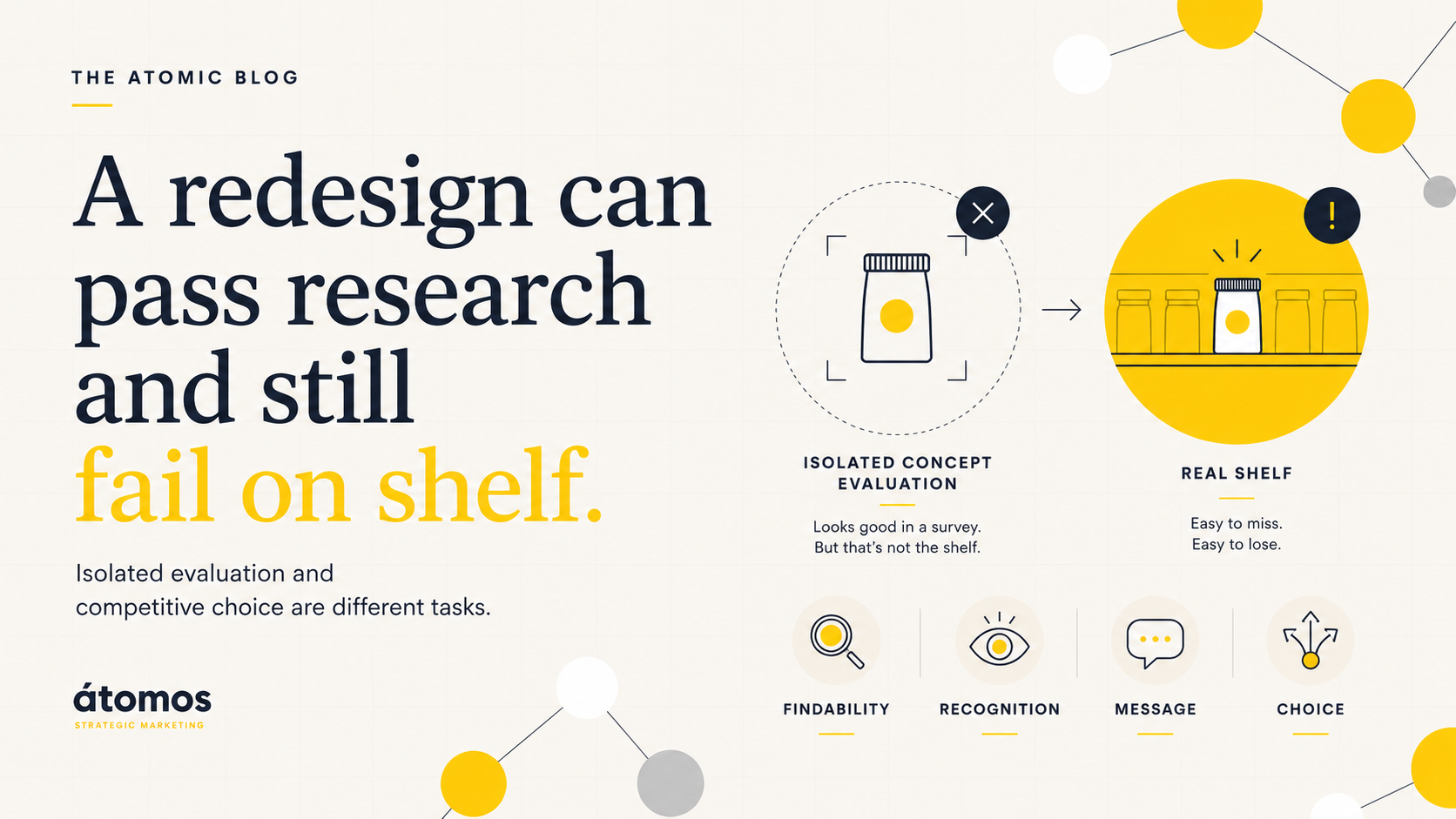
A packaging refresh doesn't fail in a vacuum. It fails because somewhere between the studio and the store, one of a small number of things breaks down. The shopper can't find it. They don't recognize it as the brand they already buy. They misread the primary message. They grab the wrong variant. The familiar visual cues that used to do the recognition work are gone. Or, when the moment of truth arrives and a competitor's pack is sitting beside it, they choose the competitor.
None of those failure modes show up in a well-lit concept board evaluated on a white background. That's the uncomfortable part. A pack can score well in an isolated survey and still lose on shelf, because isolated evaluation and competitive choice are two different tasks, and only one of them is the job the package actually has to do in a store.
NIQ's BASES data is blunt about how often this happens: roughly nine out of ten packaging redesigns fail to make a meaningful difference in market. Not fail outright — fail to move the number they were built to move. Meanwhile, NIQ has also found that a properly optimized package can shift forecasted volume by as much as 5.5%. Read those two numbers together and the message is simple. The upside from getting packaging right is real. Most teams aren't getting there, and the tests they ran didn't stop them from shipping the wrong version.
The cautionary case every CPG operator should know cold
Tropicana's 2009 Pure Premium redesign is the case study that gets cited constantly, and it's worth revisiting for the right reason. The redesign replaced the brand's familiar straw-in-an-orange imagery with a glass of juice and a more minimal, modern layout. Sales fell roughly 20% in the aftermath, and academic research published in the Journal of Retailing and Consumer Services estimated the impact at approximately $27 million. The company reverted to the original packaging shortly after.
The lazy read of that story is "consumers hate change." That's not the lesson, and it undersells what actually happened. The more useful lesson is what happens when a redesign weakens the recognition cues loyal buyers already use to locate the brand. When you strip out visual shortcuts shoppers have learned over time, you're not simply modernizing the brand. You may be making your own buyer work harder to find you in an aisle where every competitor is competing for recognition.
There's a more recent, messier echo of this. Following a 2024 bottle redesign, Tropicana saw Circana-reported year-over-year sales declines of roughly 8.3% in July, 10.9% in August, and 19% by October, alongside share loss. But that redesign also came with a size reduction from 52 oz to 46 oz and shifting retailer pricing dynamics. It would be irresponsible to claim the bottle alone caused that decline because too many variables moved at once. That's actually the more useful lesson for a founder: when positioning, visual identity, claims, price and size all move in the same launch, you don't just take on more risk. You also lose the ability to diagnose cleanly what happened afterward. You can't fix what you can't attribute.
Bold isn't the risk. Bold without consumer insight is.
Concept testing and shelf testing are answering different questions
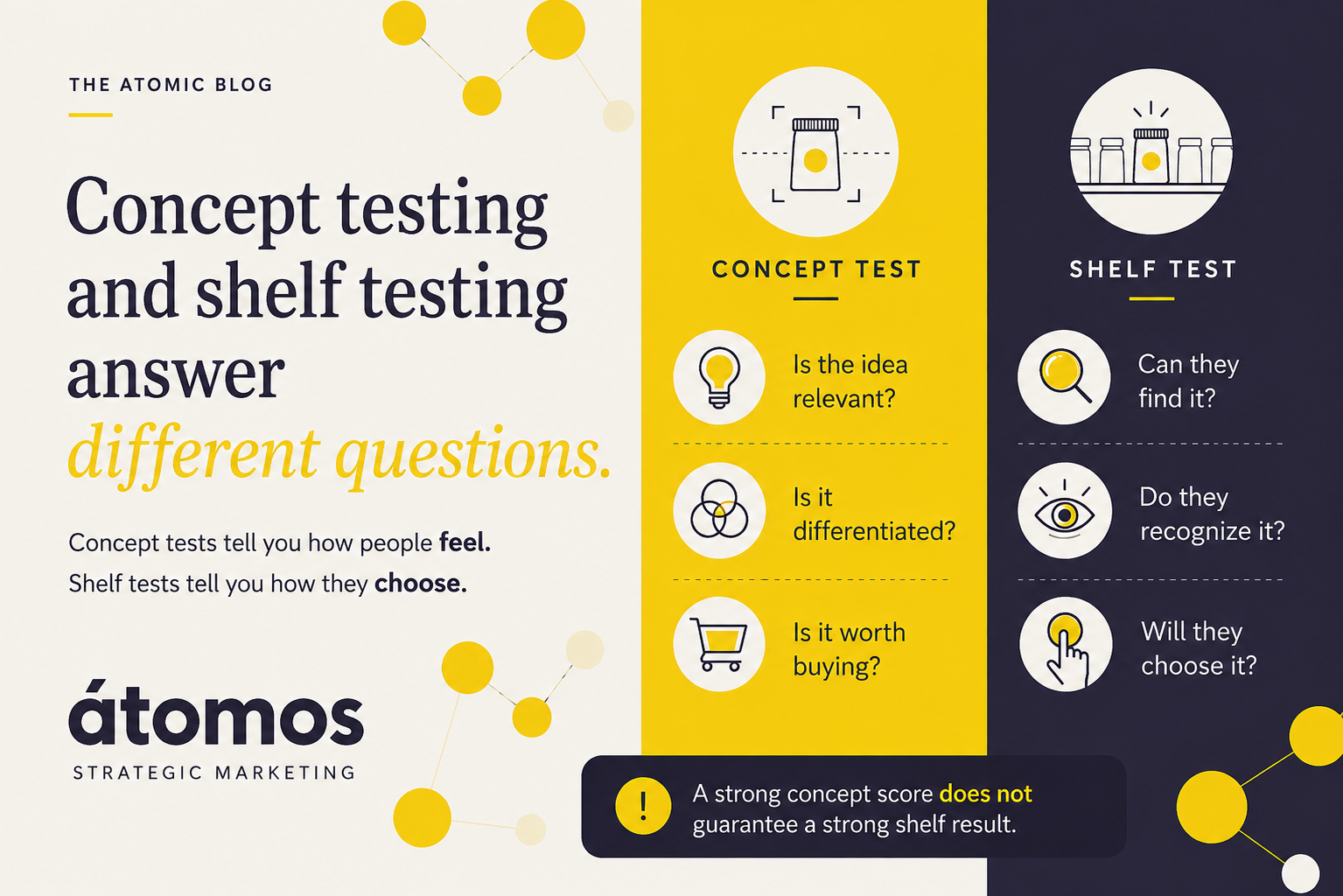
This is where most research programs quietly go wrong, and it's rarely intentional. Teams run one study, get one set of scores, and treat the result as a green light for the whole refresh. But a concept test and a shelf test are built to answer two different questions, and conflating them is how a "validated" redesign ships with an unvalidated hole in it.
Concept testing asks: is the proposition itself worth buying? It's evaluating the idea — relevance, differentiation from what's already on shelf, believability, perceived value at the intended price, fit with a real usage occasion, and whether people would actually consider buying it. This is proposition-level work. It has nothing to do with typography or color palette.
Shelf testing asks a completely different question: can the shopper find, recognize, understand and choose this specific execution, in context? That's findability, standout, brand recognition, whether your distinctive assets survived the redesign, whether the claim is legible at a glance, whether the SKU and variant are easy to tell apart from their siblings, and — critically — whether the design causes confusion or gets misattributed to a competitor.
A beautiful mockup evaluated on a white background, with no competitors in frame, is not a shelf test. It's a concept test wearing a shelf test's clothes. Real shelf testing also doesn't require a physical store. A well-constructed virtual or simulated shelf can do the job, as long as it honestly recreates the competitive set, the visual noise, and the actual shopping task: scan, compare, decide.
Kantar's approach reflects this split directly: screen a wide field of early design directions, then take the three to six strongest finalists into deeper validation, evaluated in a realistic competitive shelf or virtual store environment against recognition, recall, purchase intent and behavioral response — not just stated preference.
Ipsos has published research pointing the same direction: package "liking" on its own is a weak predictor of what people actually buy. Standout, persuasion and likeability together track much more closely with purchase behavior than likeability alone. Ipsos has also shown that a concept can test strong in isolation and produce a completely different result once it's evaluated against the real alternatives a shopper is actually choosing from. A test can be methodologically clean and still answer the wrong business question.
Distinctive assets are equity, not decoration
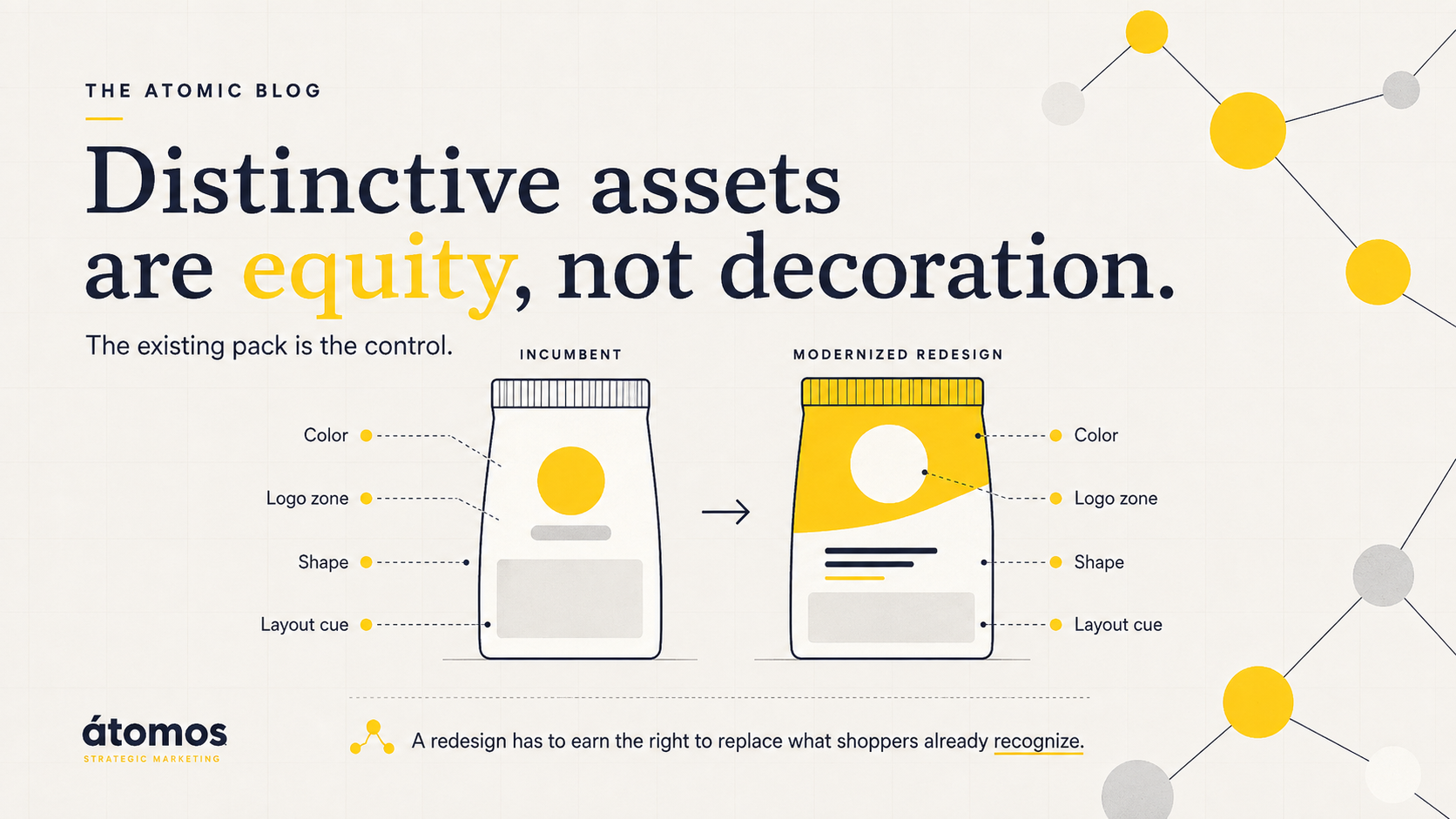
Work from the Ehrenberg-Bass Institute has long argued that a brand's distinctive assets — its color, shape, logo, typography, layout, imagery — function as recognition shortcuts. They help shoppers identify a brand without consciously processing every element of the pack. More recent 2026 research on packaging modernization adds a sharper edge to that finding: making a pack feel more modern can genuinely improve perception, but if that modernization strips out the cues people already recognize, familiarity and purchase intent can suffer.
That reframes the entire redesign conversation. The question isn't "what do we want to change?" It's "what can we not afford to lose?" NIQ's own packaging development process starts there: audit the current pack and its competitive context, identify the brand cues and visual equities worth protecting, screen new directions against that baseline, and only then validate finalists on a realistic shelf using both stated and behavioral measures.
The implication is one every team should write on the wall before a redesign kicks off: the existing package is the control. A new design has to earn the right to replace it — not just look better in a room full of people who already work on the brand.
Research theater: how testing goes wrong without anyone noticing
This is research theater: all the choreography of rigor — decks, sample sizes, scores — without enough connection to the decision the business actually needs to make. It is rarely dishonest. More often, it is well-intentioned research built around the wrong question.
It shows up when:
• "Do you like it?" replaces "Would you choose it — over what you already choose, at the price it will actually carry?"
• a broad general-population sample replaces verified category shoppers, or current loyal buyers are excluded even though their recognition is the equity most at risk
• the pack is tested alone instead of inside the competitive shelf it will actually live on
• side-by-side preference is treated as a proxy for market behavior, even though preference and choice under realistic constraints are different tasks
• positioning, visual identity, claims, price, size and format all change in the same cycle, making post-launch diagnosis almost impossible
• testing happens after tooling, production commitments or retailer resets have already made the decision effectively irreversible
• a study is commissioned to validate a decision leadership has already made rather than to stress-test the hypothesis
Qualitative research is not the problem. It is excellent for diagnosing why something works or fails. The mistake is asking qualitative enthusiasm to do the job of a market go/no-go decision.
None of these are individually catastrophic. Stacked together, they're how a brand walks into a relaunch believing it did its homework.
The Pre-Commit Consumer Validation Protocol
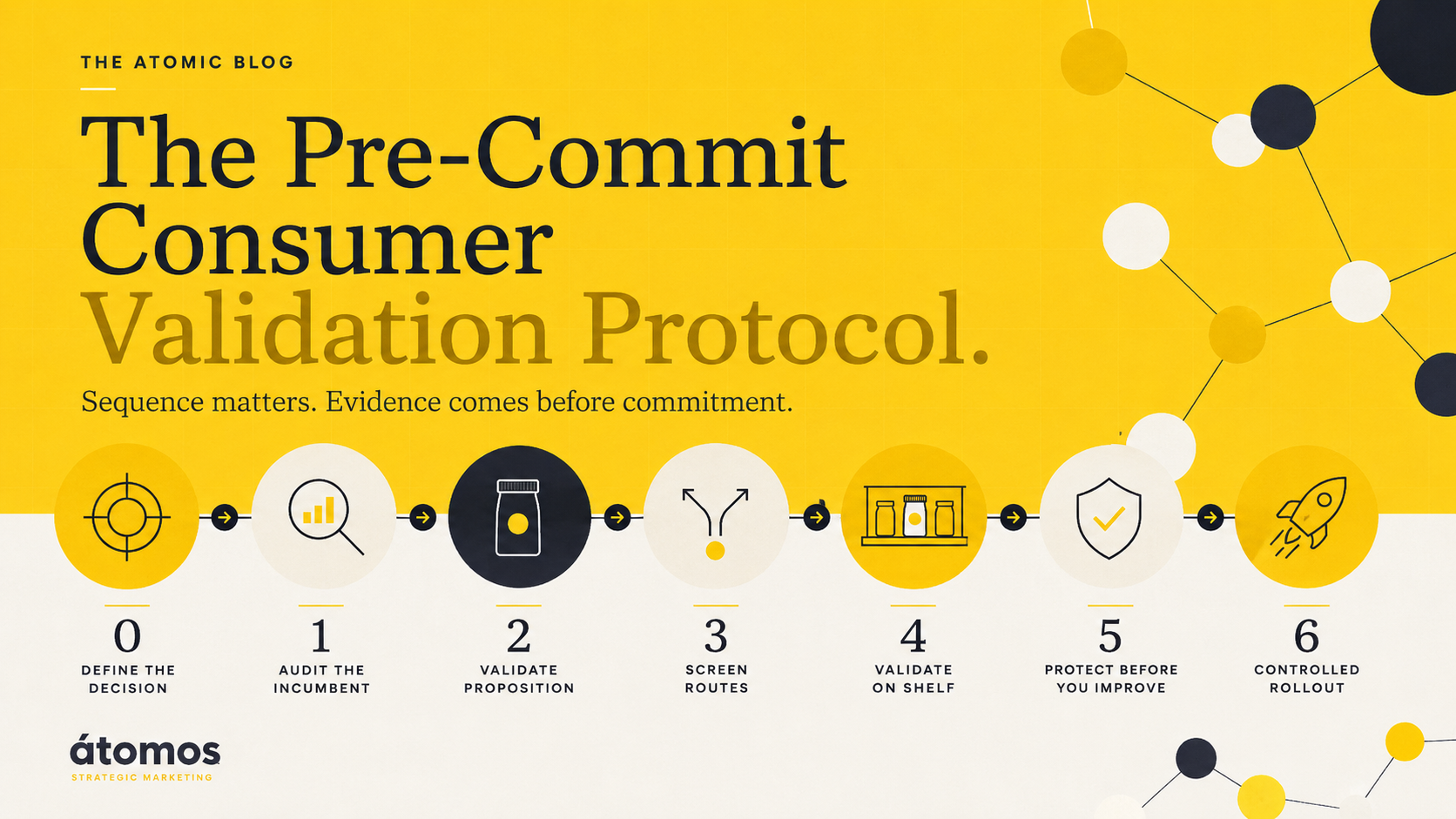
A practical stage-gate structure keeps a redesign honest before it becomes irreversible. It doesn't require a Fortune 500-sized research department. It requires discipline about sequence, evidence and decision rules.
Not every brand needs to run every gate with the same depth or methodology. The right level of rigor depends on the category, the scale of the investment, the maturity of the brand, and the risk attached to the decision. An experienced marketing or research partner can help determine which steps are essential and which can be streamlined. What should not be skipped is direct consumer validation before a major packaging decision becomes expensive or irreversible.
Gate 0 — Define the decision. Before any fieldwork, write down the actual business problem the refresh is supposed to solve, the specific consumer behavior that needs to change, the metrics that must improve, the metrics that must not deteriorate, and — this is the one teams skip — what evidence would cause you to stop. Decision rules get defined before you see a single result, not after.
Gate 1 — Audit the incumbent. Benchmark your current pack inside its actual competitive set. Identify what shoppers already recognize about it and which visual elements are doing that recognition work. Diagnose the real weakness you're trying to fix. You cannot responsibly redesign a problem you haven't actually diagnosed.
Gate 2 — Validate the proposition, separately from the execution. Test whether the underlying idea is relevant, differentiated, believable, valuable, priced appropriately, and tied to a real usage occasion — before a single pixel of final design gets locked. Packaging cannot rescue a proposition consumers don't want.
Gate 3 — Screen creative routes early. Use consumers to eliminate weak territories while the team still has the freedom to change direction. Qualitative work is genuinely useful here for understanding why something is or isn't landing — just don't let qualitative enthusiasm function as your go/no-go decision.
Gate 4 — Validate in a realistic shelf. Take your finalists into a competitive context — physical or a well-built virtual shelf — and test whether shoppers can find it, recognize it, understand it, correctly navigate the SKU or variant, and choose it. Your current package sits in that shelf too, as the control. Real competitors, real pricing, the actual channel environment.
Gate 5 — Protect before you improve. The highest-scoring new concept is not automatically the winner. It has to protect the equities you can't afford to lose while measurably improving the specific problem the refresh set out to solve. A design that scores higher on "modern" but meaningfully erodes recognition among your current buyers is not a win — it's a different kind of risk. Don't reach for a universal numeric cutoff here; the right threshold depends on your business objective, your category's risk profile, your current benchmark, and whatever norms your research partner can bring to the table. Set it before you see the data.
Gate 6 — Controlled rollout, then in-market validation. Where the channel allows it, run the new design through a limited market, retailer, or ecommerce environment before converting everything. Watch velocity, repeat rate, retailer feedback, signs of shopper confusion, findability, and conversion. Research reduces risk going in. Observed market behavior is what actually closes the loop.
How to decide whether a redesign has earned its launch
The honest test isn't whether your team likes the new direction more than the old one. Most internal teams will like the new direction more — they've been staring at the old one for two years and just spent three months building the new one. That preference tells you nothing about shopper behavior.
The question that actually matters: does the evidence show this design protects what the brand already owns while measurably improving the specific problem you set out to solve? If you can't answer that with data collected in a realistic competitive context — not a mood board, not a focus group in isolation — you don't have validation. You have a preference with a research budget attached.
The question isn't whether your team likes the redesign. The question is whether the shopper can still find you.
The real cost of skipping this
A relaunch is not a marketing exercise. It's a capital decision — production runs, retailer resets, marketing spend behind the new look, and the opportunity cost of whatever else that budget could have funded. Treating "we tested it" as sufficient evidence to greenlight that spend is how a well-intentioned team ends up explaining a velocity drop to a board eight months later, with no clean way to diagnose what went wrong because five things changed at once and nothing was isolated.
This is the kind of decision where senior marketing leadership matters. The value is not simply commissioning research. It is framing the question before fieldwork, defining the decision rules, reading the evidence without protecting a preferred answer, and translating the result into a commercial tradeoff. That's the role átomos plays inside growth-stage CPG and Food & Beverage teams: connecting consumer evidence to the decisions that affect positioning, packaging, retail performance and spend.
If your next refresh is approaching that decision point, the useful question is not "does the new pack test well?" It is "what evidence would make us confident enough to commit?"
Want to see what this looks like in practice? Chifles went through a comprehensive branding and packaging refresh with consumer insights built into the decision process. See how átomos helped the $50MM category leader connect strategy, packaging, consumer validation, and growth.
-
Concept testing evaluates whether the underlying idea — relevance, differentiation, value, believability — is worth buying. Package testing evaluates whether the actual execution can be found, recognized and chosen on shelf. A strong concept score does not guarantee a strong shelf result, and the two should be tested separately.
-
Focus groups are useful for understanding why a design resonates or falls flat, but stated enthusiasm in a room is not a reliable predictor of shelf behavior. Preference expressed in isolation, without a competitive set or realistic purchase task, frequently diverges from what people actually choose when shopping.
-
Yes. The current package should be treated as the control in any validation study. A new design should be required to prove it protects the equities the current pack already owns while measurably improving the specific problem the redesign was meant to solve — not simply outscore the old design on a single dimension like "modernity."
-
Testing should happen in stages, starting before any final design work begins — auditing the incumbent and validating the proposition first — and continuing through screening and shelf validation, all before production, tooling or retailer commitments make the decision irreversible. Testing after that point functions as a formality, not a safeguard.