
The Distribution Trap: Why CPG Brands Need Marketing Leadership Before an Agency

A brand wins a major retail placement. Doors open, and the pressure to support them arrives fast. The instinct is understandable: hire an agency, launch media, fund promotions, and build a sampling plan before the reset window closes.
Six months later, distribution is up, spend is up, and velocity has not moved.
This is the distribution trap: treating expanded availability as proof that demand is already there, then buying more execution before the brand has diagnosed what is limiting growth. Distribution creates the opportunity to sell. It does not guarantee that shoppers will notice, choose, or repurchase the product.
Distribution Is Availability. Velocity Is Performance.
Distribution and velocity answer different questions. Distribution tells you where the product is available. Velocity tells you how productively it sells across that distribution. NielsenIQ defines velocity as sales per point of distribution, making it useful for comparing sales productivity across products with different distribution levels.
At its simplest:
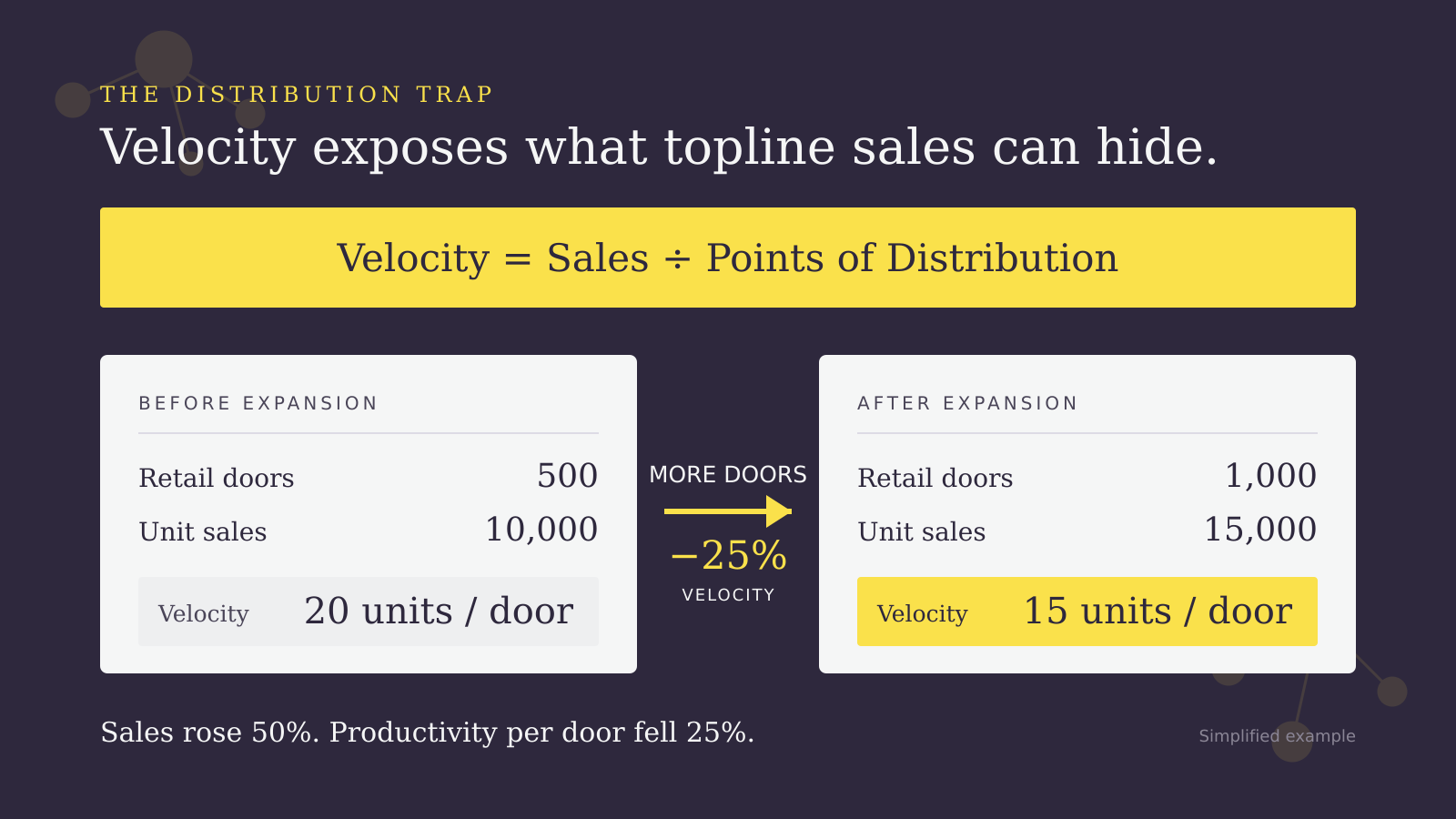
Velocity = Sales ÷ Points of Distribution
That relationship matters because topline sales can rise while productivity falls. In a simplified example, a brand that sells 10,000 units across 500 doors is moving 20 units per door. If it expands to 1,000 doors and sells 15,000 units, total sales are up 50%, but velocity has fallen to 15 units per door — a 25% decline.
More doors created more sales, but not stronger demand per door. That gap is what marketing needs to diagnose before the brand adds another layer of activity.
What Grows When a Brand Wins More Doors
New distribution does not just add shelf count. It adds operational complexity. Each retailer brings different merchandising conditions, promotional calendars, shopper behavior, and performance expectations. Decisions about which SKUs, markets, occasions, and retailers deserve investment become more consequential.
Spend grows too. The brand may add a creative agency, media partner, shopper marketing specialist, demo or sampling partner, and PR support while increasing trade and promotional investment. Each partner can execute its scope well and still pull the brand in a different direction if no one owns the shared diagnosis, priorities, and measurement framework.
That is why more execution can produce more activity without improving velocity.

The Agency Is Not the Problem
Agencies multiply execution capacity. They do their best work when the client has already established the business problem, priority consumer, strategic brief, decision rights, and definition of success.
Without that clarity, the agency receives a list of deliverables instead of a problem to solve. Media optimizes for reach or efficiency. Creative optimizes for the campaign idea. Shopper marketing optimizes for retailer activation. Demo partners optimize for samples delivered. Everyone can hit their individual target while the brand still cannot explain why velocity is flat.
The agency was not the problem. The brand had never decided what the agency was supposed to solve.
Leadership and agency execution are complementary, not interchangeable. Marketing leadership decides where growth is constrained, what matters now, and how success will be measured. Agencies and specialist partners bring the capacity to act on that direction.

What to Diagnose Before Buying More Execution
When distribution grows and velocity does not follow, leadership should work through five questions:
Distribution quality — Are the new retailers, doors, and markets aligned with the priority consumer?
Awareness and trial — Does that consumer know the brand exists, understand its value, and have a reason to try it?
Shelf conversion — Are pricing, merchandising, availability, and the retail environment helping or limiting purchase?
Product experience and repeat — Does trial convert into a second purchase, or does interest fade after one?
Ownership and measurement — Can one person connect marketing activity to velocity, repeat, and retailer performance, then turn the signal into a decision?
The answer determines the hire.
If the diagnosis, positioning, consumer, and priorities are unclear, the brand needs marketing leadership. If the strategy is clear but a capability or additional hands are missing, it likely needs a specialist agency or execution partner. If distribution and spend are expanding while no one owns the system, the sequence is leadership first, then execution against a unified brief.
Leadership Creates Direction. Agencies Create Leverage.
Distribution earns a brand the opportunity to compete. Velocity shows whether that opportunity is converting into demand.
Closing the gap is not about choosing leadership instead of an agency. It is about sequence. Leadership establishes the diagnosis, priorities, and measurement framework. Agencies, demo partners, and other specialists create leverage by executing that direction at scale.
If your brand has more doors, more partners, and more spend but no clear answer for why velocity is not following, pause before funding the next campaign. átomos helps growth-stage CPG brands diagnose the constraint, align the team, and decide what kind of support the business actually needs next.
-
Velocity measures how productively a brand sells across its distribution. A simple version is sales divided by points of distribution, which allows brands to compare performance even as door count changes.
-
When distribution expands faster than demand, topline sales may increase simply because the product is available in more places. If sales per door decline, the new distribution is not yet producing the same level of productivity.
-
Choose leadership first when the growth constraint, priority consumer, positioning, strategic brief, decision rights, or success metrics are still unclear. Choose an agency or specialist when the strategy is clear and the gap is execution capacity or a specific capability.
-
Start with distribution quality, awareness and trial, shelf conversion, product experience and repeat, and ownership of measurement. The diagnosis should determine which workstream and partner receives investment.
-
Yes. A fractional CMO can own the diagnosis, priorities, and measurement framework while agencies, shopper teams, demo partners, and other specialists execute against one unified brief.
ÁTOMOS — FRACTIONAL CMO FOR FOOD & BEVERAGE
We bring big-CPG playbooks to growing food and beverage brands.
We embed inside your business, read your category the way large CPG does, and help you move with clarity and speed — without the full-time cost.
→ Let's talk: atomos.us/contact
