Why Marketing Fails Without Leadership (And What It Costs CPG Brands That Don't Fix It)
Most marketing problems are not marketing problems. They are leadership problems showing up as marketing problems.
Most Marketing Problems Are Not Marketing Problems
The agency is producing content. The paid media account is running. The brand has a presence on multiple channels. The team is in meetings. The calendar is full.
And the business is not growing the way it should.
When this happens, the instinct is to fix the marketing: change agencies, increase spend, redesign the packaging, try a new channel, hire another freelancer. More activity. More output. More motion.
But in most growth-stage CPG and food and beverage brands I have worked with, the problem is not the marketing. The problem is that no one is leading it.
Marketing without leadership produces activity. It does not produce compounding growth. And the longer a brand scales activity without a leadership layer, the more expensive the eventual reset becomes.
"Most marketing problems are not marketing problems. They are leadership problems showing up as marketing problems."
What Happens When Marketing Scales Without a Leader
Growth-stage CPG brands often reach a point where they have the budget to invest in marketing but not yet the infrastructure to lead it. They hire an agency. They bring on a junior marketing manager. They engage a social media freelancer. The founder stays involved in every decision because no one else has the authority or the context to make them.
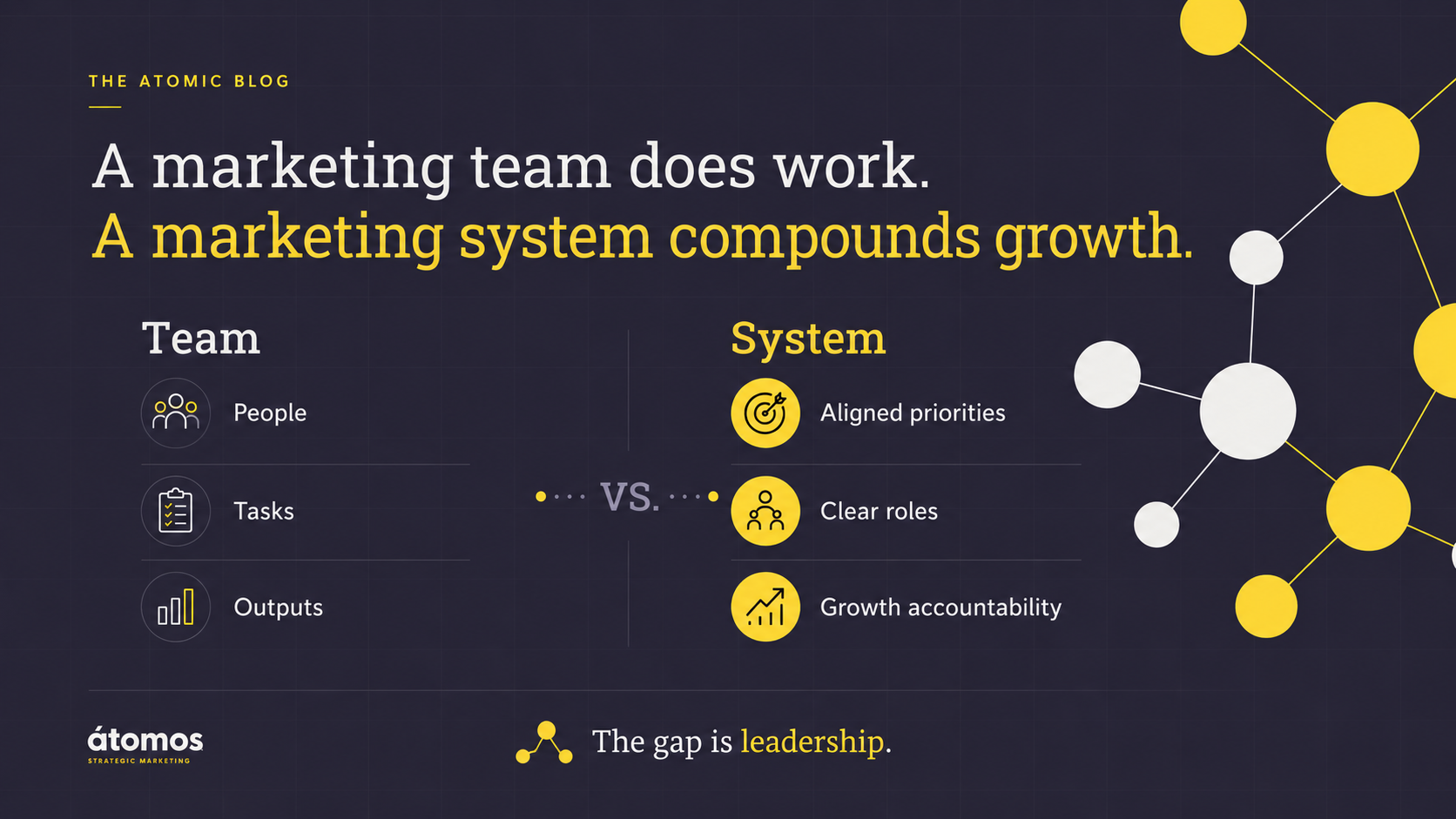
This is when the fragmentation starts.
Agencies work in silos, not toward a shared strategy.
Each agency partner — social, PR, performance, creative — executes within its own lane. Without a senior marketing leader to connect the lanes, the strategy never adds up to more than the sum of its parts. The social agency does not know what the performance agency is testing. The creative work does not reflect the positioning the PR team is pitching. Everything is professional. Nothing is aligned.
The founder becomes the default CMO.
Without senior marketing leadership in place, every meaningful marketing decision flows back to the founder or CEO. Campaign approvals. Agency briefs. Budget calls. Channel priorities. The founder is already the head of sales, product, operations, and culture. Adding de facto CMO to that list is not a sustainable operating model. And founders, however talented, rarely have the CPG marketing depth to make all of those calls well.
Activity is mistaken for progress.
Junior teams are good at execution. They post, report, respond, produce, and deliver. What they cannot do without leadership is decide what the execution is building toward. In the absence of strategic direction, teams default to volume. More posts. More campaigns. More decks. More meetings. The activity looks productive. The business metrics tell a different story.
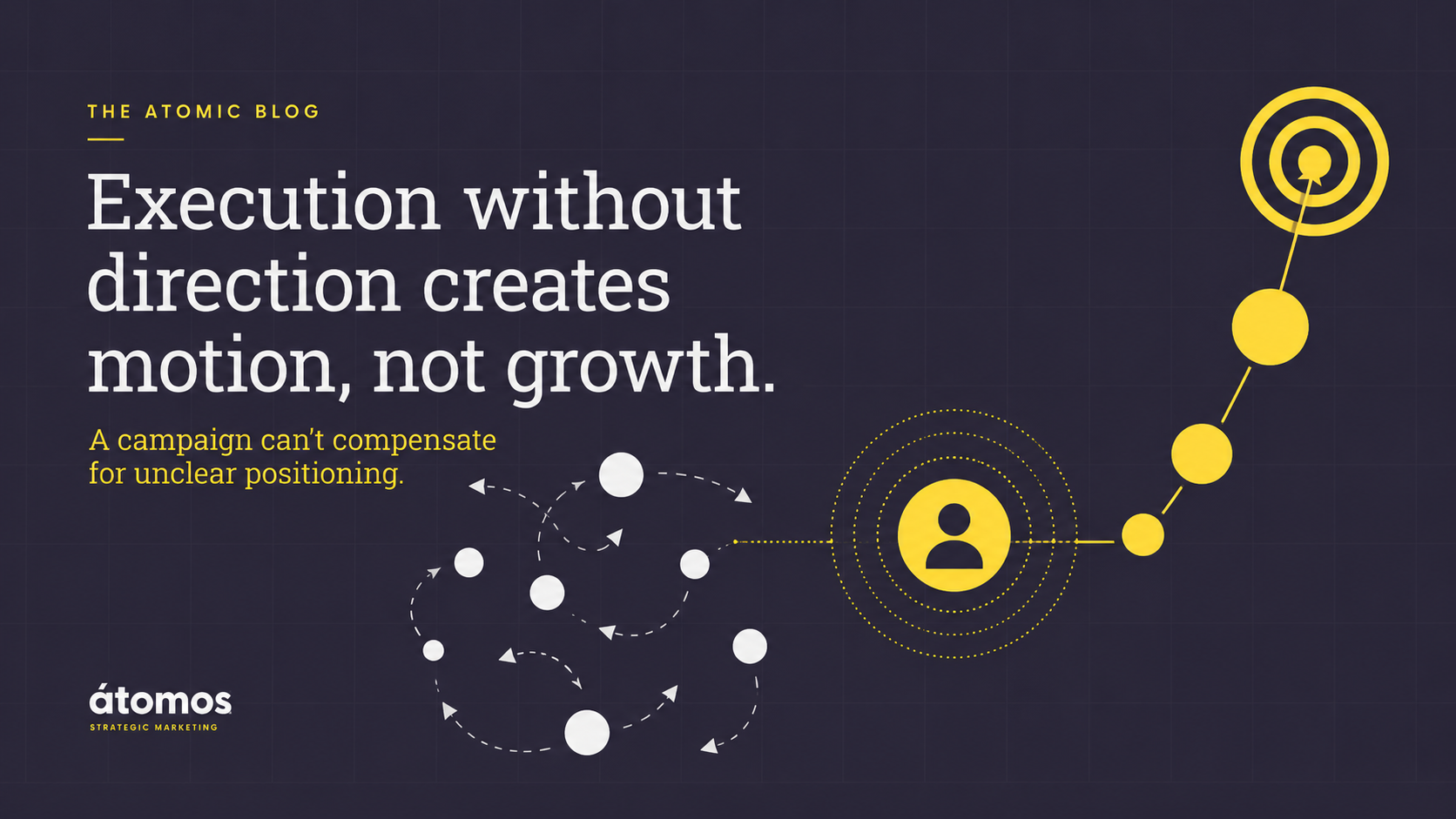
"Execution without direction creates motion, not growth."
Why Execution Alone Is Never Enough
There is a version of this conversation that sounds like a critique of execution. It is not. Execution matters. Great creative matters. Optimized paid media matters. Consistent content matters.
But execution is only as good as the strategy it serves. And strategy is only as good as the leadership that builds and protects it.
A campaign cannot compensate for unclear positioning. A TikTok strategy cannot fix a broken retail velocity story. An influencer program cannot substitute for a consumer insight that has not been validated. Performance marketing cannot generate efficient returns when the brand's value proposition is not sharp enough to convert.
Every execution lever in marketing has a ceiling. That ceiling is determined by the quality of the strategic foundation underneath it. And the foundation is a leadership responsibility — not an agency responsibility, not a junior team responsibility, and not something a founder can maintain indefinitely alongside everything else a growing CPG business demands.
"A campaign cannot compensate for unclear positioning. More activity does not fix a leadership gap."
What Marketing Leadership Actually Does Inside a CPG Brand
Marketing leadership is not a title. It is a function. And in a growth-stage CPG or food and beverage brand, that function has a specific set of responsibilities that no agency, no junior hire, and no founder wearing multiple hats can reliably cover.
A senior marketing leader inside a CPG business does the following:
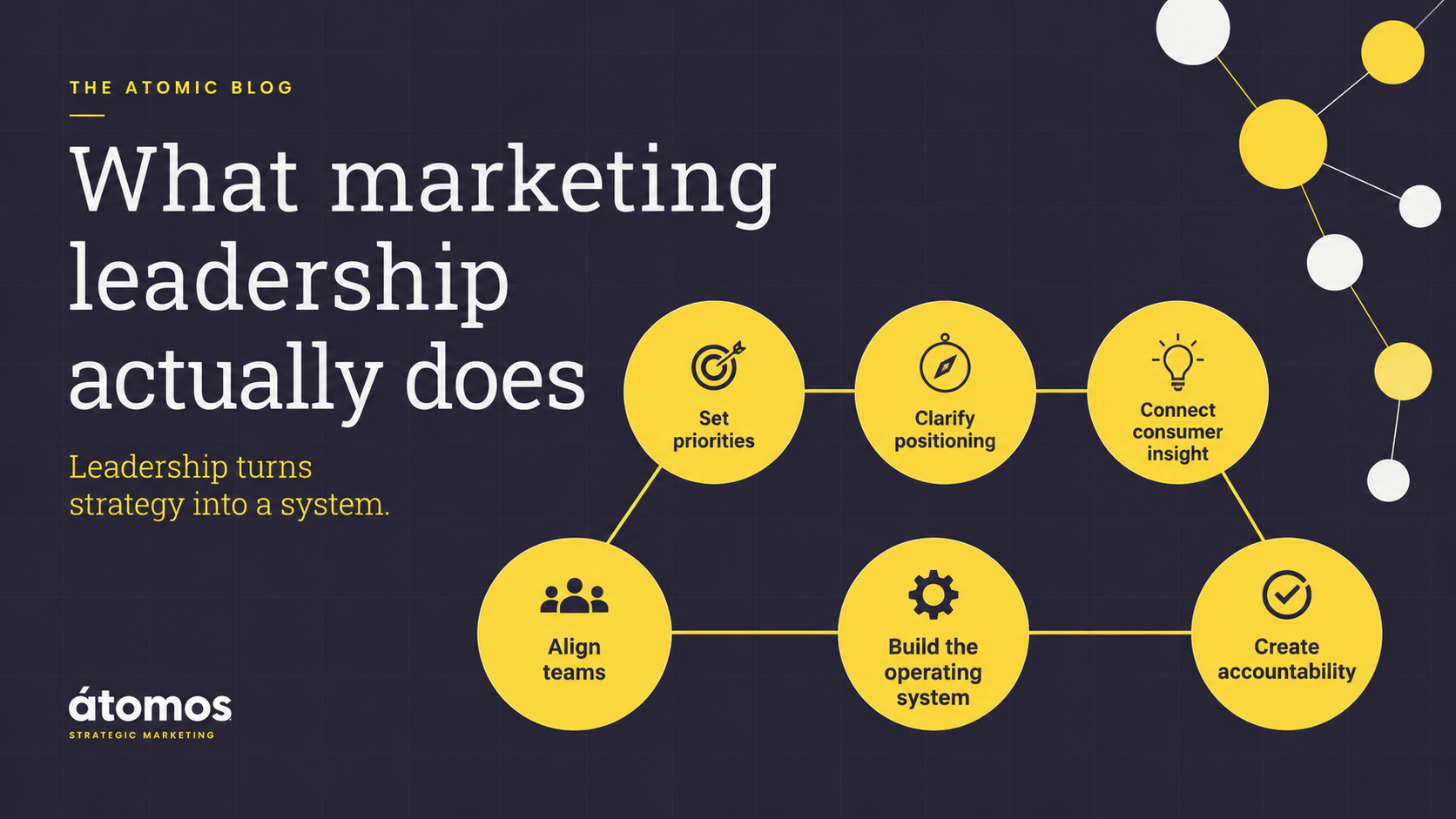
Sets priorities — not just for this quarter's campaign, but for the 12-month marketing architecture.
Clarifies positioning — ensuring the brand says one thing consistently across every channel, touchpoint, and retailer interaction.
Connects consumer insight to action — translating what the brand knows about its buyer into briefs, channel decisions, and product priorities.
Aligns agencies and internal teams — so that every partner is executing toward the same strategic north star.
Decides what not to do — which is often more valuable than deciding what to do next.
Builds the marketing operating system — the infrastructure of planning, briefing, measurement, and learning that makes execution compound over time.
Creates accountability around growth — connecting marketing decisions to business outcomes, not just to marketing outputs.
Connects marketing investment to the P&L — so that spend decisions are made in the context of margin, velocity, and retail performance.
This is not a list of tasks. It is a system. And it requires someone with enough seniority and CPG operating experience to run it
"Marketing leadership is not a title. It is the function that turns strategy into a system and execution into compounding growth."
The Difference Between a Marketing Team and a Marketing System
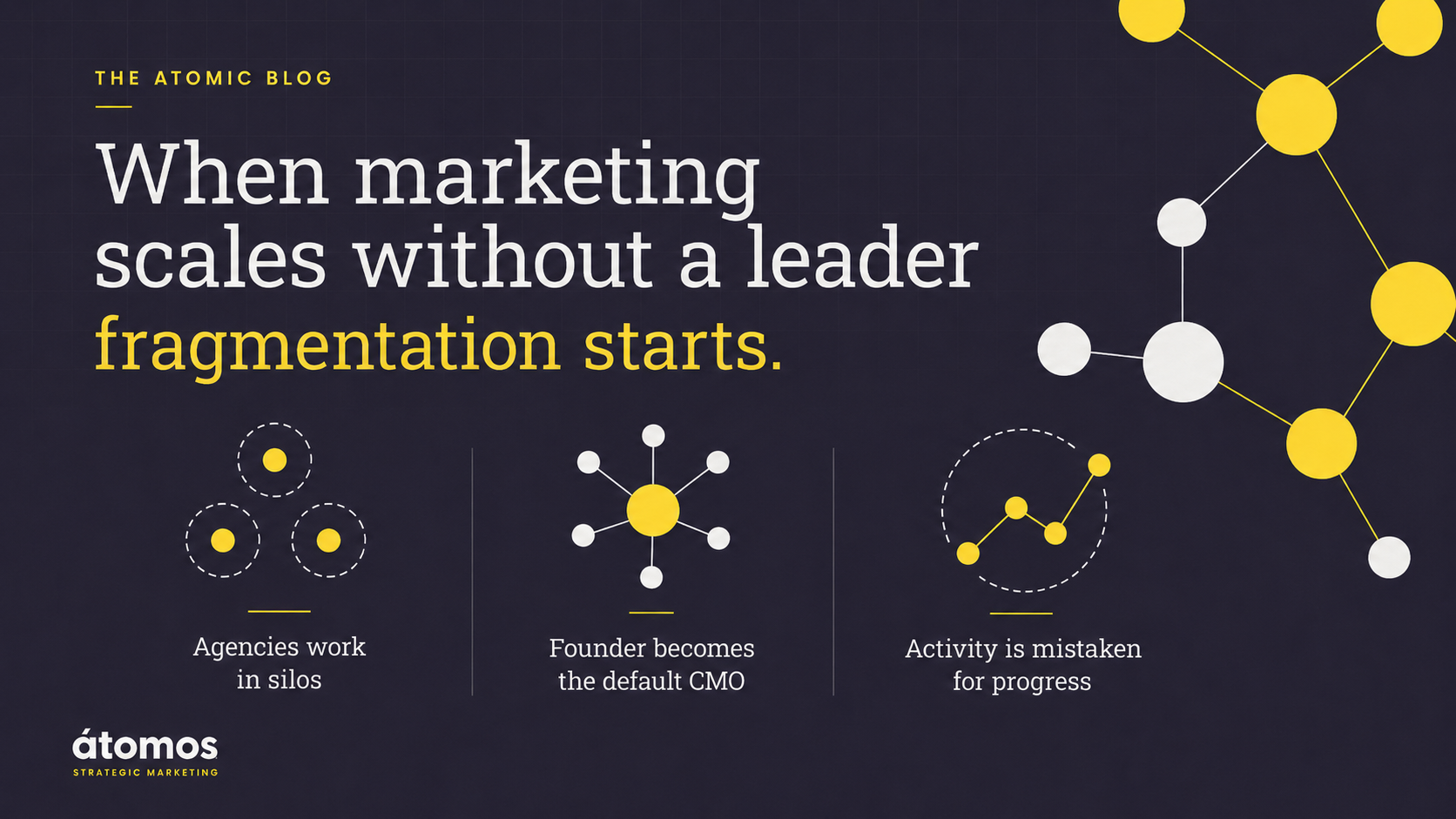
A marketing team is a group of people doing work. A marketing system is the architecture that connects what those people do to what the business needs.
Most growth-stage CPG brands have the former but not the latter. They have people: an agency, a manager, a freelancer, a founder. They do not have a system: aligned priorities, clear roles, defined KPIs, a decision framework, and a leader accountable for connecting all of it to growth.
The difference shows up in a few specific ways.
A team produces content. A system builds brand equity through content.
A team runs campaigns. A system evaluates campaigns against positioning, consumer insight, and retail goals.
A team reports on impressions and ROAS. A system connects marketing activity to velocity, repeat purchase, and household penetration.
A team responds to founder direction. A system operates with enough strategic clarity that most decisions can be made without the founder in the room.
The gap between a team and a system is a leadership gap. It is not filled by adding another agency or promoting a junior hire. It is filled by installing senior marketing leadership with the authority and accountability to build and run the system.
Six Questions That Tell You Whether You Have a Leadership Gap
These are the diagnostic questions I use when I first sit down with a founding team or a PE operating partner trying to understand why marketing is not converting to growth:
1. Are we producing more marketing output but learning less about what is working?
2. Do our agencies receive tasks and briefs — or do they receive strategic direction?
3. Is the founder or CEO still making every meaningful marketing decision?
4. Does the marketing team know what specific growth problem they are solving this quarter?
5. Are our campaigns tied to positioning, retail velocity goals, and consumer insight — or to content calendars and available budget?
6. Is there one person in the business who is accountable for marketing decisions and their connection to business outcomes?
If the answer to most of these questions is uncomfortable, the issue is not execution quality. The issue is that the marketing leadership function does not exist in the business.
"More activity does not fix a leadership gap. Diagnosing the gap is the first step to closing it."
Why Fractional Marketing Leadership Solves the Gap
Most growth-stage CPG and food and beverage brands reach the leadership gap before they are ready to hire a full-time CMO. The business is past the stage where the founder can carry the marketing function alone. But it is not yet at the revenue scale where a full-time senior marketing executive is the right hire.
This is the exact problem that fractional CMO leadership is designed to solve.
A fractional CMO is not a consultant who delivers a strategy deck and moves on. Done right, it is embedded senior marketing leadership that operates inside the business: setting priorities, aligning agencies, building the marketing operating system, and staying accountable to growth outcomes.
For a growth-stage CPG brand, the value of fractional marketing leadership is not just cost efficiency — though that matters. The value is access to the kind of operating experience that most brands at this stage cannot afford to hire full-time: someone who has managed $500M brand portfolios, run retail velocity programs, built consumer insight frameworks, and aligned cross-functional teams around a single strategic direction.
That experience changes the quality of every downstream decision. The agency brief gets sharper. The retailer pitch gets cleaner. The budget allocation gets smarter. The measurement gets connected to the right outcomes. And the founder gets their time back.
Marketing Needs Leadership Before It Needs More Activity
The pattern I see most often in growth-stage CPG and food and beverage brands is not a lack of effort or investment. It is a lack of leadership architecture. The team is working hard. The agencies are producing. The budget is going somewhere. But without a senior marketing leader to connect all of it to a clear strategy and a set of growth outcomes, the activity never compounds.
More campaigns will not fix this. More content will not fix this. A new agency will not fix this.
What fixes it is installing the leadership layer that every other part of the marketing system depends on.
Marketing leadership is what connects brand positioning to consumer insight. It is what turns channel strategy into a coordinated system instead of a set of disconnected tactics. It is what keeps the team aligned, the agencies accountable, and the founder focused on the business instead of the next campaign approval.
When the leadership is in place, everything else gets faster, sharper, and more productive. When it is missing, everything else gets more expensive.
"Marketing does not need more activity first. It needs leadership, structure, and accountability.
-
The most common reason is not poor execution — it is the absence of senior marketing leadership. Growth-stage CPG brands often scale activity (campaigns, agencies, channels, content) before installing the leadership layer that connects all of it to a coherent strategy and measurable growth outcomes. The result is fragmented execution, inconsistent positioning, and spend that does not compound.
-
Marketing leadership is the function that sets strategic priorities, aligns agencies and internal teams, clarifies brand positioning, connects consumer insight to action, and holds every marketing decision accountable to business outcomes. It is not a content calendar or a campaign plan. It is the operating architecture that makes everything else work.
-
The clearest signals: the founder is still making every meaningful marketing decision; agencies are executing tasks without strategic alignment; the team is producing output but the business metrics are not improving; different channels tell different stories about the brand; and no one in the business is accountable for connecting marketing investment to growth outcomes.
-
A marketing team is a group of people doing work. A marketing system is the architecture that connects their work to strategic priorities, consumer insight, channel roles, and business outcomes. Most growth-stage brands have a team. What they are missing is the leadership that builds and runs the system.
-
A fractional CMO provides embedded senior marketing leadership without the full-time cost. For CPG and food and beverage brands, this means setting strategic priorities, aligning agencies, clarifying positioning, building the marketing operating system, and staying accountable to growth outcomes. The result is access to big-CPG operating experience at a cost structure that works for growth-stage businesses.
-
When the brand has enough marketing budget and activity to require strategic leadership, but is not yet at the revenue scale to justify a full-time CMO. This typically happens between Series A and Series B, or when retail expansion and brand investment begin to outpace the founder's capacity to lead the marketing function alone.
-
No. An agency executes within its scope. It cannot set business-level priorities, align other agencies, build a marketing operating system, or hold the full P&L accountability that senior marketing leadership requires. Agencies need a leader to brief them well and connect their work to the brand's growth strategy. Without that leader, agencies work in silos and execution never adds up to more than the sum of its parts.
ÁTOMOS — FRACTIONAL CMO FOR FOOD & BEVERAGE
We bring big-CPG playbooks to growing food and beverage brands.
We embed inside your business, read your category the way large CPG does, and help you move with clarity and speed — without the full-time cost.
→ Let's talk: atomos.us/contact