What a Real Marketing Foundation Looks Like
Most CPG and food & beverage brands don't have a marketing problem. They have a foundation problem. And building a foundation is not the same as building campaigns.
Most Brands Don't Need More Marketing First. They Need a Foundation That Can Make Decisions.
I talk to a lot of founders and brand leaders at growing CPG and food and beverage companies. And the conversation almost always starts the same way.
They are not happy with their marketing results. They have spent money on agencies. They have run campaigns. They have tried influencers, paid media, trade events, maybe a rebrand. And the needle hasn't moved the way they expected.
So they come in asking for better execution. A sharper campaign. A stronger agency. A cleaner content strategy.
But when we go deeper, the issue almost never turns out to be execution. The issue is that there is no foundation underneath the execution. Every tactic is floating. Every decision gets made on instinct or momentum. And the brand is accumulating spend without accumulating strategic clarity.
The real problem is not that the marketing is bad. The problem is that the brand has never built the system that allows good marketing to happen.
"Most brands don't need more marketing first. They need a foundation that can make decisions."
What Most Brands Call a Foundation (And Why It Isn't One)
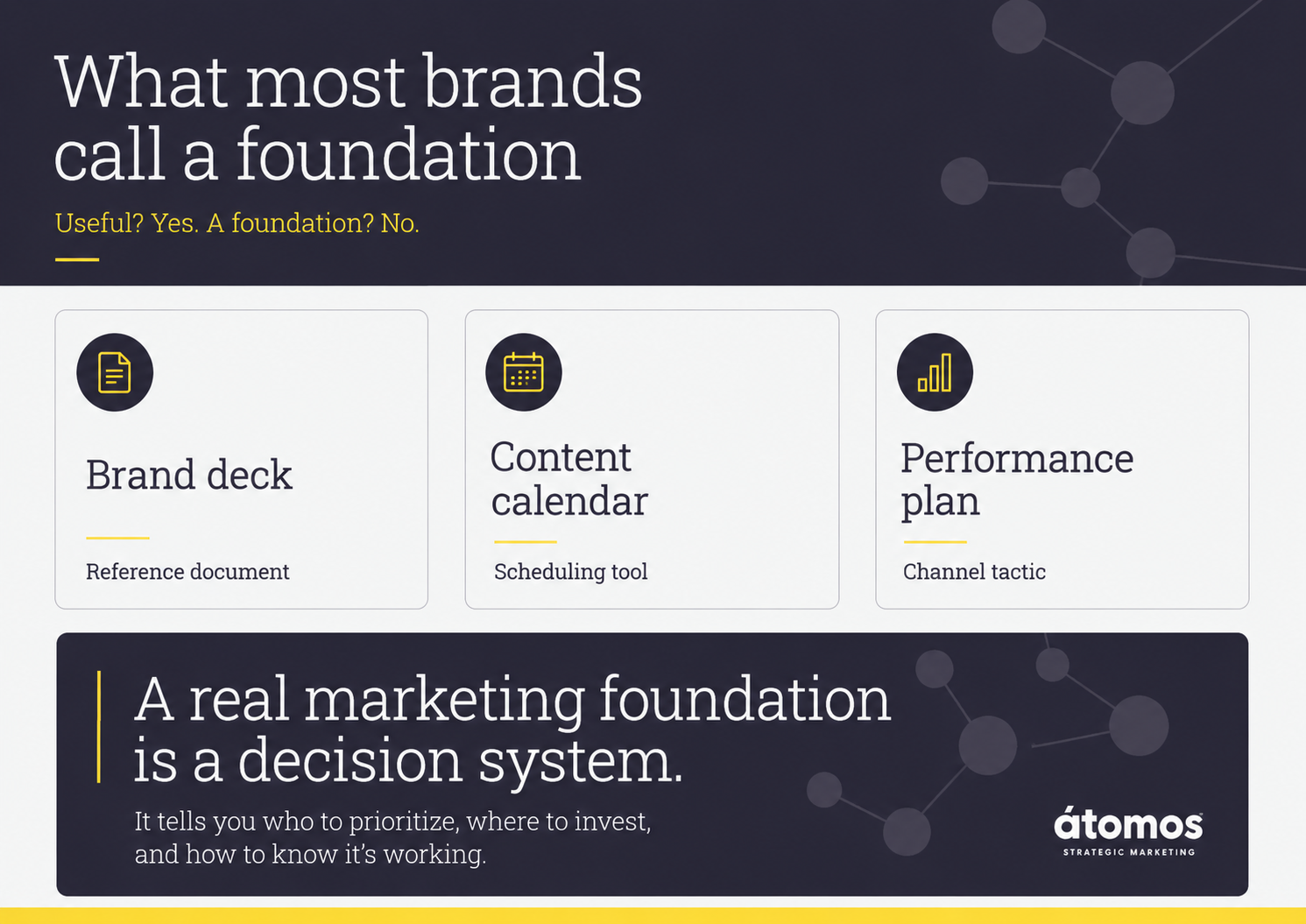
When I ask brand leaders whether they have a marketing foundation, most say yes. And then they describe one of the following:
A brand deck is not a foundation.
A 40-slide brand book with logo guidelines, color palettes, typography rules, and a brand purpose statement is a reference document. It is useful. It is not a decision system. It does not tell you which consumer to prioritize when resources are constrained. It does not tell you which channel to invest in next. It does not tell you why your velocity is stalling at a specific retailer.
A content calendar is not a foundation.
A calendar tells you when you will post. It does not tell you what you are building toward, which consumer you are trying to reach, or what you want them to do after they see it. Most content calendars are organized around cadence, not strategy. They produce activity, not compounding brand equity.
A performance plan is not a foundation.
A media plan or performance marketing playbook is a channel tactic. It tells you where to spend and how to optimize. It does not answer the upstream questions that determine whether that spend will work: who the right consumer is, what message will convert them, and whether the product-to-shelf-to-repeat cycle is healthy enough to make acquisition worthwhile.
None of these are bad things to have. The problem is treating them as the foundation when they are actually outputs of a foundation that has not been built yet.
"A brand deck is a reference document. A content calendar is a scheduling tool. A performance plan is a channel tactic. None of them is a marketing foundation."
What a Real Marketing Foundation Actually Is
A real marketing foundation is a decision system. It is the architecture that allows every person inside the business — and every partner outside it — to make better decisions, faster, with less waste and less friction.
It is not a single document. It is not a one-time exercise. It is a set of aligned answers to the questions that come up constantly in a growing brand: Who are we for? Why should they choose us? What does each channel do? How does awareness become a purchase? How do we know it's working?
When those questions have clear, validated answers, the brand can move. Agencies get better briefs. Retailers get clearer sell stories. The team makes faster decisions with less escalation. New channels get evaluated against consistent criteria instead of gut feel.
When those questions don't have clear answers — or when different people in the organization would give different answers — everything slows down. Every decision becomes a debate. Spend goes in without a clear thesis. Results come back ambiguous. And the marketing never quite stacks.
"A real marketing foundation is a decision system. It is the architecture that makes every downstream decision faster, sharper, and less expensive."
The Five Components of a Real CPG Marketing Foundation
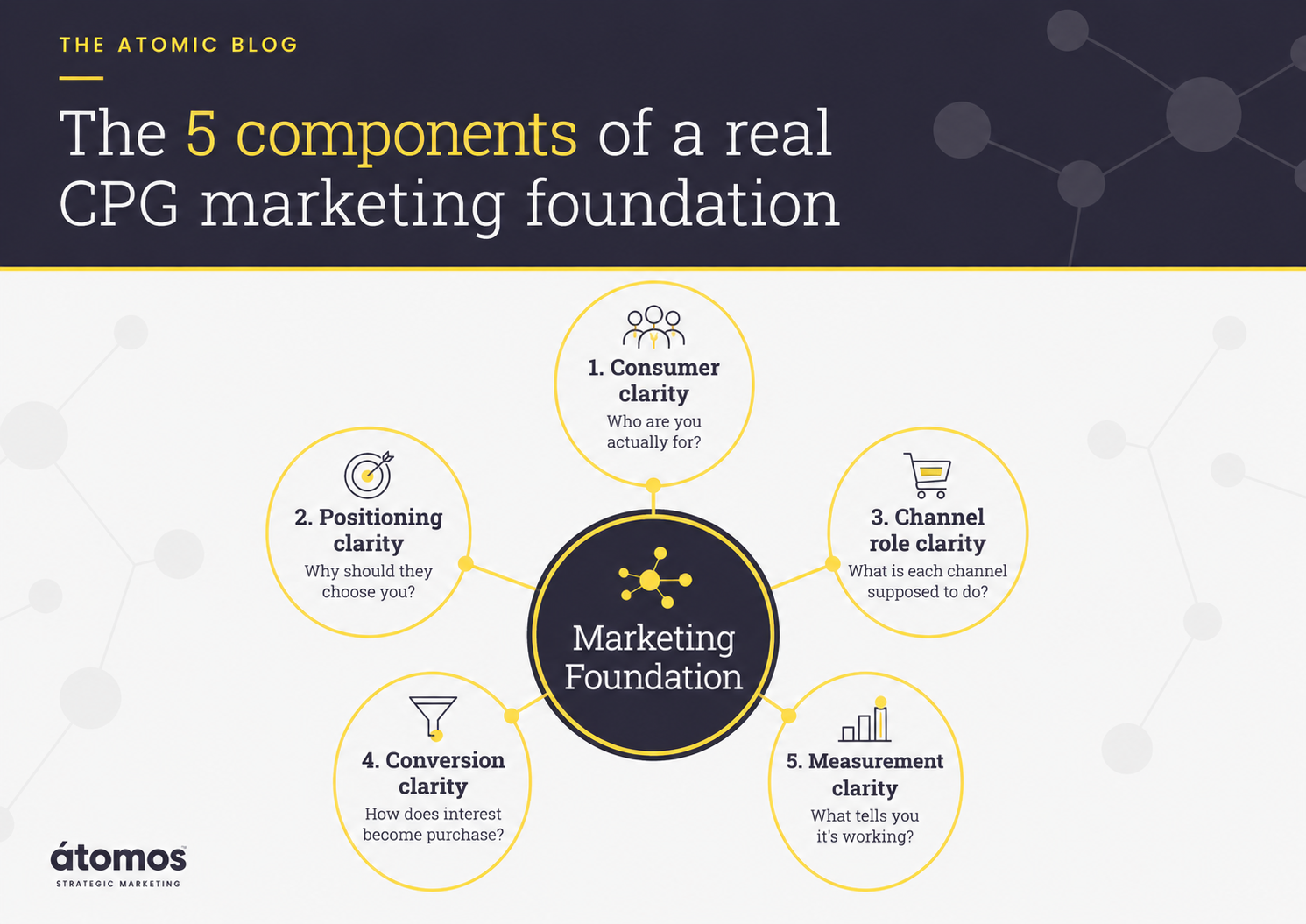
For CPG and food and beverage brands, a real foundation is built from five components. Each one is a layer of clarity. Each one answers a different category of decision. And each one collapses the cost of getting things wrong at the next stage.
1. Consumer Clarity — Who Are You Actually For?
The question it must answer:
Not 'health-conscious millennials.' A specific person. A real purchase occasion. A clear problem this product solves in their actual life. You should be able to describe your core consumer the way you'd describe someone you know: what they read, where they shop, what they were buying before this product existed, and why this works better for them than the alternative.
When it doesn't exist:
You try to be relevant to everyone and end up resonating with no one. Messaging is broad, the retail pitch is vague, and velocity stalls because the shelf doesn't know how to talk about the product to the right buyer.
How it helps you scale:
Every downstream decision gets a filter. The agency brief gets more specific. The retailer pitch gets sharper. The product roadmap gets cleaner. Consumer clarity is the first thing that separates scaling brands from spending brands.
2. Positioning Clarity — Why Should They Choose You?
The question it must answer:
Not a list of features. One reason — the most important reason — that the right consumer would choose your product over the eight things next to it on the shelf. Fever-Tree won by reframing tonic as a craft ingredient. Poppi won by making gut health feel like a soda. Both had one clear idea. What's yours?
When it doesn't exist:
Packaging and ads tell different stories. The sell sheet is a laundry list of benefits. Different people on the team would give different answers if asked what the brand stands for. And when consumers can't articulate why they chose the product, they default to the cheaper option next time.
How it helps you scale:
Positioning clarity makes everything downstream cheaper. The right message reaches the right person without wasted impressions. Retail expansion builds on a consistent story. The brand accumulates equity instead of just running campaigns.
3. Channel Role Clarity — What Is Each Channel Supposed to Do?
The question it must answer:
Not 'we're on Instagram, TikTok, Amazon, and working with a broker in three regions.' What specific job is each channel doing in the consumer journey? Is this channel building awareness or driving trial? Converting or retaining? Feeding velocity or building cultural relevance? Every channel should have a defined role — and a way to measure whether it is doing that job.
When it doesn't exist:
Spend goes evenly across channels that serve wildly different purposes, without clarity on what is working or why. The brand is everywhere and nowhere at the same time. ROAS looks reasonable but repeat purchase is flat. Or awareness is building but velocity isn't following.
How it helps you scale:
When every channel has a job, budget allocation becomes a strategic decision instead of a negotiation. You can add channels deliberately, not reactively. And when something isn't performing, you know what question to ask.
4. Conversion Clarity — How Does Interest Become a Purchase?
The question it must answer:
At each stage of the consumer journey — awareness, consideration, trial, repeat — what specifically has to happen for the consumer to move forward? What does packaging need to do in eight seconds? What does the sell sheet need to communicate in thirty? What drives someone who tried the product once to come back?
When it doesn't exist:
Investment goes into top-of-funnel awareness with no clear line of sight to how that awareness becomes trial or repeat purchase. The funnel leaks at every stage and it's unclear where. D2C brands overinvest in acquisition before validating retention. Retail brands win distribution before understanding what will drive velocity.
How it helps you scale:
Conversion clarity lets you invest in the right stage at the right time. It prevents the most common and most expensive mistake in CPG marketing: scaling spend before the consumer journey is tight enough to make that spend productive.
5. Measurement Clarity — What Tells You It's Working?
The question it must answer:
Not impressions. Not follower count. The metrics that tell you whether the strategy is producing the business outcomes that matter: velocity, repeat purchase rate, household penetration, ACV growth, and the efficiency of investment in each of those. And a clear answer to: what number, if it moved, would tell me the foundation is working?
When it doesn't exist:
Campaigns run and outputs get reported — ROAS, CPM, reach — without connecting those outputs to the business outcomes that actually matter. Retailers ask about velocity and get awareness numbers. The team optimizes for the wrong things because no one has defined what right looks like.
How it helps you scale:
Measurement clarity creates accountability across the organization. It makes investor conversations easier. Agency briefs get better because the agency knows what the brand is actually optimizing for. And it prevents the slow drift that happens when brands confuse marketing activity with marketing progress.
How This Applies to CPG and Food & Beverage Brands Specifically
In CPG and food and beverage, the stakes of not having a foundation are higher than in almost any other industry. The margin for error is narrow. The path from product launch to sustainable retail presence requires getting a lot of things right in the right order. And the signals that tell you whether your strategy is working — velocity data, repeat purchase rates, retailer reorder behavior — take time to accumulate.
A brand without a foundation can get distribution. It can even look like it's growing for a while. But when the retailer reviews the data and velocity is flat, when promotional spend isn't driving repeat, when the agency is producing creative that isn't converting — the absence of a foundation is what made all of that expensive and hard to fix.
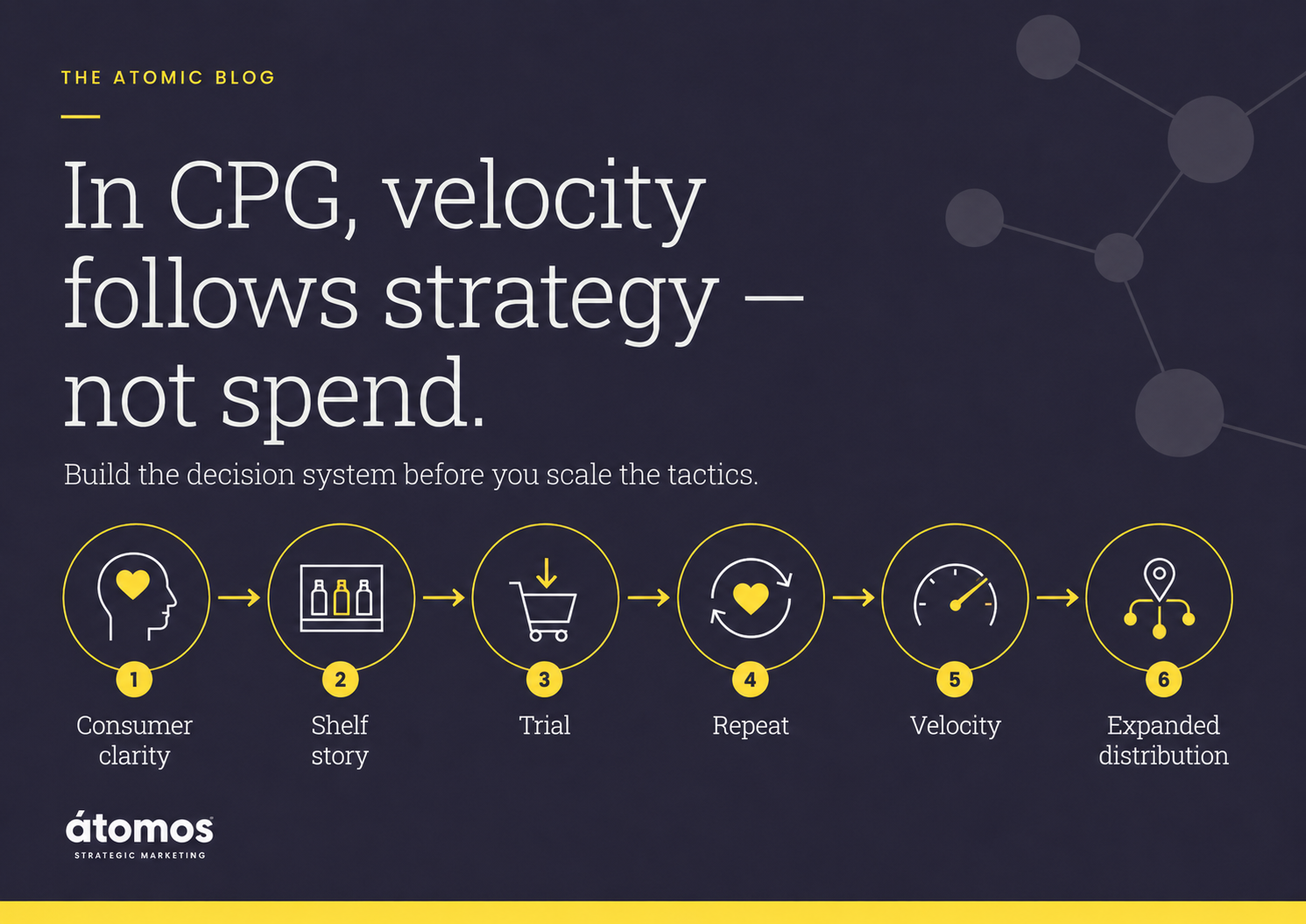
The brands that grow well in CPG — the ones that hold shelf, build repeat, and earn expanded distribution — are the ones that built the foundation before they scaled the tactics. They knew who their consumer was before they ran paid media. They had a clear positioning before they briefed an agency. They understood what velocity they needed to sustain before they took on a new retailer.
That sequence is not accidental. It is the result of building the decision system before building the campaigns.
"In CPG, a brand without a foundation can get distribution — and still fail. Velocity is the truth test. And velocity follows strategy, not spend."
Seven Signs Your Brand Doesn't Have a Foundation Yet
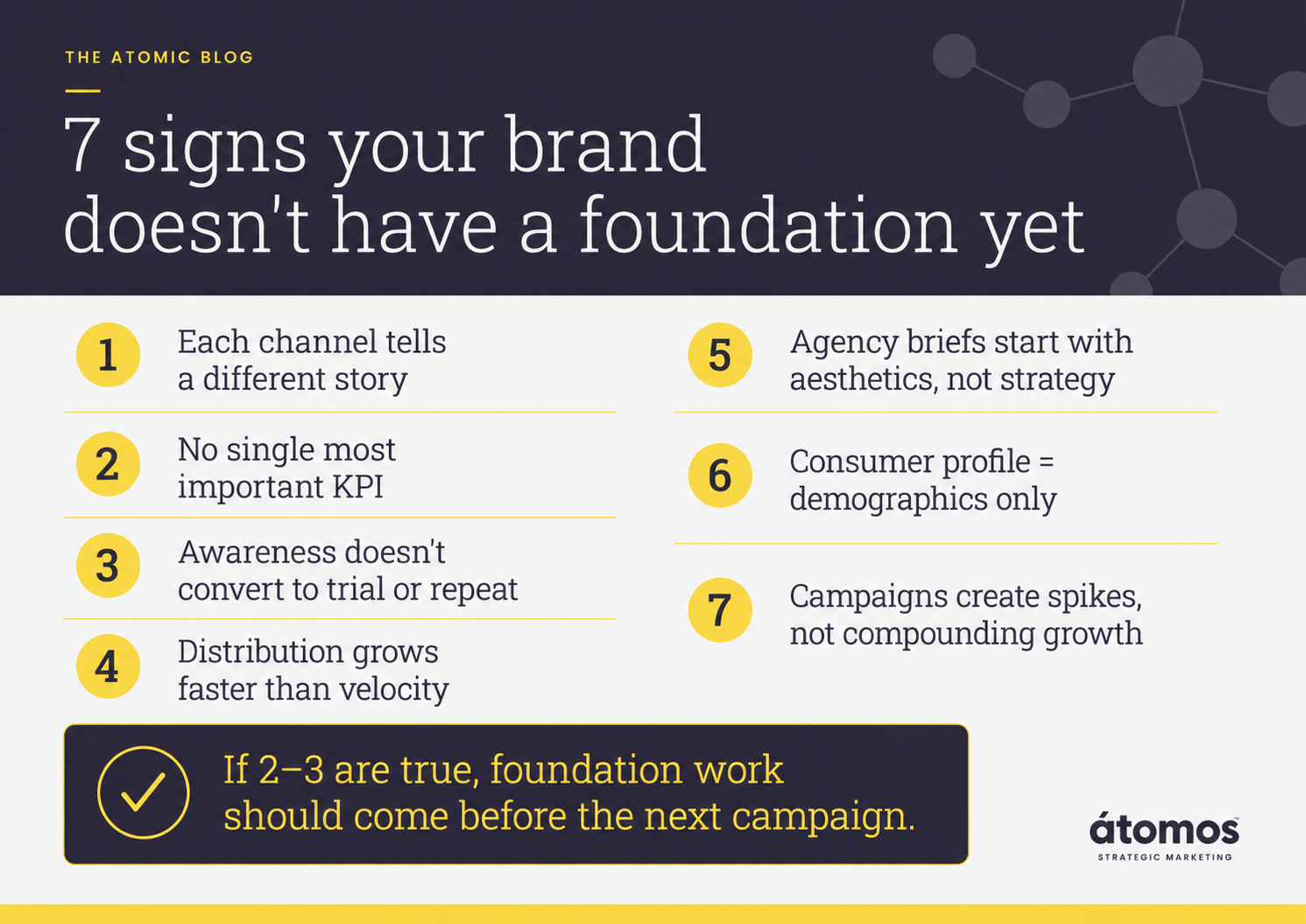
These are the signals I see most often. They look like execution problems. They are not. They are foundation problems wearing execution clothes.
1. Each channel tells a slightly different story about what the brand is and who it's for.
2. The team doesn't agree on the single most important KPI — or the KPI changes by quarter.
3. Investment is going into awareness but there's no clear model for how awareness becomes trial or repeat.
4. Retail expansion is outpacing marketing leadership — new doors are opening but velocity isn't following.
5. The brief to the agency starts with 'make it feel premium' instead of 'our buyer is X, facing problem Y, and here's why this wins.'
6. The consumer profile is defined by demographics, not by behavior, occasion, or purchase context.
7. The brand depends on campaigns to generate demand instead of a compounding strategy that builds over time.
Any one of these signals is worth pausing on. More than two or three together is a clear indicator that foundation work should come before the next campaign or channel investment.
When the Foundation Is Clear, Everything Gets Faster
This is the part that is counterintuitive for most founders. Building a foundation feels like it slows things down. It feels like time spent in strategy rooms instead of in market. It feels like delaying the real work.
The opposite is true.
When the consumer is clear, you stop debating who to target. When the positioning is clear, you stop producing three versions of creative that pull in different directions. When each channel has a defined role, you stop spreading budget across six channels doing overlapping and undefined jobs. When the measurement is clear, you stop reporting metrics that don't connect to business outcomes.
Every hour of foundation work eliminates multiple hours of downstream confusion, rework, and wasted spend. And in CPG, where every distribution point, every promotional dollar, and every retailer relationship is a real cost — that efficiency compounds.
The brands that are scaling well right now are not the ones with the biggest budgets. They are the ones with the clearest systems. They brief better. They spend smarter. They adapt faster. And they build equity that accumulates instead of campaigns that expire.
"When the foundation is clear, marketing gets faster. When it isn't, marketing gets expensive."
-
A marketing foundation is the decision system that sits underneath all marketing execution. It is not a brand book or a content calendar. It is a set of aligned answers to five questions: who the right consumer is, why the brand wins for that consumer, what role each channel plays, how interest converts to purchase, and what metrics actually indicate the strategy is working.
-
Most growth-stage food and beverage brands go straight to execution — agencies, campaigns, distribution — before the strategic architecture is in place. Early wins make it feel like the foundation is solid. But those wins are often not replicable because they weren't built on a system. When growth stalls, the instinct is to add more tactics, when the real answer is to build the foundation that makes tactics work.
-
Positioning clarity is one of the five components of a real marketing foundation. It is the answer to the question 'why should the right consumer choose us over everything else available to them?' Without it, messaging drifts across channels, agency briefs produce mediocre creative, and retail sell stories fail to differentiate. Positioning is not a tagline — it is the strategic logic that makes every downstream marketing decision sharper and faster.
-
Velocity — units per store per week — is the metric retailers use to determine whether a product earns its shelf space. A brand with a weak marketing foundation typically struggles with velocity because the positioning isn't converting at the shelf, the channel strategy isn't driving trial, or the repeat purchase mechanism isn't working. Building the foundation first gives you the decision system needed to diagnose and fix velocity problems before they become distribution problems.
-
A Fractional CMO embedded at an early-stage or growth-stage CPG brand typically begins with the foundation before anything else: getting consumer clarity, sharpening positioning, defining channel roles, establishing the measurement system, and aligning the team around a single strategic direction. This architectural work is what makes every downstream execution — agency work, media investment, retail strategy — produce better results at lower cost.
-
The signals are usually clear: each channel tells a different story, the team doesn't agree on the most important KPI, awareness investment isn't converting to trial or repeat, retail expansion is outpacing marketing leadership, or the brand depends on campaigns to generate demand instead of a compounding strategy. Any two or three of these together is a strong indicator that foundation work should come before the next campaign or channel investment.
-
A marketing strategy is a plan for a specific period or objective. A marketing foundation is the decision system that makes strategy possible. A brand can have an annual marketing strategy without having a foundation — and many do. But without the foundation, the strategy is built on assumption rather than validated consumer understanding, and every strategy cycle starts from scratch instead of building on compounding clarity.
ÁTOMOS — FRACTIONAL CMO FOR FOOD & BEVERAGE
We bring big-CPG playbooks to growing food and beverage brands.
We embed inside your business, read your category the way large CPG does, and help you move with clarity and speed — without the full-time cost.
→ Let's talk: atomos.us/contact