What the World Cup 2026 Reveals About How the Best CPG Brands Actually Use Seasonal Moments
Limited-edition packaging is not a design project. It is a commercial strategy. And right now, the world's largest CPG brands are running that strategy in real time — across 16 cities, 48 nations, and a tournament that some are calling 14 Super Bowls in one.
Seasonal Packaging Is Not a Decorative Decision. It Is a Commercial Strategy.
Every four years, the FIFA World Cup creates one of the most concentrated commercial opportunities in global consumer goods. And every time it arrives, the distance between brands that have a packaging strategy and brands that have packaging artwork becomes very clear.
The brands that win during major seasonal events — the Super Bowl, the World Cup, the Olympics — are not the ones that slap a logo on a can and call it a campaign. They are the ones that treat seasonal activation as a business decision: a calculated move to increase trial, drive velocity, earn premium shelf placement, unlock retailer co-investment, and build the kind of cultural relevance that compounds beyond the event window.
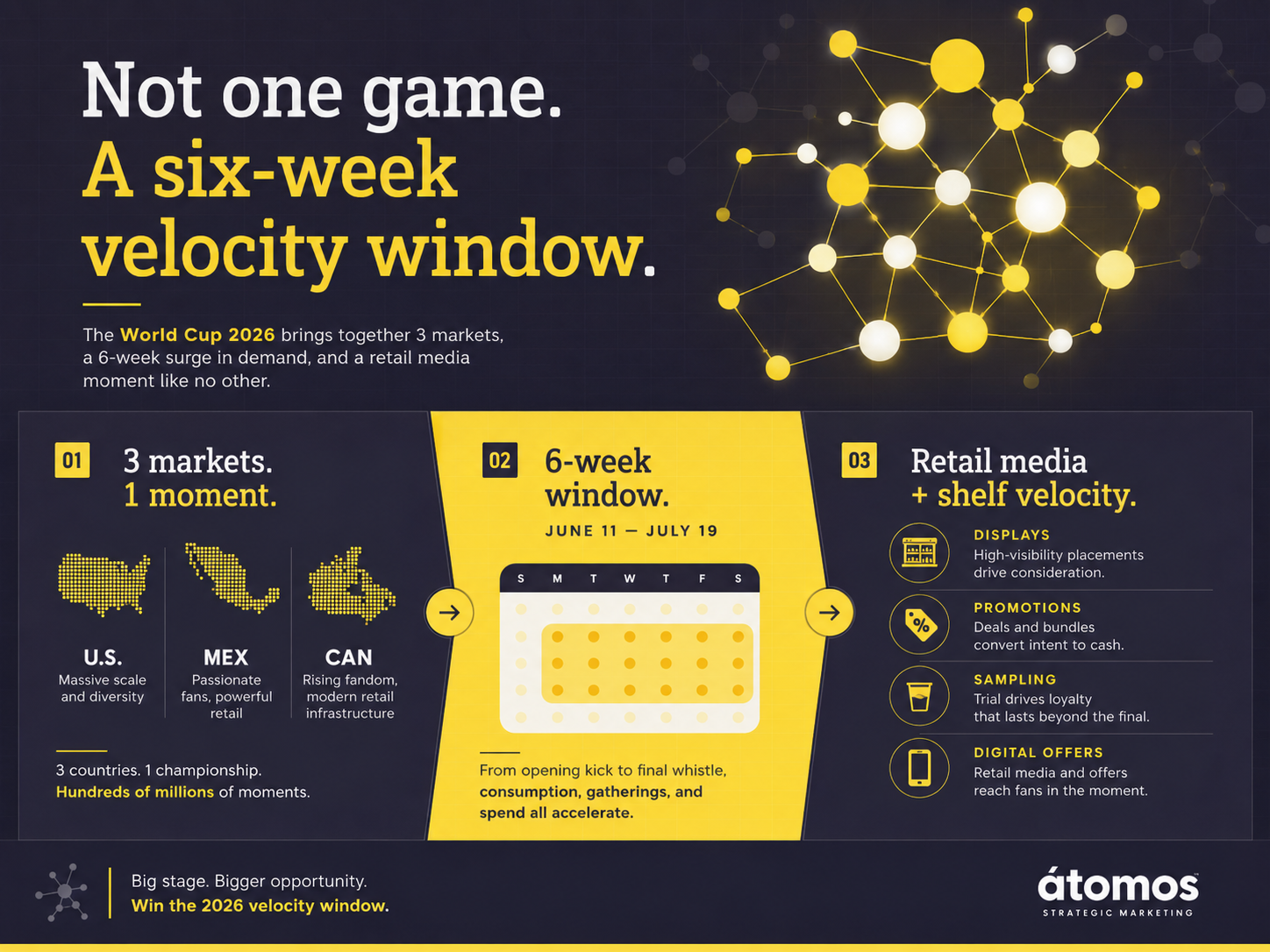
The 2026 FIFA World Cup is an especially useful case study because of its scale. This is the first World Cup hosted across three countries — the United States, Mexico, and Canada — with 48 teams, 16 host cities, and a six-week tournament window running June 11 through July 19. Forecasters estimate total consumer spending tied to the tournament at $7.5 billion in North America alone. Numerator data shows that the average World Cup consumer plans to spend roughly $74 on event-related items — higher than the Super Bowl ($68) and the Winter Olympics ($63).
That context matters because it explains why the largest CPG brands in the world have invested not just in advertising, but in their actual packaging. The shelf is a media channel. And right now, the shelf is the World Cup.
"Seasonal packaging is not a design project. It is a commercial strategy. The shelf is a media channel — and right now, the shelf is the World Cup."
Why the World Cup 2026 Is the Largest Seasonal Event CPG Brands Have Faced in a Decade
To understand why the packaging investment at this year's World Cup is so significant, it helps to understand the specific commercial conditions that make this event different from a typical sports marketing moment.
First, the geography. A World Cup hosted in the United States, Mexico, and Canada reaches three of the most important CPG markets in the Western Hemisphere simultaneously. The Latino consumer — already the fastest-growing purchasing demographic in U.S. CPG — is directly in the center of this event's cultural gravity. Brands that have been building equity in this community for years are positioned to activate; brands that have been ignoring it are visibly absent.
Second, the duration. Unlike the Super Bowl, which is a single Sunday, the World Cup runs for six weeks. That is six weeks of sustained consumer attention, retailer promotional windows, retail media activations, and cultural conversation. Brands that built seasonal packaging and retail programming for this window have six weeks of incremental velocity potential. Brands that did not have six weeks of watching the shelf belong to someone else.
Third, the retail media dimension. Major grocery retailers — Kroger, Ahold Delhaize, Meijer, Wawa, Hy-Vee — are running co-branded World Cup programs that include featured placements, display windows, sampling activations, in-store screens, and digital promotions. The brands that show up in those programs are the ones that planned their packaging and promotional assets months in advance. Last-minute participants get the leftover shelf.
"Six weeks of sustained consumer attention. The World Cup is not one game. It's a six-week velocity window — and the brands that planned for it are already winning the shelf."
The Playbooks Big CPG Is Running Right Now — And What Each One Is Actually Doing
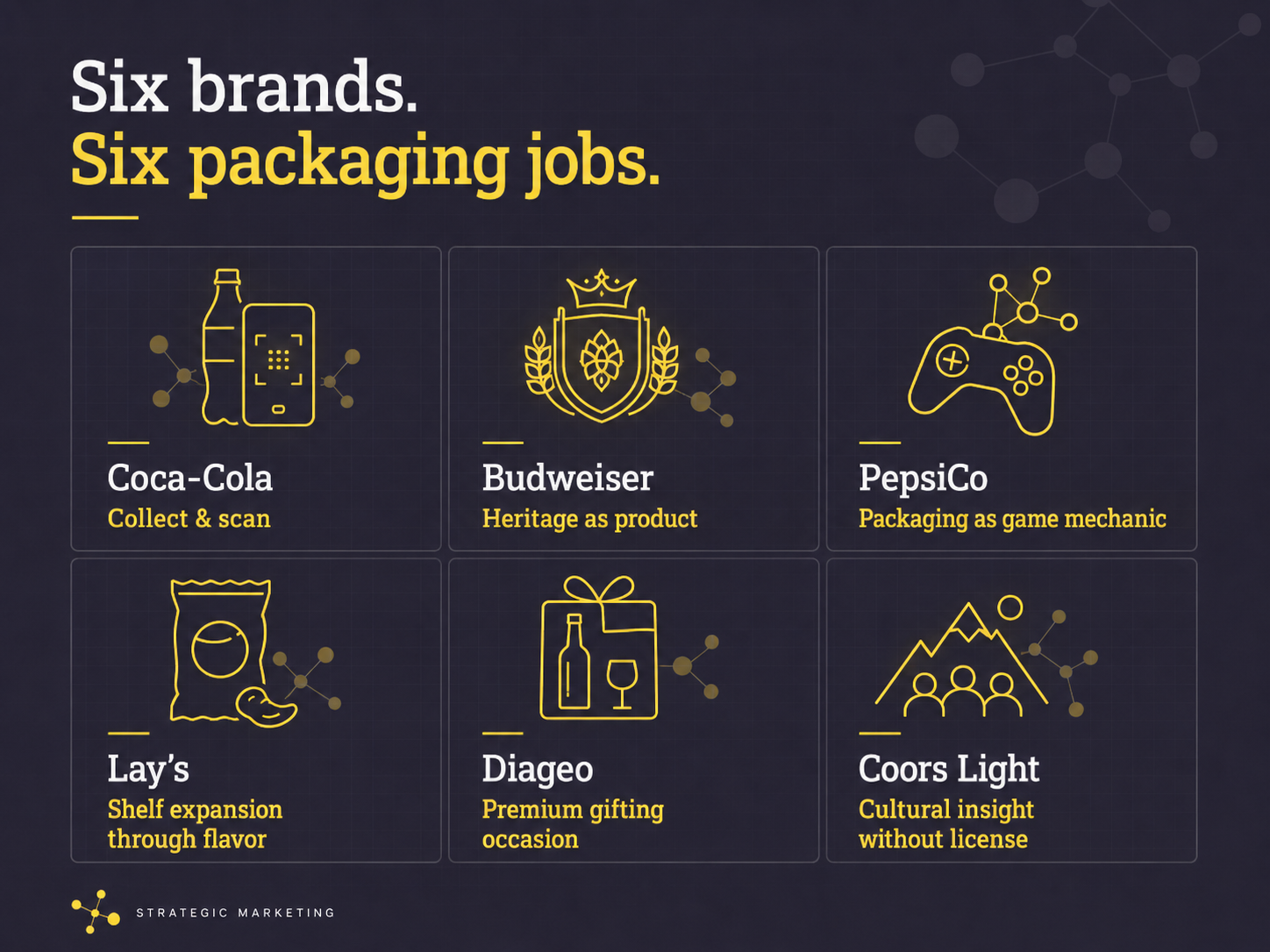
The most instructive thing to study in this World Cup is not the advertising. It is the packaging decisions — because packaging decisions reveal the strategic logic more honestly than campaign messaging does. Here is what the major players are actually doing and why it matters.
Coca-Cola Official Soft Drink of FIFA World Cup 2026
What they did:
Coca-Cola has deployed multiple simultaneous packaging strategies: country-specific can designs running across Spain, Brazil, England, and the U.S.; peel-back labels on 20oz bottles that reveal collectible Panini player stickers from 12 of the competing nations; a commemorative 8 fl. oz glass FIFA World Cup collectible bottle retailing at $9.95; and localized digital experiences that allow fans to scan packaging to win match tickets and complete virtual Panini sticker albums.
Why it works strategically:
Coca-Cola is not just selling a beverage. It is creating a behavior — the ritual of collecting — and attaching that behavior to purchase. Every bottle becomes a reason to pick Coke over the private label cola next to it. The sticker mechanic drives repeat purchase. The country-specific designs drive social sharing. The Trophy Tour drives foot traffic to retail. Each packaging element is doing specific work in the consumer journey.
Lesson for emerging brands:
Packaging can be a trial driver, a repeat purchase driver, and a social amplification tool at the same time — if it is built around a consumer behavior, not just an event logo.
Budweiser Official Beer Sponsor of FIFA World Cup — 40-Year Anniversary
What they did:
Budweiser created the 'FIFA World Cup Anniversary Pack' — 11 commemorative aluminum bottles and cans, each representing a different tournament from Mexico 1986 through 2026, developed in partnership with branding agency Jones Knowles Ritchie. The cans include QR codes that unlock digital content tied to each tournament era. The 'Budstalgia' global platform connects the packaging to a brand film, out-of-home placements, and a digital fan hub. The collection rolls out across Brazil, China, and select European markets.
Why it works strategically:
Budweiser is using its 40-year relationship with the World Cup as a product — not just a sponsorship asset. The anniversary pack turns brand heritage into something a consumer can hold, collect, display, and share. The collectible mechanic shifts the purchase from commodity to experience. And because each can is tied to a specific tournament year, it creates natural scarcity and emotional connection for fans who have memories attached to those moments.
Lesson for emerging brands:
Institutional memory is a brand asset. If your brand has a history with a consumer occasion — even a smaller one — that history can become the product. Nostalgia packaging is not just retro design. It is a conversion mechanism.
PepsiCo Temperature-Sensitive Limited Edition Cans + Quaker Oats FIFA Partnership
What they did:
PepsiCo launched 86 million football-themed cans for the World Cup window — of which only 150,000 are 'Perfect Chilled' rare variants, printed with special ink that turns vibrant blue at the optimal drinking temperature of 8 degrees Celsius. Fans who find a rare can can win cash, home entertainment bundles, football tickets, and Pepsi merchandise. Separately, PepsiCo's Quaker Oats brand secured the designation of official breakfast of FIFA World Cup 2026 and is sponsoring the Player Escort Program.
Why it works strategically:
PepsiCo is running two distinct strategies simultaneously. The temperature-sensitive can turns packaging into a game mechanic — the packaging itself is the prize trigger. With only 150,000 rare variants out of 86 million cans, PepsiCo creates a sweepstakes structure that drives trial across the entire run in pursuit of the rare find. The Quaker Oats move shows that seasonal activation does not require being the official sponsor of the main event — a portfolio sub-brand can find its own occasion angle within the same cultural moment.
Lesson for emerging brands:
You do not need a flagship license to participate. Different brands in a portfolio can find different entry points into the same cultural moment. And making the packaging itself interactive — through temperature, QR, or AR — turns a passive product into an active consumer experience.
Lay's / PepsiCo Official Snack of FIFA World Cup 2026
What they did:
Lay's introduced 40 limited-edition potato chip flavors inspired by cuisines from competing nations across North America, South America, Europe, Africa, and Asia. In the U.S., the focus is on three anchor flavors: Argentinian-Style Steak with Chimichurri, Brazilian-Style Garlic Sauce, and Wavy French Onion Soup. Packaging features country-specific design elements. Distribution spans major retailers, snacks.com, and TikTok Shop. The 'No Lay's, No Game' campaign is supported by a celebrity WhatsApp group channel featuring Messi, Beckham, and Thierry Henry.
Why it works strategically:
Lay's is using the World Cup to solve a specific retail problem: giving a snack brand a reason to own multiple shelf facings instead of one. Forty limited-edition flavors across different countries means 40 potential SKUs that each earn their own placement, trial occasion, and social sharing moment. The international flavor strategy turns packaging into a cultural exploration that makes consumers curious about more than one product. Each flavor is a separate trial event.
Lesson for emerging brands:
Limited-edition flavor innovation is a shelf expansion strategy. It gives buyers a reason to approve incremental space and gives consumers a reason to try more than their default SKU. The cultural angle — tying each flavor to a competing nation — creates a narrative that works across social, in-store, and retail media simultaneously.
Diageo (Don Julio · Casamigos · Buchanan's · Johnnie Walker · Smirnoff) Official Spirits Supporter in the Americas of FIFA World Cup 2026
What they did:
Diageo is activating five brands simultaneously across all 16 host cities through ground activations, advertising, limited-edition bottles, and retail programs. Don Julio released a special Tequila Don Julio 1942 FIFA World Cup 2026 Edition bottle design as the centerpiece of its 'Made to Be Raised' campaign. Casamigos is running a Team Classic Margarita vs. Team Spicy Margarita brand rivalry mechanic. Buchanan's is activating its deep equity with Latino consumers across U.S. host markets.
Why it works strategically:
Diageo's multi-brand strategy shows how a portfolio can approach a single cultural event from multiple consumer entry points — premium gifting (Don Julio 1942), cultural identity (Buchanan's), playful occasion (Casamigos), and mainstream accessibility (Smirnoff). The Don Julio 1942 FIFA bottle is a premium collectible at a price point that makes it a gift purchase, not a convenience purchase — an entirely different retail occasion from a standard spirits sale.
Lesson for emerging brands:
One cultural moment can unlock multiple commercial occasions across a portfolio. The question is not 'which brand do we activate?' but 'which consumer occasion does each brand own within this event?' Premium limited editions are not just brand plays. They are gift occasion plays that unlock a different retail channel.
Coors Light Non-Sponsor Packaging Play — 'The Cooors Call'
What they did:
Without an official FIFA license, Coors Light redesigned its cans with limited-edition, soccer-themed packaging featuring an elongated brand name — 'Cooors' — that mirrors the drawn-out cheer of fans celebrating a goal. The design is self-referential and fan-behavior-driven, requiring no licensed marks, no official designation, and no multi-million-dollar sponsorship investment.
Why it works strategically:
Coors Light's approach is the most instructive for brands that cannot afford official licensing. By anchoring the design to a fan behavior — the elongated goal celebration chant — rather than to a FIFA trademark, Coors Light participates in the cultural moment without requiring legal authorization. The design is inherently shareable because it is playful and self-aware. And it earns shelf placement in World Cup displays because retailers want variety in their themed sections.
Lesson for emerging brands:
You do not need a license to participate in a cultural moment. You need cultural intelligence — a genuine insight into how your consumer experiences the event — and the courage to express it in the packaging rather than in an ad. Fan behavior is always licensable. FIFA marks are not.
Three Strategic Archetypes Behind Every Seasonal Packaging Move
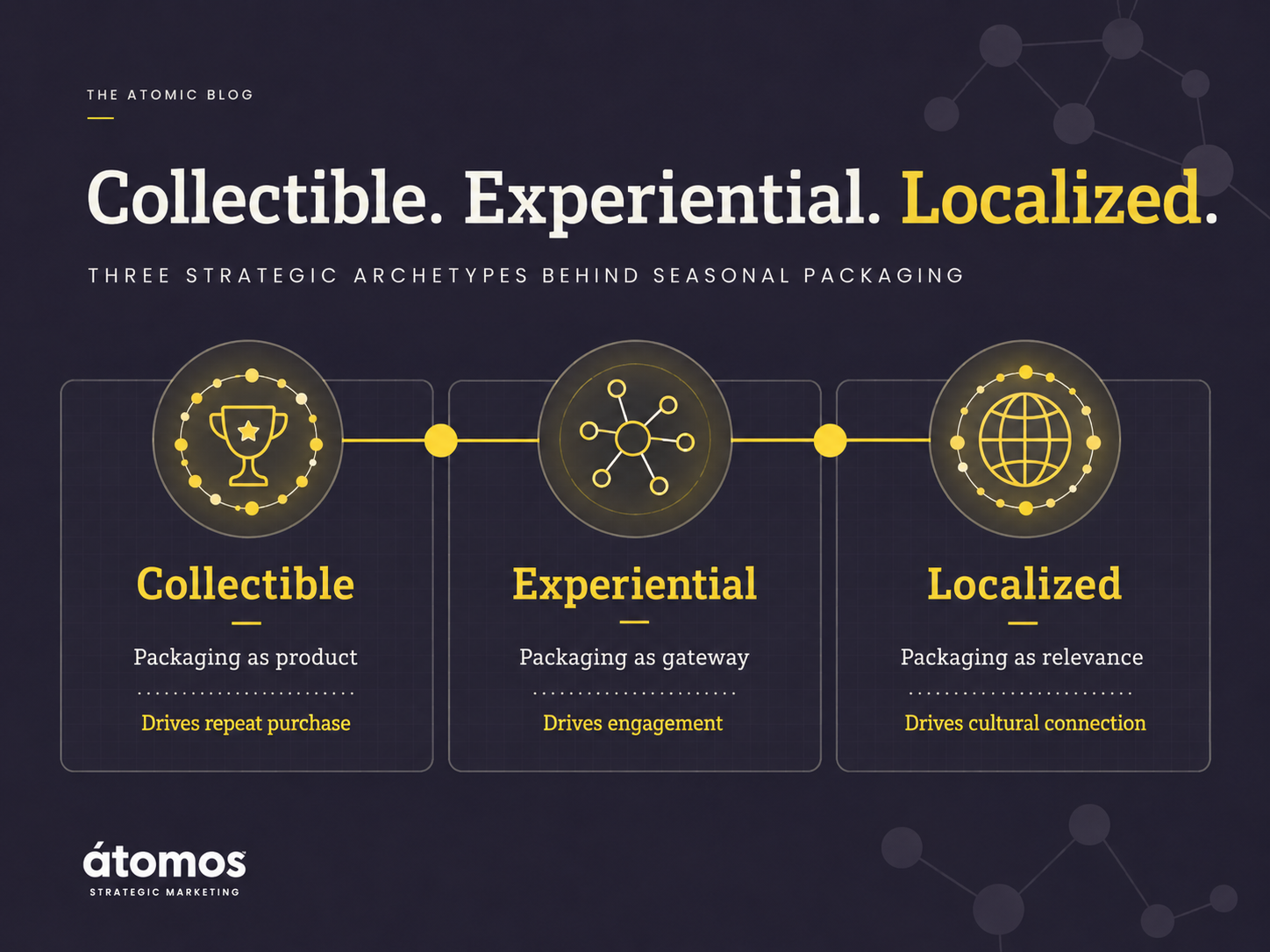
Across all of the activations above, the packaging strategies fall into three distinct archetypes. Understanding which archetype fits your brand is more useful than trying to replicate what a specific large CPG did with a nine-figure sponsorship budget.
Archetype 1 — The Collectible: Packaging as Product
Budweiser's anniversary cans and Coca-Cola's sticker labels are both collectibles. The packaging itself becomes the reason to buy. Scarcity, serialization, and completionist behavior drive repeat purchase and social sharing. This archetype works best when the brand has enough cultural equity that the consumer values ownership of the package independent of the product inside it.
Archetype 2 — The Experiential: Packaging as Gateway
PepsiCo's temperature-sensitive 'Perfect Chilled' cans and Coca-Cola's QR-linked digital experiences are both gateways. The packaging initiates an interaction that extends beyond the physical product. The consumer scans, plays, or discovers something — and the brand earns engagement that outlasts the consumption moment. This archetype works best when the brand has a digital ecosystem to extend into.
Archetype 3 — The Localized: Packaging as Relevance
Lay's international flavors, Coors Light's fan behavior design, and Coca-Cola's country-specific cans are all forms of localization. The packaging signals to a specific consumer: this product was made with you in mind. Cultural specificity earns relevance with consumers who want to see their identity reflected in the brands they choose. In a World Cup context — where 48 nations are represented and Latino consumers are the dominant demographic in many host markets — localization is not niche. It is the mainstream play.
"Three archetypes. Three different jobs. Collectible: drives repeat purchase. Experiential: drives engagement. Localized: drives relevance. The best activations run more than one simultaneously."
What Emerging CPG and Food & Beverage Brands Can Actually Learn From This
The brands above are all working with hundreds of millions in marketing investment, official FIFA licenses, and global design agencies. The playbook they are running is not directly replicable by a growth-stage CPG brand with a $2M marketing budget. But the strategic logic underneath that playbook is.
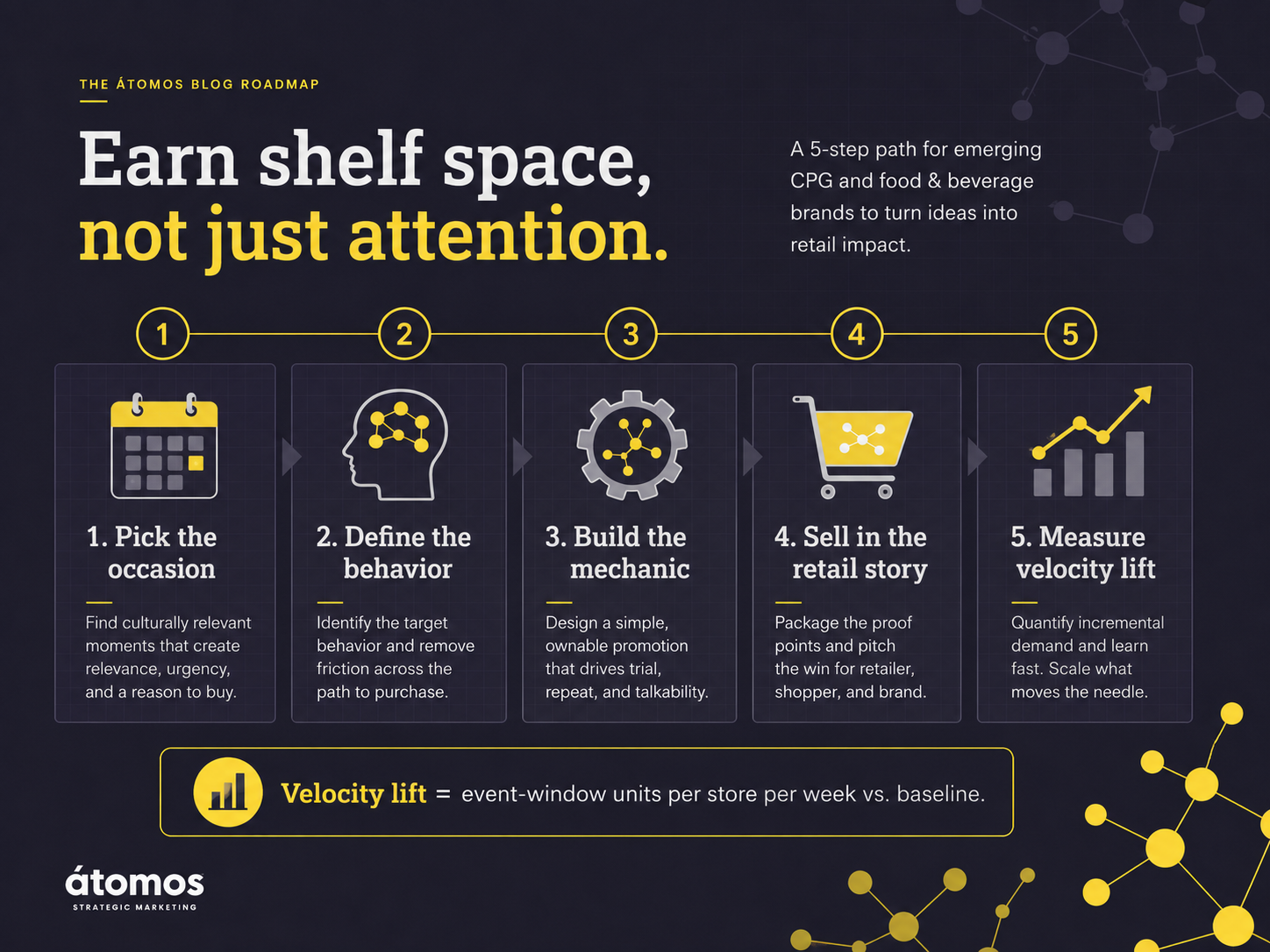
Lesson 1: Seasonal packaging is a retail strategy first
The primary value of limited-edition packaging in CPG is not brand equity — it is shelf placement. Retailers allocate display space, featured placements, and co-branded promotions to brands that bring seasonal relevance. A seasonal packaging program is your application for that space.
Lesson 2: You don't need a license to participate
Coors Light proved it. Cultural intelligence is more valuable than a trademark. Identify the consumer behavior at the center of the event — not the logo — and build your packaging around that. Fan behavior, occasion language, cultural references, and team colors are all available without a licensing agreement.
Lesson 3: The mechanic matters more than the artwork
The most effective seasonal packs are not the ones with the best design. They are the ones with the most compelling mechanic: collect these, scan this, find the rare variant, win something, build a set. Artwork gets noticed. Mechanics drive behavior.
Lesson 4: Plan 6–9 months ahead or don't plan at all
Retailers allocate World Cup display space in Q4 of the prior year. The brands in those displays had packaging ready, sell sheets prepared, and promotional programs built before most brands had started thinking about the tournament. Speed matters, but timing matters more.
Lesson 5: Velocity is the scorecard, not awareness
All of this packaging investment is measured at one place: the point of sale. Units per store per week during the event window versus baseline. Brands that track velocity against their seasonal packaging investment know what it is worth. Brands that track impressions and social engagement are measuring the wrong thing.
Lesson 6: Latino consumers are not a sub-segment — they are the audience
In a U.S.-hosted World Cup, the Latino consumer is the primary commercial audience. Buchanan's understands this. Casamigos understands this. Brands that have built cultural equity in this community over time are positioned to capture outsized returns from a tournament that was always going to feel personal to this audience.
The Strategic Mistakes to Avoid When Activating Seasonal Moments
For every brand that uses a seasonal event well, there are ten that execute tactics without a strategy. The mistakes are consistent and worth naming directly.
Designing packaging for the event without a retail plan. Seasonal packaging that does not come with a clear retailer sell-in strategy, promotional support materials, and a velocity hypothesis is just an art project. The packaging does not sell itself. The story behind it has to be built and sold to the buyer before the consumer ever sees the shelf.
Activating the moment without activating the consumer occasion. A World Cup themed bag of chips is interesting. A World Cup themed bag of chips tied to a specific watch party moment, with a buy-one-get-one program running during match windows and a social component that drives UGC from game day parties — that is a conversion engine. The occasion is not the event. It is the specific consumer moment within the event.
Treating limited editions as a brand launch. Limited-edition packaging works best for brands that have an established positioning. When a brand without clear positioning launches seasonal packaging, the consumer has nothing to attach the novelty to. The limited edition amplifies what is already there — including the absence of clarity.
Skipping the retailer co-investment conversation. The brands winning display space in Kroger, Ahold, and Hy-Vee during this World Cup are the ones that showed up to the buying conversation with a complete program: packaging, promotion, in-store support, and a velocity projection. The brands waiting to see if the packaging sells are not in the display. They are on the regular shelf hoping someone notices.
"Limited-edition packaging amplifies what is already there — including the absence of clarity. Seasonal activation is not a positioning strategy. It is a multiplier on the positioning you already have."
The Lesson Underneath All of It
The World Cup 2026 is a live laboratory for CPG brand strategy. Every day from June 11 through July 19, the brands that built their seasonal activation on a clear strategic foundation are compounding their advantage. And the brands that built their seasonal activation on the hope that a limited-edition can would do the positioning work for them are learning an expensive lesson.
The underlying truth is the same one that governs every CPG marketing decision: packaging is the most powerful marketing medium a consumer brand has. It is the thing the consumer holds. It is the thing that sits in the aisle and makes the case without any media support. And in a seasonal window where the retailer is giving you eight inches of display space next to five competitors who also have World Cup packaging, what that packaging says and does at the point of purchase is everything.
The brands that use seasonal moments well are the same brands that have clear positioning the rest of the year. The event creates the opportunity. The foundation determines what you do with it.
That is the playbook. Not a license. Not a design budget. A strategy that knows what it is building, who it is building for, and how a seasonal window accelerates that goal rather than replacing it.
"The event creates the opportunity. The foundation determines what you do with it."
-
The most effective CPG brands use seasonal events as a retail velocity strategy, not just a brand awareness play. They develop limited-edition packaging that earns premium shelf placement, co-investment from retailers, and elevated in-store positioning. The packaging itself is designed with a specific commercial mechanic — collectible series, interactive elements, localized designs — that drives trial and repeat purchase during the event window.
-
No. Coors Light demonstrated this clearly in 2026 with its 'Cooors Call' packaging — a fan behavior-inspired design that required no official license. The strategic principle is to anchor the packaging to consumer behavior and cultural intelligence rather than to a trademark. Fan rituals, occasion language, team colors within certain guidelines, and cultural references all offer legitimate entry points without licensing costs.
-
For major retail events like the World Cup, Super Bowl, or Olympics, the planning window is 6 to 9 months before the event. Retailers allocate display space, promotional programs, and co-branded opportunities during category review cycles that often happen in Q4 of the prior year. Brands that arrive with finished packaging and promotional materials inside that window earn placements. Brands that arrive after it compete for leftover space on the standard shelf.
-
A collectible packaging strategy is designed to drive repeat purchase through completion behavior — a consumer buys multiple units to collect a full set, series, or sequence. Budweiser's 11-can anniversary series and Coca-Cola's 12-player sticker labels are both collectible mechanics. A standard limited edition changes the visual design but does not create a behavior that drives multiple purchases. Collectible mechanics are significantly more effective at driving velocity because they create a structural reason to buy again.
-
Velocity — units per store per week during the event window versus baseline — is the primary metric. A well-executed seasonal packaging program should produce a measurable lift in velocity during the activation period. Secondary metrics include retailer display penetration (how many stores featured the seasonal packaging in a prominent position), trial conversion (new buyers during the window versus repeat), and sell-through rate before the event ends. Awareness and social metrics are not the right scorecard for a retail packaging investment.
-
The World Cup 2026 is hosted in the United States, Mexico, and Canada, with significant match activity in cities with large Latino populations including Los Angeles, Miami, New York, Dallas, and Houston. Latino consumers are the fastest-growing purchasing demographic in U.S. CPG and have a deeply personal cultural connection to the World Cup across most of Latin America. Brands that have built genuine cultural equity with this community — like Buchanan's and Casamigos within the Diageo portfolio — are positioned to capture outsized returns during a tournament that carries significant emotional weight for this audience.
-
Seasonal packaging amplifies whatever positioning already exists — which is why it works best for brands with clear, established positioning and creates confusion for brands that are still finding their identity. Limited-edition packaging is not a way to establish what a brand stands for. It is a way to express it more vividly within a cultural moment. A brand that does not know exactly who it is for and why will produce seasonal packaging that generates visual interest but not brand equity.
ÁTOMOS — FRACTIONAL CMO FOR FOOD & BEVERAGE
We bring big-CPG playbooks to growing food and beverage brands.
We embed inside your business, read your category the way large CPG does, and help you move with clarity and speed — without the full-time cost.
→ Let's talk: atomos.us/contact