
Conductor or Musicians? What an Early-Stage CPG Brand Actually Needs First

You finally have budget for marketing. Now you have to decide what to do with it.
Do you hire a strategist who can tell you what matters? A marketer who can actually make things happen? A performance specialist? A social person? Someone senior enough to run the show, or someone scrappy enough to get moving?
This is where many founders start searching for a fractional CMO for startups. But the title is not the most important decision. The sequence is.
For this article, “early-stage” does not mean a pre-revenue founder looking for a first marketing hire. It means a CPG or Food & Beverage brand with real traction, meaningful marketing decisions to make, and growing complexity that can no longer live entirely in the founder’s head.
The short answer is that most brands at this stage do not need strategy or execution in isolation. They need senior judgment close enough to the work to turn decisions into action, then specialist capacity once the jobs are clear.
The False Choice Between Thinkers and Doers
A common mistake is separating strategy and execution too early.
On one side is the pure strategist: senior, experienced, capable of building a strong plan, but too far from execution to feel the constraints that shape the real decision. A recommendation can look smart in a review and still fall apart against a retail calendar, a production timeline, a packaging constraint, or a media budget that is smaller than the plan assumes.
On the other side are the doers: freelancers, junior generalists, channel specialists, agencies. They can produce content, run media, design packaging, build CRM flows, manage shopper programs, and keep a calendar moving. But when nobody has decided what deserves to be done first, excellent execution can still create the wrong kind of momentum.
That is the real risk. A growth-stage CPG brand does not need a conductor standing in front of an empty stage, and it does not need ten musicians playing ten different songs. It needs enough senior judgment to decide what matters and enough execution capacity to move the business forward. Early on, those responsibilities often belong closer together than founders expect.

What Conductor Work Actually Looks Like
“Strategy” is too vague a word for this stage. Conductor work is a set of concrete business decisions:
• Diagnose the actual growth constraint. Is the brand dealing with awareness, trial, distribution, repeat, velocity, weak positioning, or something else?
• Define the priority consumer precisely enough to make tradeoffs in messaging, media, product, and retail.
• Sharpen the positioning so the shelf story, the brand story, and the consumer promise reinforce each other.
• Decide which channels and jobs matter now, and which ones are premature.
• Allocate a limited budget against the constraint instead of distributing it evenly across every marketing activity.
• Set KPIs that connect marketing to business performance: velocity, trial, repeat, cost per trial, qualified demand, or another metric that reflects the job to be done.
• Build briefs that give specialists and agency partners a clear problem, audience, objective, guardrails, and definition of success.
• Make the hardest decision of all: what not to do yet.
This is the work that keeps a brand from confusing activity with progress. It also explains why the marketing leadership gap can become expensive long before a company is ready for a full-time CMO.
What Musician Work Actually Looks Like
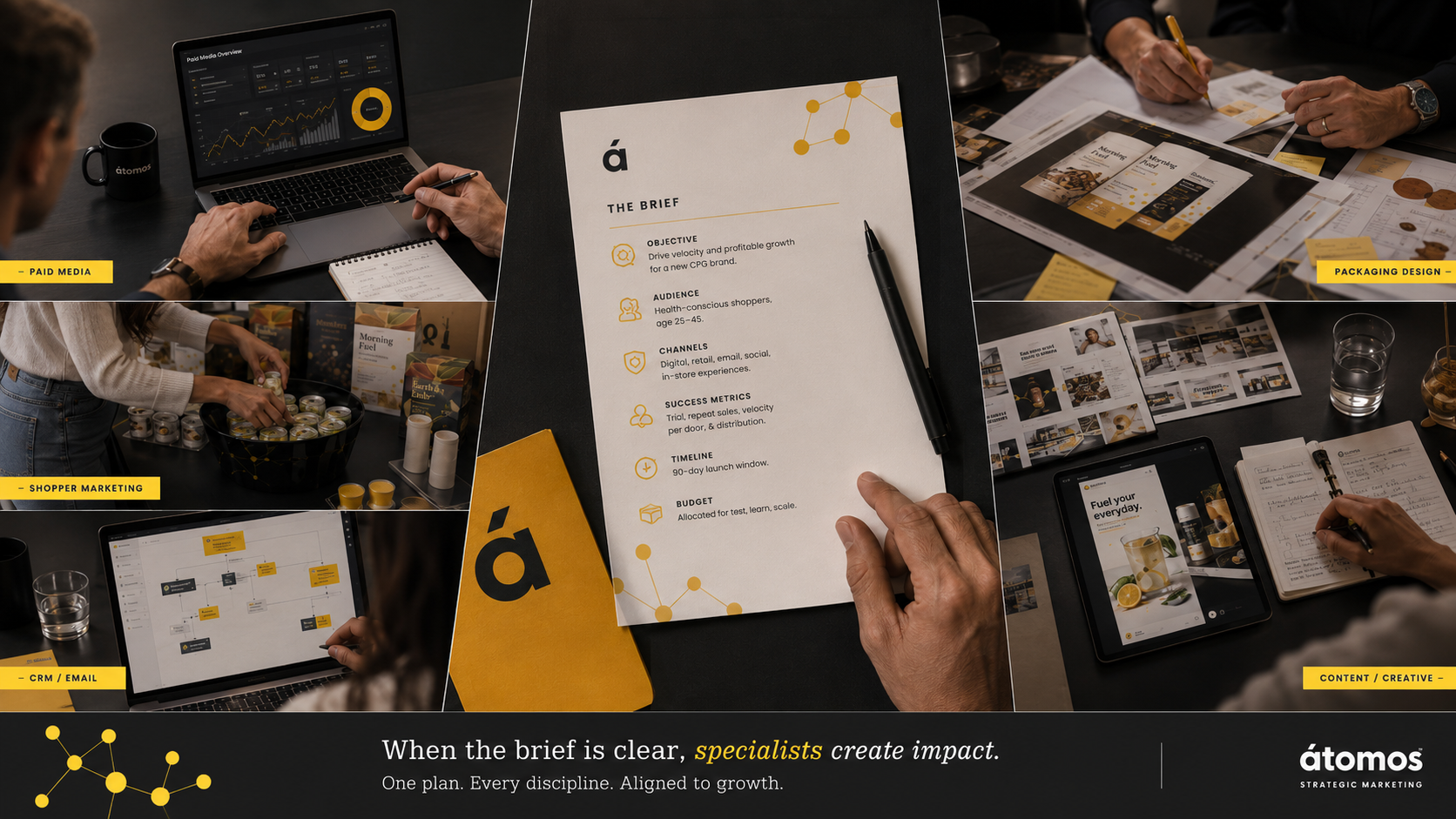
Once the assignment is clear, specialists become incredibly valuable. Creative production, paid media, social, CRM, retail activation, sampling, shopper marketing, packaging, PR, analytics, and content all require real expertise.
The issue is not whether those capabilities are good. The issue is whether they have a clear job.
A talented performance marketer with an unclear audience will optimize toward whoever clicks, not necessarily the consumer most likely to repeat. A strong designer without a clear positioning decision can create beautiful packaging that still fails to say something distinct on shelf. A social team can publish consistently and still have no role in the business problem the brand is trying to solve.
That is why the fractional CMO vs. agency question is usually less useful than it sounds. Agencies and specialists can be exactly the right answer. They simply work better when someone has already made the decisions that define the assignment.

What a Fractional CMO for a CPG Startup Should Actually Do
For many growing brands, the most useful first senior marketing role is a working conductor: a player-coach who can set direction and stay close enough to the work to make sure it moves.
That person may define the positioning and then write the brief. They may set the media priorities and sit in the first creative reviews. They may establish the retail focus and help translate it into the activation plan. They know which work requires senior judgment, which work they can drive directly, and which work should move to a specialist once the job is defined.
Hands-on does not mean doing everything forever. It means maintaining enough proximity to execution to pressure-test the strategy, remove friction, and stay accountable for what happens next. As the system matures, day-to-day coordination and execution can shift to a marketing analyst working from the strategy, priorities, and guidance set by the fractional CMO.
That distinction matters. At this stage, the brand often cannot justify a structure with one senior leader, multiple internal specialists, several agency partners, and a fully built marketing function. The better answer is usually to build the capability in sequence.
This is what a fractional CMO for a CPG startup should be able to provide when the business is still navigating ambiguity: senior judgment, operating discipline, and enough executional proximity to convert decisions into movement.
How the Marketing Role Evolves as the Brand Grows
The working-conductor model is not the end state. It is a phase, and the role should change as the business becomes clearer.
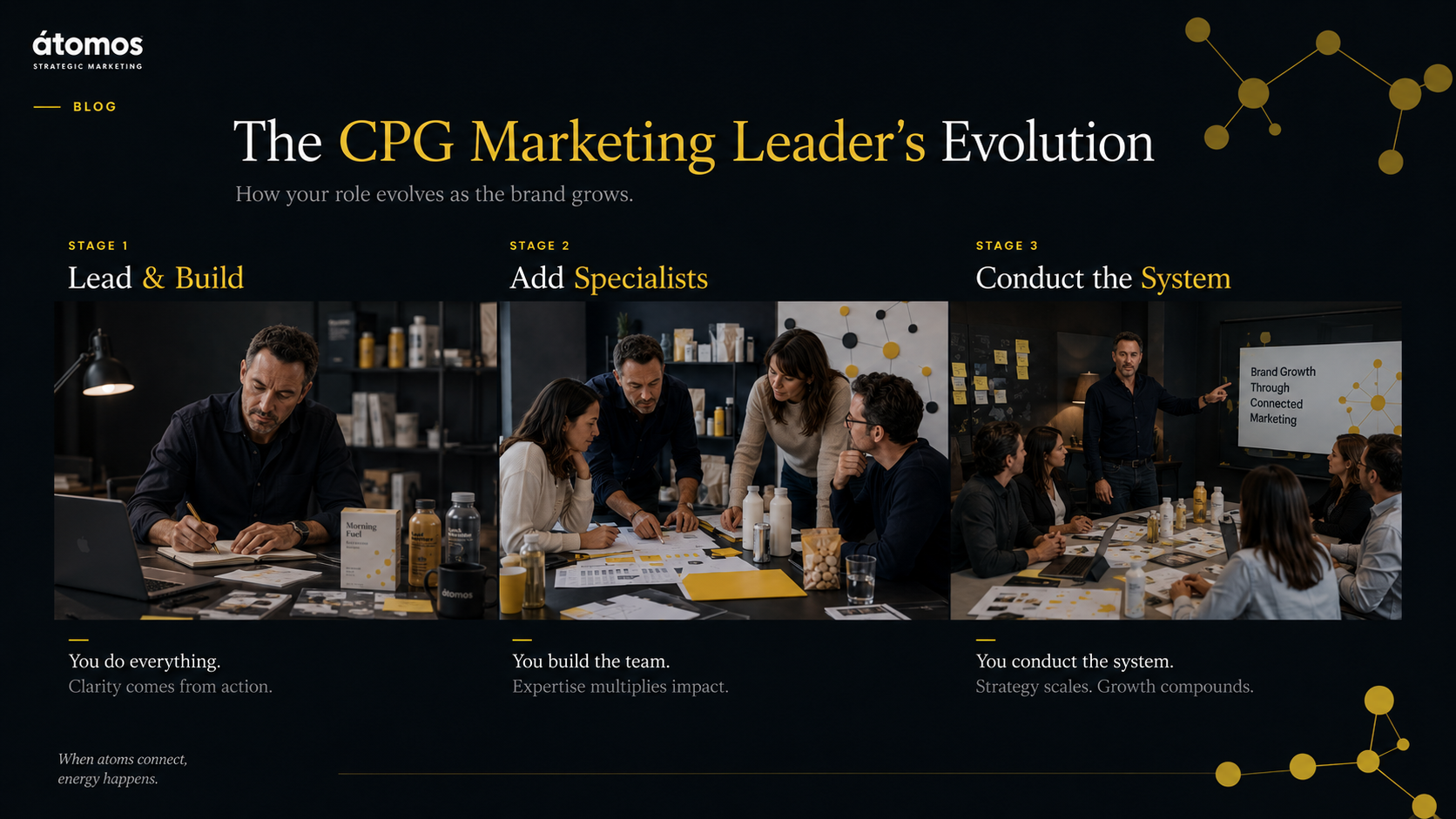
1. High ambiguity: lead and build.
When the consumer, positioning, growth constraint, channel roles, or success metrics are still unresolved, the brand needs senior hands-on leadership. The job is to diagnose, prioritize, make the core decisions, and drive the highest-leverage work.
2. Clear direction, low capacity: add specialists.
Once the strategy is clear, specific capability gaps become easier to see. A paid media specialist can own a defined acquisition job. A CRM partner can build against established triggers. A shopper agency can activate against a clear retail objective. The specialist is no longer being asked to rediscover the strategy before doing the work.
3. Growing complexity: conduct the system.
As the brand adds channels, partners, budgets, markets, and internal talent, the senior leader should spend more time aligning priorities, managing tradeoffs, directing partners, and holding the full system accountable to business outcomes. Day-to-day coordination and execution can increasingly sit with a marketing analyst, while the fractional CMO owns strategy, priority-setting, tradeoffs, guidance, and accountability to business outcomes.
The role shifts because the business changed. That is the point. The right marketing structure should follow the stage of the company, not an org chart borrowed from a brand three times its size.
Leadership, Capacity, or Direction? A Founder Diagnostic
If you are deciding what to hire next, start with seven questions:
• Can we clearly articulate the consumer we are prioritizing—not just a demographic, but the person the next phase of growth is built around?
• Do we know the specific growth constraint marketing is supposed to solve?
• Could we write a one-page brief for an agency or specialist today without another round of internal debate?
• Do we know which metric tells us the work is succeeding?
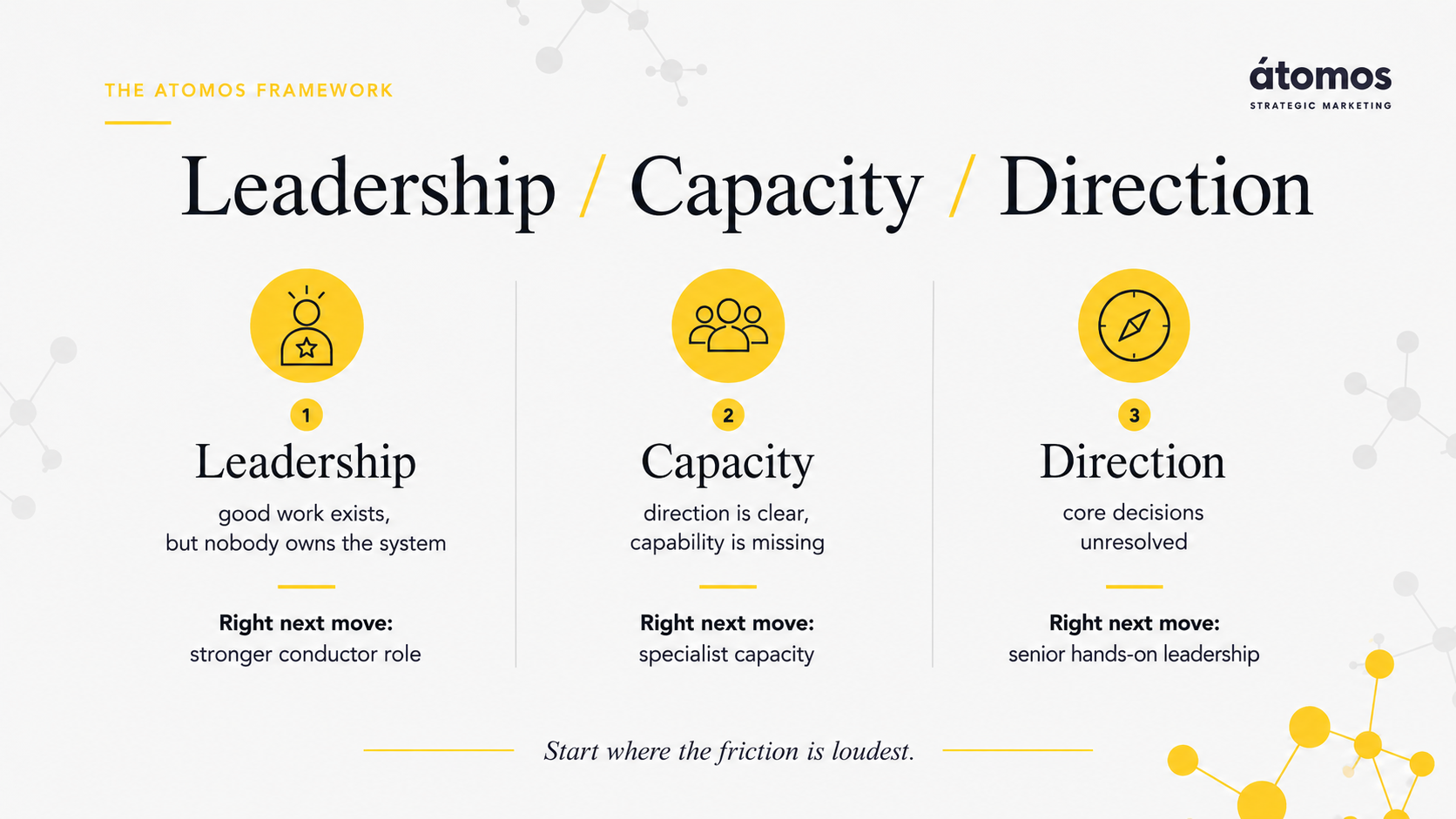
• Is our bottleneck a lack of senior leadership, a lack of execution capacity, or a lack of clear direction for the people already doing the work?
• Is the founder still the default senior marketing decision-maker, setting priorities and resolving tradeoffs across every channel and partner?
• Are we hiring because there is a defined job to own, or because the organization feels like it “needs marketing”?
The answers usually point to one of three problems:
Leadership problem
Core strategic questions may still be unresolved, or no senior marketer owns the decisions and tradeoffs that connect marketing to the business. More hands will create more activity, not more clarity. The priority is senior, hands-on marketing leadership.
Capacity problem
Leadership and direction are clear, the brief exists, and a specific capability is missing. Add the marketing analyst, specialist, or agency that can own the execution job.
Direction problem
Senior leadership is in place, but the people doing the work do not yet have clear enough priorities, briefs, decision rules, or guidance to execute consistently. The fractional CMO should set the direction; a marketing analyst can coordinate execution against it.
Four Sequencing Mistakes That Cost Growing Brands
1. Building the band before writing the score.
When multiple specialists arrive before the strategic direction is settled, each one starts solving the problem through the lens of their own channel. The result is often more output and less coherence.
2. Hiring a conductor who stays too far from the work.
At this stage, leadership has to understand how the plan behaves in the real operating environment. If the senior person never enters the brief, the creative review, the retail conversation, or the budget tradeoff, the gap between strategy and reality gets too wide.
3. Expecting one junior generalist to supply CMO-level judgment.
A strong junior marketer can be invaluable, but execution capacity and senior judgment are different capabilities. Hiring for one and expecting the other creates frustration on both sides.
4. Keeping the founder as the accidental CMO for too long.
Founders should stay close to the brand. They should not have to remain the senior decision-maker for every campaign, agency, asset, approval, and tradeoff. When every marketing decision still escalates to the founder, growth eventually starts competing with the founder’s bandwidth.
Sequence the Role Before You Scale the Team
The goal is not to choose between direction and execution forever. It is to put them in the right order and keep them close enough together that good decisions become good work.
A growing CPG or Food & Beverage brand should buy judgment before it multiplies complexity. But judgment only creates value when it is connected to action. That is what strong fractional marketing leadership should deliver at this stage: direction with enough proximity to move the business.
The best early-stage marketing leader does not simply point at the work. They help build the system until the organization is ready for more musicians, then make sure every specialist is playing from the same score.
That is the model átomos brings to growth-stage CPG and Food & Beverage brands: embedded senior leadership, clear priorities, and hands-on problem solving that scales with the business. If you are unsure whether your current bottleneck is leadership, capacity, or direction, diagnose that before adding more headcount or spend.
-
A fractional CMO can make sense when a brand has traction, meaningful marketing investment, and strategic complexity, but is not ready for a full-time senior marketing executive. For CPG startups, the strongest fit is often a hands-on operator who can set direction and stay close to execution.
-
Usually, the better question is what the business lacks: leadership, capacity, or direction. If nobody senior owns strategy and tradeoffs, leadership should come first. If leadership is in place but the team lacks clear priorities and guidance, the issue is direction. If both are clear and the gap is execution bandwidth or a specific skill, add capacity.
-
Hire a specialist when there is a specific, repeatable job to own and a clear brief to execute against. Paid media, CRM, shopper marketing, creative, PR, and other specialist capabilities become more effective once the audience, objective, priorities, and success metrics are defined.
-
A fractional CMO can diagnose the growth constraint, clarify the priority consumer and positioning, set budget priorities and KPIs, build the marketing plan, align partners, and guide execution. In a growing CPG company, the role is often more hands-on than a traditional advisory engagement.
-
Yes. In an early growth stage, a fractional CMO often should stay close to high-leverage execution while the marketing system is still being built. As specialist roles become clearer and the team expands, the CMO can shift more time toward orchestration and leadership.
ÁTOMOS — FRACTIONAL CMO FOR FOOD & BEVERAGE
We bring big-CPG playbooks to growing food and beverage brands.
We embed inside your business, read your category the way large CPG does, and help you move with clarity and speed — without the full-time cost.
→ Let's talk: atomos.us/contact
