
5 Things Every Clear CPG Brand Does. Most Founders Skip #3.

The market is making clarity non-negotiable
Most CPG founders I talk to don't have a marketing problem. They have a clarity problem. And in 2026, that problem is getting more expensive to ignore.
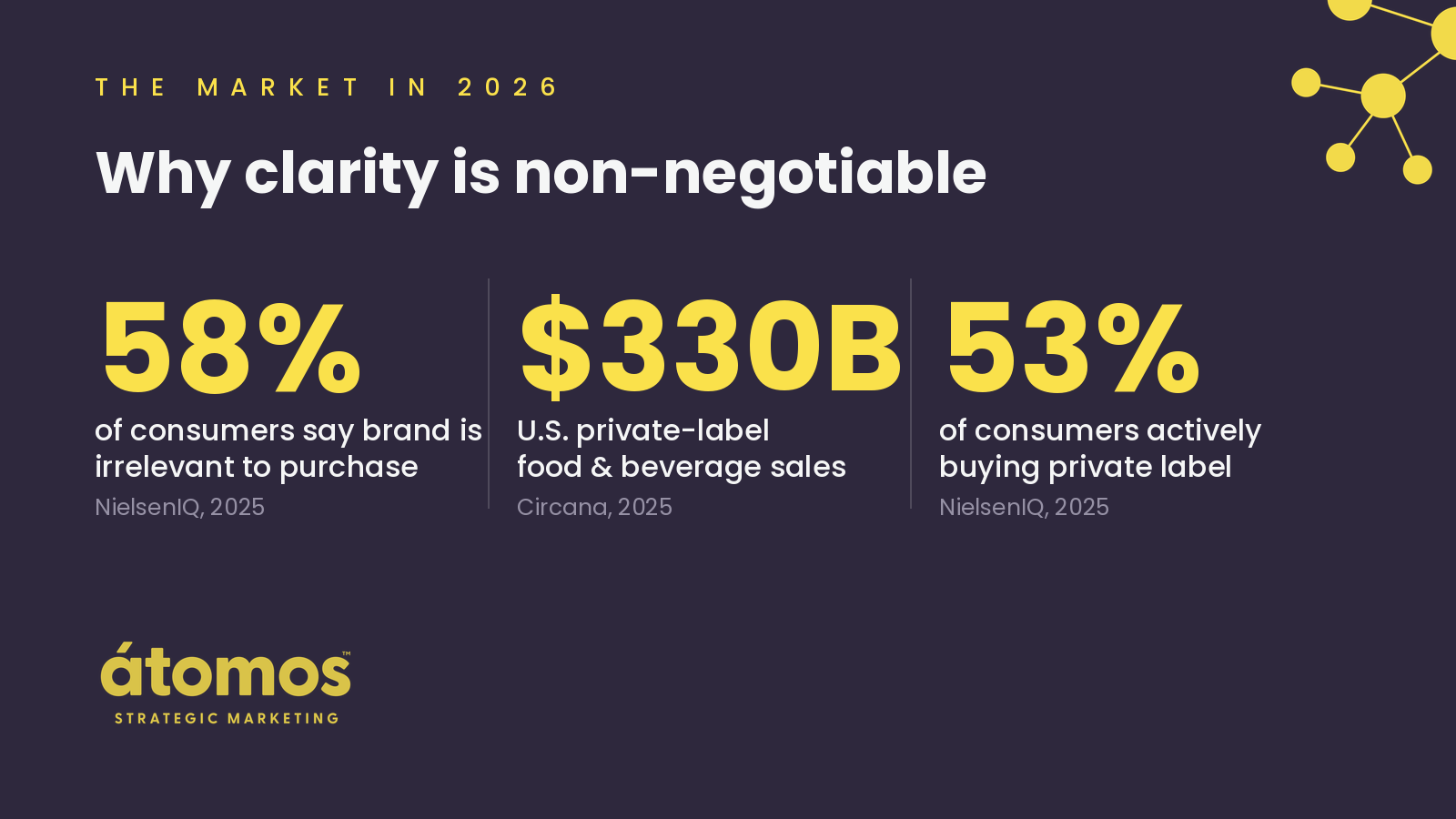
Private label just crossed $330 billion in U.S. sales 24% of the food and beverage market by value, according to Circana.
A 2025 NielsenIQ survey found that 58% of consumers say brand is irrelevant to their purchase decision. Store brands are now leading innovation in multiple categories. Retailer first-party data gives private label a strategic edge that national brands can't easily replicate.
This isn't a warning about private label. It's a context for what brand clarity actually means right now. When consumers default to what's cheaper and what's familiar, the only weapon a growing food or beverage brand has is a positioning so clear, so specific, so consistent, that it justifies the premium and earns the repeat purchase.
The brands that are winning aren't out-spending the competition. They're out-clarifying it.
"When consumers default to what's cheaper and what's familiar, the only weapon a growing food or beverage brand has is a positioning so clear it justifies the premium."
What brand clarity actually means in food and beverage
Clarity isn't a tagline. It's not a brand voice document. It's not a mood board.
In CPG, clarity means one thing: a consumer standing in an aisle, with 8 seconds and 40 competing options, reaches for your product instead of the one next to it. And they do it again the next week. And the week after.
That kind of clarity is built upstream, before any campaign runs. It lives in the positioning, in the packaging, in the channel decision, in the retailer pitch. Fever-Tree didn't win by outspending Schweppes on advertising. They won by reframing tonic water as a craft ingredient rather than a commodity, and then making sure every touchpoint reinforced that single idea. Poppi didn't win by explaining gut health better than anyone else. They won by putting prebiotic functionality inside a familiar soda format, making the benefit obvious without requiring consumer education.
Both examples share the same core discipline: one clear idea, consistently executed, validated with real consumers before scale.
Here are the five moves I've seen the clearest CPG brands make, every time:
1 They say one thing.
Not five. Not three. One.
The clearest CPG brands can finish this sentence in under ten words: 'We are the [X] for [Y].' One benefit. One consumer. One reason to pick this over the thing next to it on the shelf.
Every time a brand tries to say two things at once, functional and great-tasting, premium and accessible, better for you and indulgent, it ends up saying nothing to anyone. The consumer's brain resolves ambiguity by defaulting to the familiar. In 2026, that familiar option is often store brand at a lower price. Ambiguity is a gift to private label.
2 They repeat what matters.
Clarity isn't a one-time brand exercise. It's a discipline that requires resisting the urge to say something new every time.
The brands that stick are the ones that say the same core idea across every touchpoint, the packaging, the retailer pitch, the sampling script, the sell sheet, the Instagram caption. Not the same words, but the same promise.
The brands that lose clarity are almost always the ones that got bored of their own message before their consumer ever heard it. The rule of seven, that a consumer needs to see a message seven times before it registers, is conservative in a world of infinite scroll. Consistency isn't boring. Inconsistency is expensive.
3 They build a consumer-validated strategy before they spend.
This is the one most founders skip. And it's the reason the other four collapse when they do.
Consumer-validated doesn't mean a focus group or a market research deck. It means the brand's core positioning has been tested in the real world, through sampling, through early retail velocity data, through conversations with real buyers, before significant spend goes in.
Without this, you're not scaling a strategy. You're scaling an assumption. And in food and beverage, scaled assumptions are expensive. Circana data shows that new product failure rates in CPG remain above 80%, and positioning misalignment is consistently among the top reasons. The brands that get validation right early don't just avoid expensive mistakes. They build the evidence base that makes every downstream decision, the retailer pitch, the agency brief, the next SKU, sharper and faster.
Why skipping #3 breaks everything else:
Move 1 collapses: If you say one thing but it hasn't been validated with real consumers, you might be saying the wrong one thing — clearly.
Move 2 collapses: If you repeat what matters before you know what matters to your buyer, you're amplifying a guess at scale.
Move 4 collapses: If you say no more than yes but your filter is built on untested positioning, you're optimizing for the wrong outcome.
Move 5 collapses: If you know exactly who you're for but that profile is based on assumption rather than evidence, your targeting is fiction.
The bottom line: Validation is the foundation. Not the last step — the first.
4 They say no more than yes.
Clarity requires subtraction. Every channel, every SKU, every partnership, every campaign is a decision, and every yes dilutes the one thing you're trying to build.
The clearest brands are ruthless about focus, not because they have fewer opportunities, but because they understand that bandwidth is finite and that spreading it across ten decent bets produces worse results than concentrating it on two excellent ones.
The brands that lose clarity don't usually do it with one big strategic mistake. They do it gradually, one reasonable-sounding yes at a time. A new SKU that expands the range but muddies the positioning. A partnership that reaches a new audience but confuses the existing one. A campaign that's on-trend but off-brand. Each decision seems defensible in isolation. Together they add up to a brand that nobody can describe in a single sentence.
The SKU discipline test:
Before adding any new SKU, partnership, or channel, ask: does this make the brand's core idea clearer or more complicated? If it's the latter — even if the opportunity looks attractive — the answer is almost always no. Brands that pass this test consistently are the ones that retailers trust, because clarity at the product level translates directly to clarity at the shelf set level.
5 They know exactly who they're for.
Not 'health-conscious millennials.' Not 'everyone who cares about what they eat.' A real person. A real occasion. A real purchase moment.
The brands with the sharpest positioning can describe their core consumer the way you'd describe someone you know, what they read, where they shop, what they were buying before this product existed, what problem this solves in their actual life, and why this product is better for them than the established alternative.
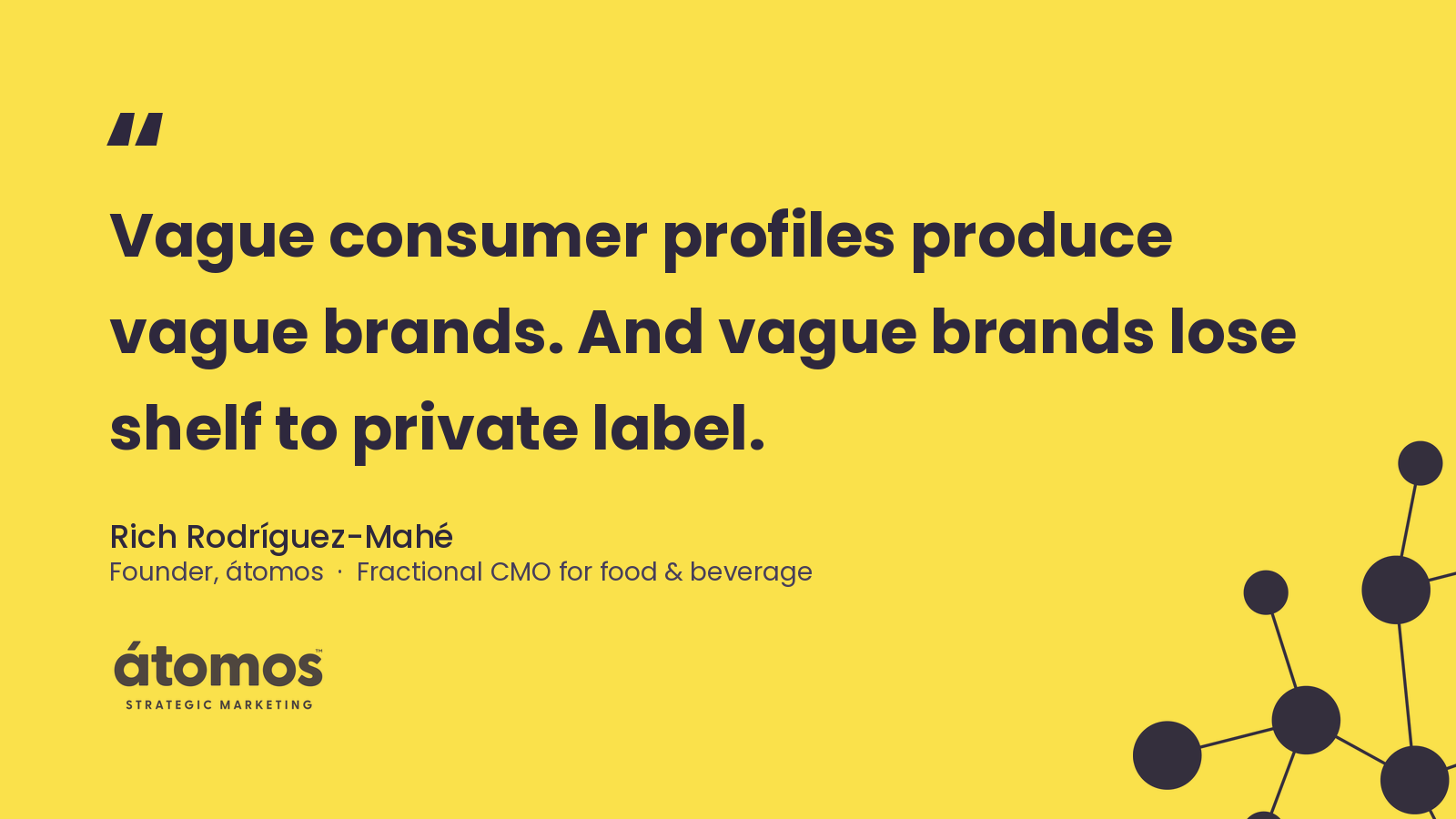
That specificity is what makes the message land on shelf. It's also what makes the retailer pitch believable. Vague consumer profiles produce vague brands. And vague brands lose shelf to private label, because when a consumer can't articulate why they chose your product over the store brand, they don't come back.
What this looks like in practice
The five moves above aren't a sequential checklist. They're interdependent, which is exactly why they collapse together when one is missing.
In practice, the brands we work with at átomos that execute all five well tend to share a few observable behaviors:
They brief agencies differently.
Instead of 'make us look premium,' they say 'our buyer is a 34-year-old who shops Whole Foods twice a week, bought Siete before us, and needs to believe this is better for their gut without feeling like a health supplement.' That brief produces different creative. Better creative.
They have a positioning filter.
Before any new initiative, someone in the room asks: does this reinforce the one thing we're saying, or does it add a second thing? That question, consistently applied, is worth more than any brand strategy document.
They track velocity, not just awareness.
Units per store per week tells you whether the positioning is working where it matters: at the moment of purchase. Impressions and followers don't. The clearest brands are the ones that measure clarity in sales data, not in brand health surveys.
They revisit the consumer profile regularly.
Not to change it, but to sharpen it. The best brands I've worked with can tell you how their core consumer has evolved, what they're buying now that they weren't two years ago, and how the brand's positioning has stayed relevant to that evolution.
Clarity isn't a brand exercise.
It's a business decision.
The market context in 2026 makes this more urgent than it's been in years. With private label at 24% share and growing, consumer ad budgets tightening, and CPG ad spend growth slowing below the national average, the brands that rely on awareness and distribution alone are running out of runway.
The brands that will hold shelf, and take share, are the ones with a positioning so clear that it's irreplaceable. Not because no one else makes a good product. But because no one else makes this product for this person in this way.
That's the work. Not campaigns. Clarity first.
ÁTOMOS — FRACTIONAL CMO FOR FOOD & BEVERAGE
We bring big-CPG playbooks to growing food and beverage brands.
We embed inside your business, read your category the way large CPG does, and help you move with clarity and speed — without the full-time cost.
→ Let's talk: atomos.us/contact
