
Food and Beverage Marketing: What Most Founders Get Wrong Before They Ever Hit Shelf

I'm going to tell you something that took me years inside PepsiCo to fully understand, and that I now see founders relearn the hard way every time.
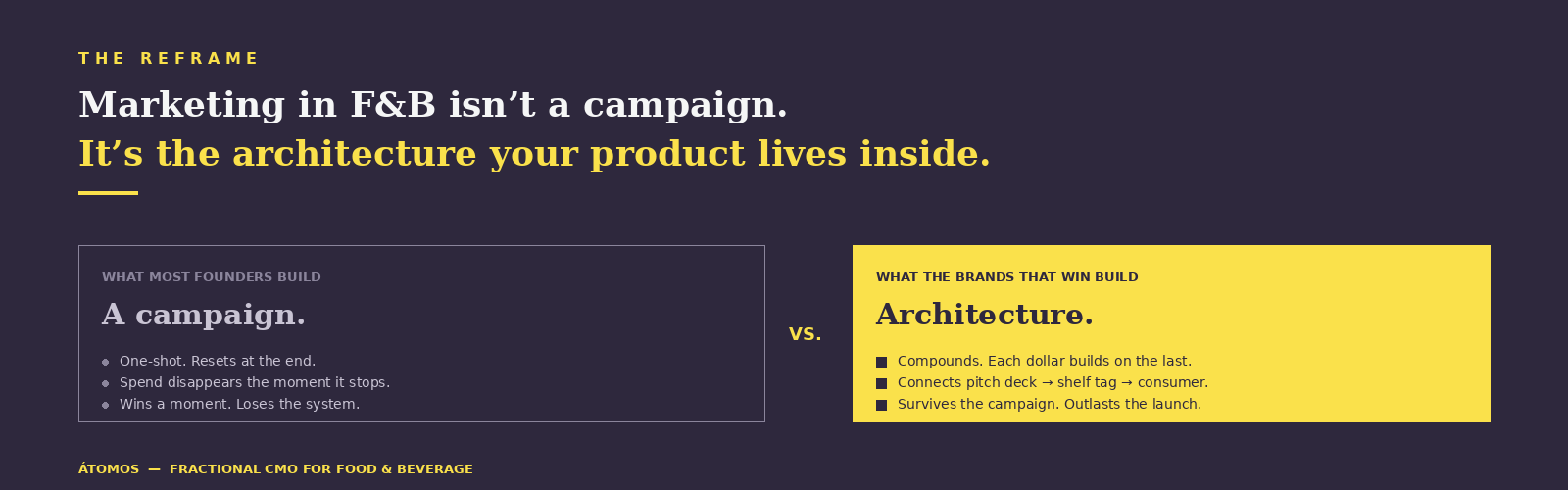
Marketing in food and beverage is not a campaign. It's the architecture your product lives inside. And most founders build it in the wrong order. Not because they're not smart. Because nobody tells them the order matters.
By the time a brand reaches us at átomos, the pattern is almost always the same: great product, real consumer demand, and a marketing system that was built backwards. Awareness spend before trial was figured out. Retail placement before the shelf story was ready. A social media manager before there was a strategy for them to execute.
This is what I want to talk about. Not a framework you can find in a textbook. The specific things that I've seen determine whether a food or beverage brand builds real momentum, or stays stuck.
"Marketing in food and beverage is not a campaign. It's the architecture your product lives inside. And most founders build it in the wrong order."
The shelf doesn't care about your campaign
Here's what's different about food and beverage that most marketing advice misses: your buyer makes the decision in less than 5 seconds, standing in an aisle, with 40 competing options and zero patience for nuance.
You're not there. Your brand manager isn't there. Your packaging is there. Your price point is there. Your shelf position is there.
That's the real first impression. And if that moment isn't right, if the packaging doesn't communicate the right thing instantly, if the price doesn't signal the right value, if the product is on the wrong shelf in the wrong set, no campaign is going to fix it.
I learned this the hard way inside PepsiCo, where even with world class resources and teams, products that deserved to win sometimes didn't get the shelf traction they needed. Not because the marketing wasn't excellent. But because at that scale, the portfolio is enormous, the velocity bar is enormous, and the shelf story can't get the individual focus every product deserves. That gap between a great product and great retail execution is where brands get lost.
The lesson: get the shelf right before you touch the consumer.
01
Positioning in 3 seconds
Your packaging has to answer 'why this one?' before the consumer reaches for something else. Not in the pitch deck on the shelf.
02
Channel before campaign
Being in the wrong channel or the right channel with the wrong velocity, can kill a brand that deserved to win. This is a marketing decision, not a sales decision.
03
Velocity is the only KPI retailers care about
Units per store per week. That's what determines whether you keep the shelf or lose it. Everything else is a vanity metric until that number moves.
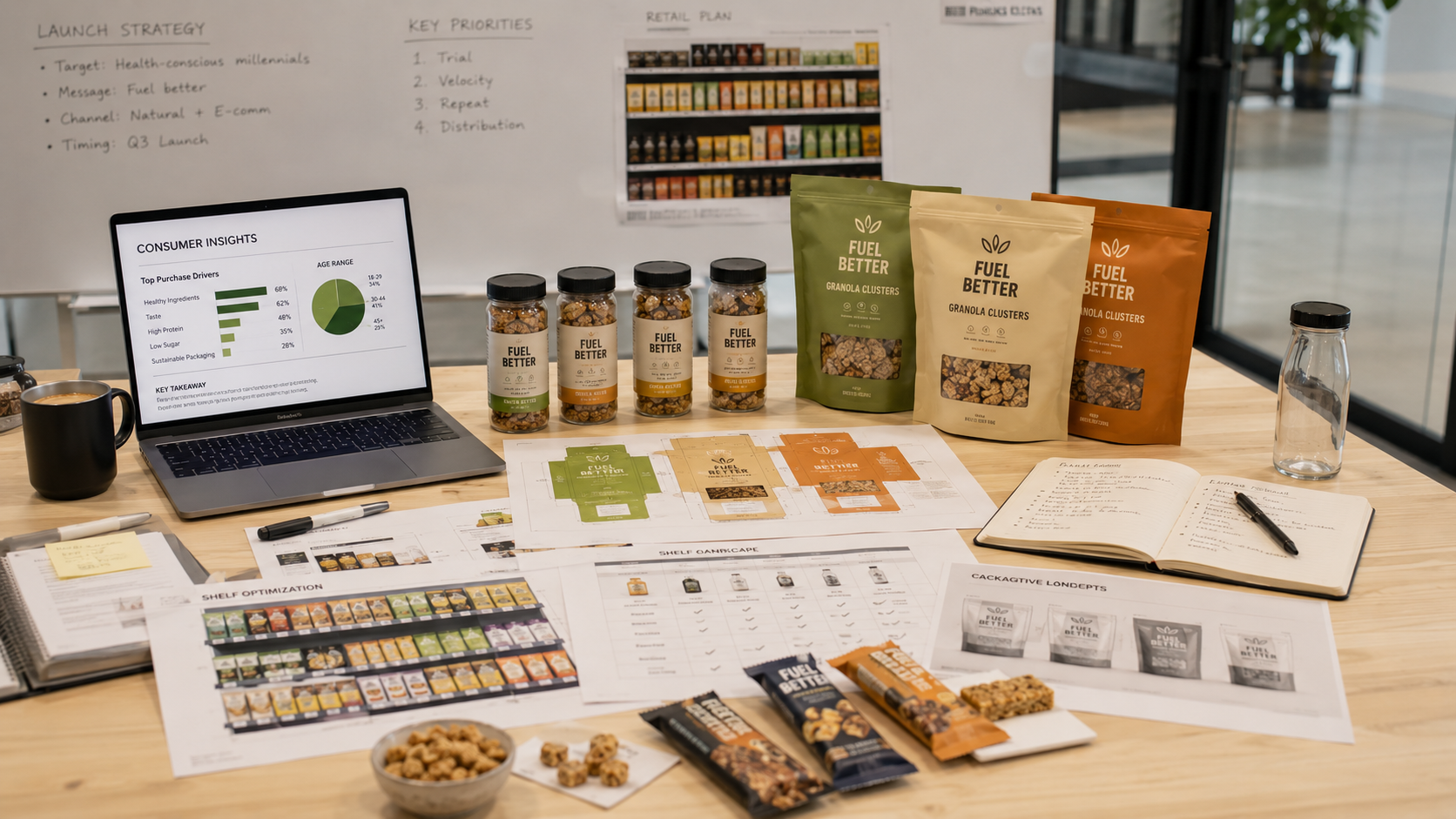
What we see again and again, and what it teaches us every time
We've seen this pattern more than once. A brand with real distribution, a loyal consumer base, and a product that has earned its shelf space — but a positioning story that isn't traveling correctly from the retailer pitch to the shelf to the consumer's hand. The product was right. The architecture around it hadn't caught up.
What we built together wasn't a campaign. It was architecture, a way for the brand's story to travel consistently from the retailer pitch deck to the shelf tag to the consumer's hand. A way for every marketing dollar to compound instead of reset.
That's the work nobody talks about. Not the creative. The connective tissue between the product, the retail partner, and the consumer. When that's right, everything else gets easier. When it's missing, nothing works the way it should, even if the individual pieces are good.
"The work nobody talks about is the connective tissue between the product, the retail partner, and the consumer. When it's missing, nothing works, even if the individual pieces are good."
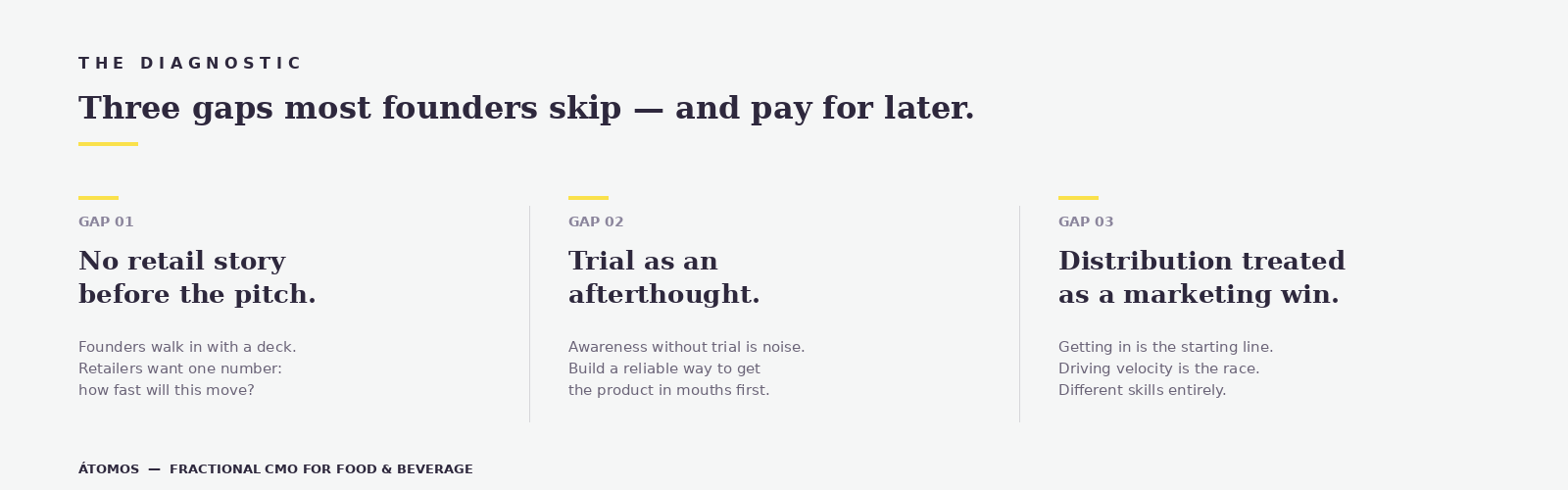
The three things most founders skip, and pay for later
After years inside large CPG and now embedded in emerging brands, the mistakes I see aren't random. They cluster around the same three gaps.
The order that actually works
I'm not going to give you a 12 step framework. I'm going to tell you the order, because the order is the thing.
An amazing product first. Everything else is built on top of something worth selling. Then positioning — a clear, shelf-testable answer to why this product, for this consumer, and how it does it better than the established players in that channel. Everything else builds on both.
Retail story second. Your sell sheet, your retailer pitch, your velocity projections. Your retail buyer needs to believe before your consumer does.
Trial mechanism third. Something that reliably gets the product in someone's mouth before they've decided to buy it. Sampling, DTC, creator partnerships, pick one and make it work.
Velocity before scale. Once you have velocity data that holds across a few doors, you have something to show the next retailer. That's how you expand. Not before.
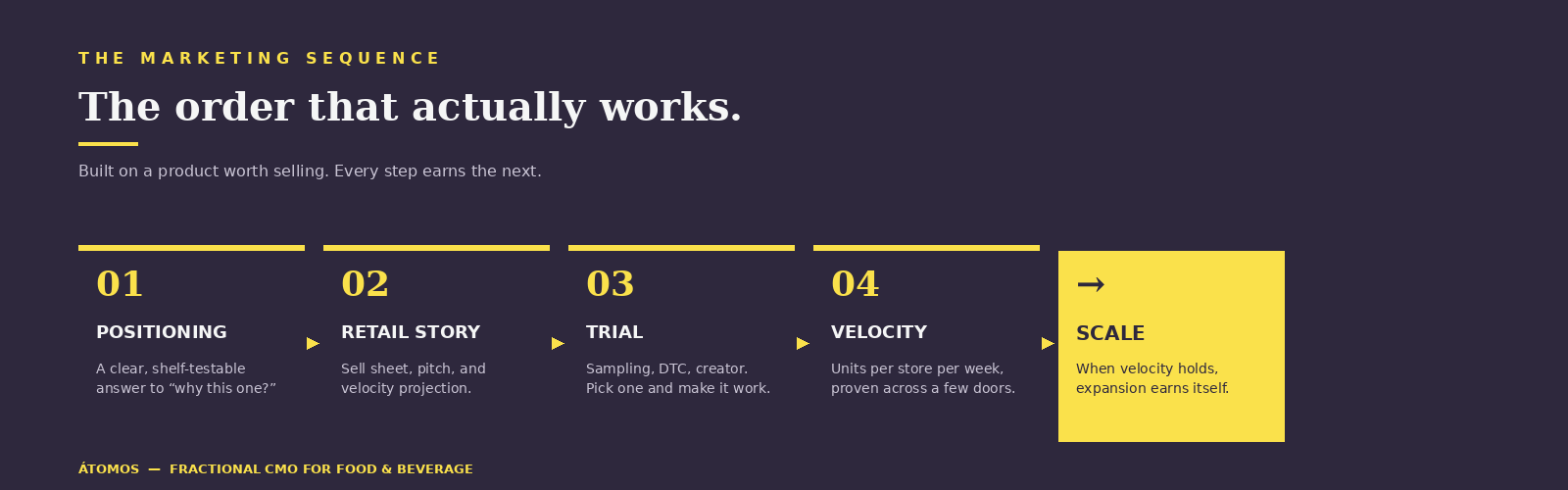
That's it. That's the order. It sounds simple. The reason brands get it wrong is that there's always pressure to skip ahead, to launch the campaign, take the meeting, expand to another retailer. The brands that resist that pressure are the ones that end up with something durable.
"Get the shelf right before you touch the consumer. Build trial before you build awareness. Prove velocity before you scale. The order isn't optional."
What this means if you're launching now
If you're in the early stages of bringing a food or beverage product to market, the most valuable thing you can do is slow down long enough to get the sequence right. Not because moving fast is wrong, but because moving fast in the wrong direction is expensive in ways that are hard to recover from in this category.
The brands that win in food and beverage aren't the ones with the biggest marketing budgets. They're the ones that understand the mechanics of the category, and build accordingly.
That's the work we do at átomos. Not campaigns. Architecture.
ÁTOMOS — FRACTIONAL CMO FOR FOOD & BEVERAGE
We bring big-CPG playbooks to growing food and beverage brands.
We embed inside your business, read your category the way large CPG does, and help you move with clarity and speed — without the full-time cost.
→ Let's talk: atomos.us/contact
