
Why Every Beverage Brand Is Changing Right Now
The forces reshaping food and beverage are not trends. They are structural shifts.
I recently sat down with The Happy Customer Channel for Episode 109 called Why Every Beverage Brand Is Changing Right Now of their podcast to talk through what is actually driving change in the CPG and beverage industry right now — not the surface-level trend noise, but the structural forces that are redrawing the map for brand strategy, retail execution, and consumer marketing.
The conversation covered a lot of ground: health and wellness reaching mass-market saturation, GLP-1 medications reshaping consumption patterns, Gen Z pulling away from alcohol, the unforgiving mechanics of retail velocity, the role of packaging design in shelf conversion, TikTok as a product discovery engine, and where DTC brands consistently break down.
If you have not watched the full episode yet, the link is at the bottom of this post. What follows is the strategic context behind what we discussed — and what it means for your brand.
Health Is No Longer a Differentiator. It Is the Entry Fee.
For years, "better for you" was a positioning move. A way to stand out. A premium signal that justified a higher price and a more targeted audience.
That window has closed.
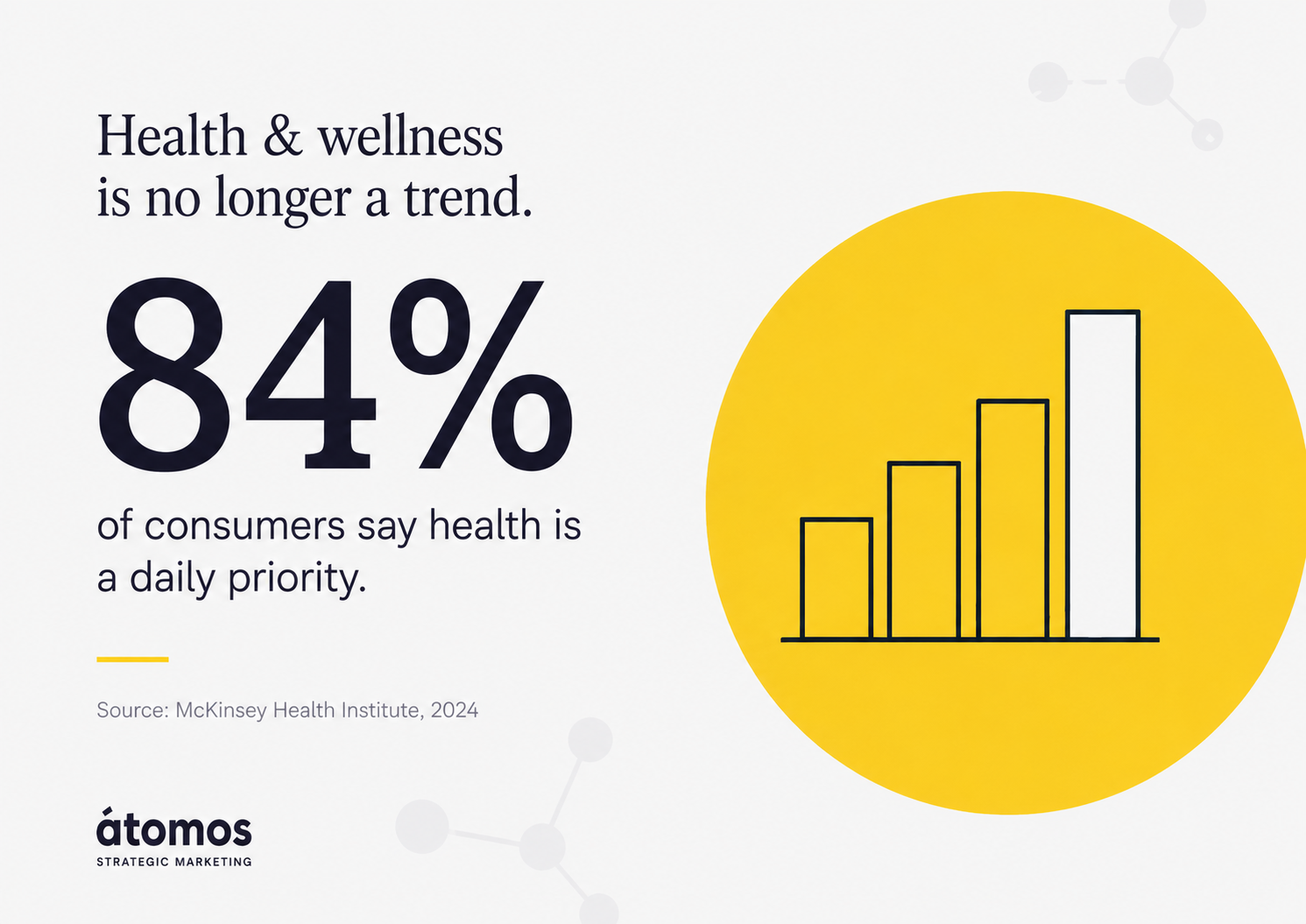
According to McKinsey's 2025 consumer health survey, 84% of U.S. consumers say wellness is a top daily priority. When a behavioral trait reaches that level of saturation, it stops being a segment. It becomes the baseline. Health-conscious is no longer a profile that sharpens your targeting — it describes almost everyone standing in the aisle.
The brands that built their entire identity around "better for you" as a point of difference now have a positioning problem. The claim that once separated them is now table stakes.
"Better for you" is no longer a differentiator. It is the floor. The question now is: better for you and what else?
What does this mean in practice? It means the differentiation work has to move upstream. Clean label, minimal ingredients, and functional benefits are no longer enough to own a shelf set or justify a premium. The brands that will hold ground are the ones that can answer a harder question: better for you and what else? What is the one thing — beyond health — that makes this product irreplaceable for a specific consumer in a specific moment?
The parallel trend accelerating this is the rise of minimally processed, clean-label products. Consumers are reading ingredient panels differently than they were five years ago. Short ingredient lists, recognizable inputs, and transparent sourcing are moving from brand virtue to purchase requirement in a growing number of categories.
GLP-1 Is Not a Niche Pharmaceutical Story. It Is a Category-Level Event.
One of the most underestimated shifts in CPG right now is the downstream impact of GLP-1 medications — the class of drugs that includes Ozempic and Wegovy — on consumer behavior and purchase patterns.
The direct effects are well-documented: users eat less, consume fewer calories, and tend to shift toward higher-protein, lower-sugar foods. But the strategic implication for CPG brands goes further than reformulation.
GLP-1 adoption is accelerating the democratization of wellness behavior. As more consumers — across income levels and demographics — experience meaningful changes in how they eat and what they want, the demand signals for the entire better-for-you category are shifting. Portion sizes matter more. Protein density matters more. Added sugar is increasingly scrutinized, even by consumers who were not previously label-readers.
For food and beverage brands, this is not a story about GLP-1 users as a niche target. It is a story about a pharmaceutical trend that is normalizing a higher standard of nutritional expectation across a much broader consumer base. The brands that get ahead of this are the ones stress-testing their formulations and positioning now — not waiting for the sales data to tell them the category has moved.
Gen Z and Alcohol: A Structural Shift, Not a Lifestyle Phase
Roughly one in three Gen Z consumers do not drink alcohol at all. That is not a cohort behavior that will reverse as the generation ages. It is a values-driven shift with structural staying power.
The implications extend well beyond the alcohol category. They reshape the entire occasion landscape that beverage brands — alcoholic and non-alcoholic alike — have built their positioning and channel strategies around.
For brands in adjacent categories — premium water, functional beverages, energy drinks, RTD mocktails, adaptogen drinks — Gen Z's departure from alcohol represents one of the most significant category expansion opportunities in decades. But capturing that opportunity requires more than launching a non-alcoholic SKU. It requires understanding the occasion the consumer is trying to serve and building a product and brand experience that earns that moment.
The brands that will win here are not the ones that position around the absence of alcohol. They are the ones that build around the presence of something worth choosing — a clear reason to reach for this product at this moment.
Shelf Placement Is Only the Starting Line
One of the things I find founders consistently underestimate is how much work begins after you get on shelf.
Getting listed at a retailer is a milestone. It is not a growth strategy. The metric that determines whether you stay on shelf — and whether you ever get a second door or a second retailer — is velocity: units per store per week.
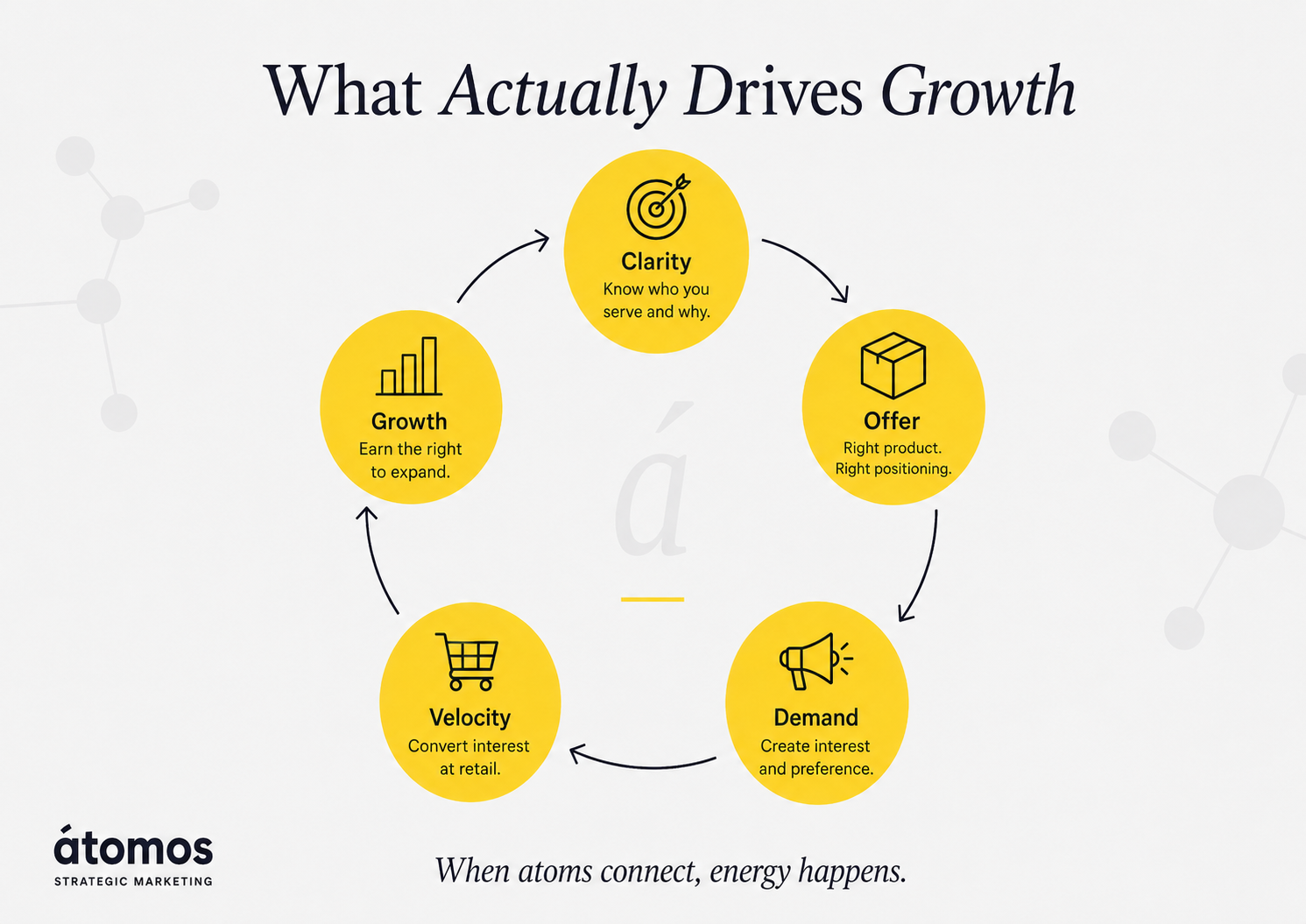
Velocity is the language retailers speak. It is how they measure whether your product earns its space. A brand that gets distribution without the marketing infrastructure to drive trial and repeat is not scaling. It is burning runway while shelf space counts down.
"Getting listed is a milestone. It is not a growth strategy. Velocity is what keeps you on shelf."
The brands that build velocity well do a few things consistently: they have a value proposition tight enough to land in one sentence, they invest in in-store execution before they invest in broad awareness, and they measure what is happening at the point of purchase — not just at the top of the funnel.
If you cannot explain why a consumer should choose your product over the eight things next to it in eight seconds, you are not ready to scale distribution. The clarity has to exist before the shelf opportunity arrives — not after.
Prefer to watch the conversation before continuing?
Packaging Is a Conversion Tool, Not a Brand Expression Exercise
Design decisions that happen in a studio often fail at the shelf. The two environments are completely different, and the consumer behavior in each is completely different.
Consumers in a retail aisle are not reading. They are scanning. They shop by color and by habit. They reach for what is familiar, and they skip what is visually ambiguous. A packaging design that communicates nuance and craftsmanship at arm's length on a mood board may communicate nothing useful at five feet on a crowded shelf.
The "bullseye" principle — designing your packaging so that the eye is immediately pulled to a single dominant visual element — is one of the most consistently effective shelf conversion tactics I have seen work across categories. It is not about making the design simple. It is about making the hierarchy unmistakable: one thing catches the eye first, then the rest of the story follows.
This matters more now than it did five years ago because the shelf is more crowded, private label design has improved significantly, and the margin for visual ambiguity has shrunk.
Where DTC Beverage Brands Break Down
Direct-to-consumer is still a viable channel for food and beverage brands, but the failure patterns are remarkably consistent.
The three most common breakdowns: websites that bury the product behind brand story and make it hard for a first-time visitor to understand what they are buying within ten seconds; positioning that has not been validated with real consumers before paid media spend starts; and scaling paid acquisition before the unit economics of the channel are understood well enough to know what a profitable customer actually costs.
The last one is the most expensive mistake. A DTC brand that finds a ROAS that looks efficient early and pours budget into it before validating repeat purchase behavior and lifetime value is not scaling a business. It is buying first purchases at a price that may never be recovered.
The brands that get DTC right treat the channel as a test-and-learn environment first. They use it to validate the positioning, understand the consumer, and build the retention infrastructure before they treat it as a growth engine.
What Small Brands Can Do That Large CPG Cannot
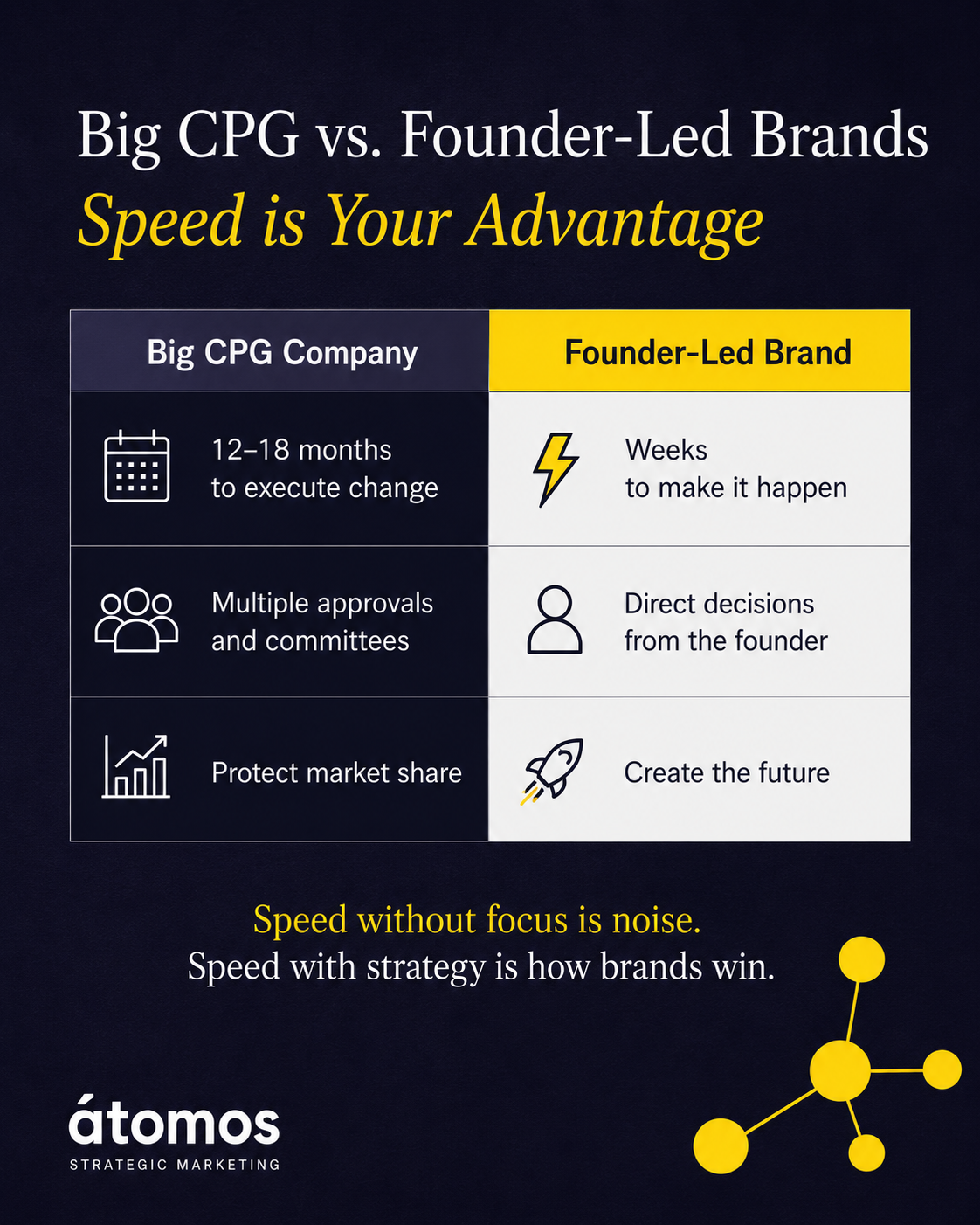
One of the most durable competitive advantages available to emerging food and beverage brands is speed — and most of them underuse it.
I spent nearly two decades at PepsiCo. I know what those planning cycles look like from the inside. A packaging refresh at a large CPG company can take 18 months from brief to shelf. A brand architecture decision that requires cross-functional alignment can take longer. The organizational machinery that makes big CPG powerful also makes it slow.
A founder-led brand with the right strategic infrastructure can identify a consumer insight, develop and test a response, and have it on shelf in a fraction of that time. That is not a small advantage. In a category environment where consumer behavior is shifting as rapidly as it is right now, the ability to move fast and respond to real signals is a genuine strategic edge.
The brands that capitalize on this are the ones that combine founder speed with the strategic discipline to focus it. Not chasing every signal. Not launching every SKU that looks interesting. But reading the category clearly, identifying the specific consumer need they are uniquely positioned to serve, and moving decisively to own that space before the large players can turn.
"Speed is the primary competitive advantage smaller brands have over big CPG. The brands that win combine founder speed with the strategic discipline to focus it."
Watch the Full Episode
If you want to go deeper on any of these topics, the full conversation is available on The Happy Customer Channel — Episode 109: Why Every Beverage Brand Is Changing Right Now.
-
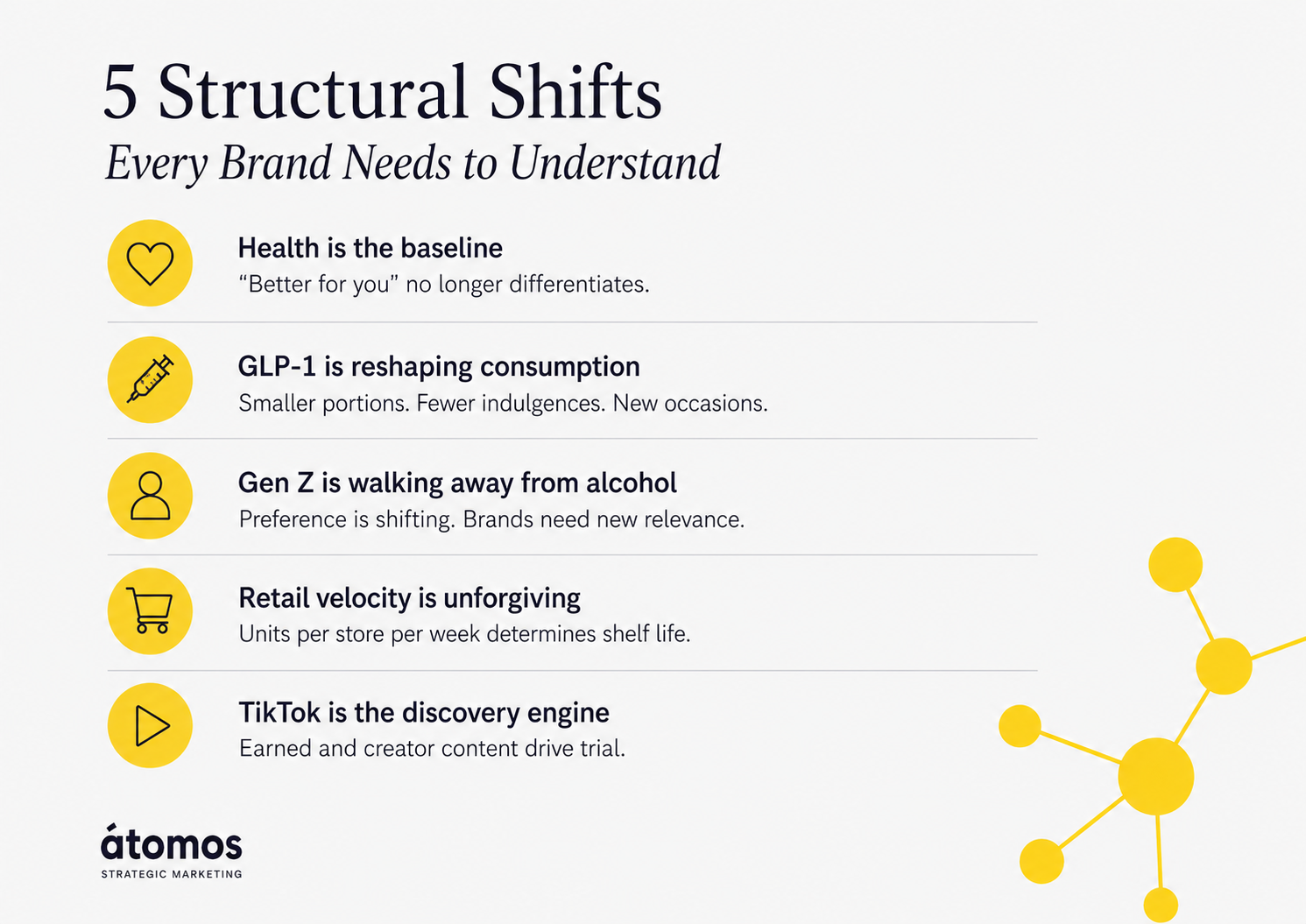
Three structural shifts are rewriting the rules: the mass-market normalization of health and wellness (84% of consumers now say it is a daily priority), the downstream impact of GLP-1 medications on consumption patterns and nutritional expectations, and Gen Z's structural departure from alcohol. Each of these changes the competitive landscape for positioning, formulation, and channel strategy.
-
GLP-1 medications are shifting consumption toward higher protein, lower sugar, and smaller portions — and accelerating clean-label expectations across a broader consumer base. For CPG brands, the implication is not just about targeting GLP-1 users. It is about a pharmaceutical trend that is raising the nutritional baseline for a much larger share of the market.
-
What is retail velocity and why does it matter?
Velocity — units per store per week — is the metric retailers use to determine whether a product earns its shelf space. Getting listed is the starting line. Driving velocity is what keeps you on shelf and earns you expanded distribution. Brands that invest in distribution before they have the marketing infrastructure to drive velocity are burning runway.
-
Why is TikTok important for food and beverage brands?
TikTok is the primary product discovery engine for consumers under 35. For food and beverage brands, earned and creator-led content consistently outperforms paid placement on the platform. The channel rewards authentic, specific storytelling — which is exactly the kind of content emerging brands with real stories are positioned to create.
-
The three most consistent failure patterns: unclear product positioning on the website, scaling paid media before validating the positioning with real consumers, and investing in paid acquisition before understanding unit economics and customer lifetime value.
-
Speed is the primary advantage. Large CPG companies often need 12 to 18 months to execute packaging changes or brand decisions. Founder-led brands with the right strategic infrastructure can move in a fraction of that time. The brands that win combine that speed with the discipline to focus it — not chasing every opportunity, but moving decisively on the right one.
-
A Fractional CMO is a senior marketing leader who embeds inside a business to provide strategic direction and execution accountability without the overhead of a full-time executive hire. For growth-stage food and beverage brands, it is the model that gives you big-CPG strategic rigor at founder speed — which is exactly the combination the current market rewards.
ÁTOMOS — FRACTIONAL CMO FOR FOOD & BEVERAGE
We bring big-CPG playbooks to growing food and beverage brands.
We embed inside your business, read your category the way large CPG does, and help you move with clarity and speed — without the full-time cost.
→ Let's talk: atomos.us/contact
