You finally have money to spend on marketing. Good. The dangerous part is treating that as permission to start buying channels.
Most founders treat this moment as a media-buying decision: pick some channels, set a monthly number, watch a dashboard. That's the wrong frame entirely. Your first marketing budget is not a media plan. It's a capital allocation system — and its job is to buy evidence, not reach.
You are not trying to be seen by as many people as possible. You're trying to find out what's true about your business: what demand actually exists, which messages get a reaction, which audiences convert and keep buying, which channel deserves the next dollar, what needs to be shut off, and whether your growth is becoming repeatable enough that the next round of capital — yours or an investor's — has somewhere productive to go.
Every dollar in that first budget should be assigned to one of those questions. If it isn't, it's not a marketing investment. It's a marketing expense that happens to feel productive.
I've written before about whyfoundation has to come before scale and whydistribution without demand is a trap. This piece assumes you've internalized that. You know marketing needs real investment now, not more hustle. The question this article answers is the one that comes right after: okay — so how do I actually build the first budget, dollar by dollar, when I have limited cash, a pile of scattered expenses, and no formal process for any of this?
Start With What the Business Can Actually Afford to Put at Risk

Skip the percentage-of-revenue exercise. It's the first thing every founder searches for, and it's also the least useful number you'll find.
Skip the universal percentage rule. An enterprise benchmark will not tell a growth-stage CPG founder what is safe, useful, or urgent for their business. The right number comes from the economics and constraint in front of you — not from a generic percentage of revenue.
What actually determines your number is narrower and more useful:
Runway. How many months of cash do you have before the current round needs to become the next one? A test that takes four months to read is a luxury you may not have.
Gross margin. A 55% margin can absorb a slower payback period on a paid test than a 30% margin can. Weak margin doesn't mean don't spend — it means every dollar has to prove itself faster.
The business constraint you're actually solving. Not "grow the brand" — a specific bottleneck. Weak trial at retail. Traffic that never converts. A creator program that produces content nobody amplifies. The constraint determines where the first dollars go, not a channel preference.
What you've already validated. If you've never run a single paid test, you don't yet know your acquisition economics — which means committing to a large, fixed monthly ad budget before you've spent a small, deliberate one is backwards.
The number you land on is the amount you can lose without threatening the business, while still being large enough to produce a real answer. That's a business math conversation, not a marketing best-practice conversation — and it's one worth having with whoever else has a stake in your runway before you have it with an agency.
Build the Budget in Three Layers, Not One Lump Sum
Most founders build a marketing budget the way they'd build a grocery list: this much for ads, this much for a freelancer, this much for samples, add it up, done. Every dollar gets committed on day one, to a fixed purpose, for the full month or quarter.
That's the mistake. A first-time marketing budget should be built in three layers, and one of those layers should be money you deliberately have not spent yet.
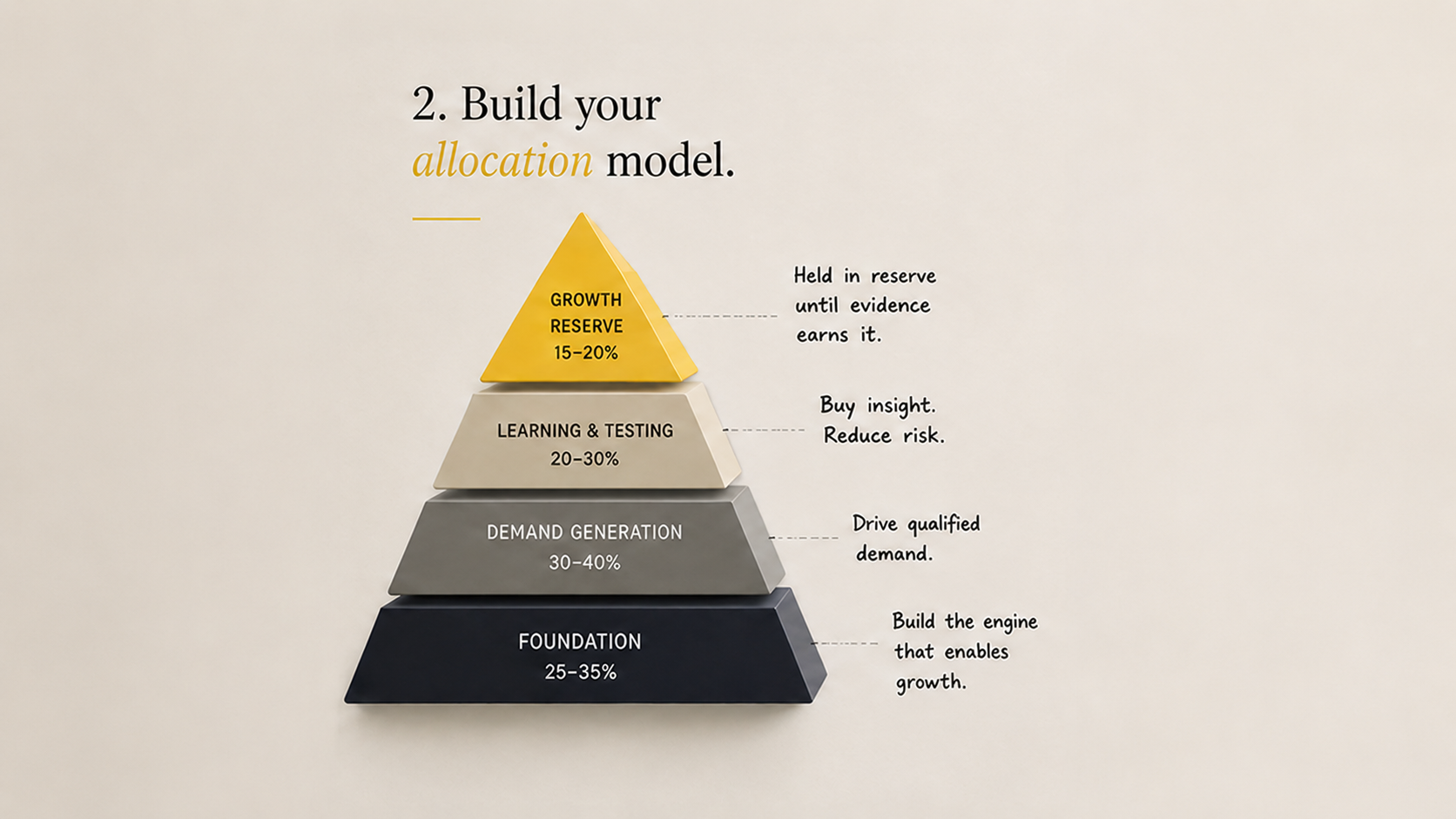
Base. This is the floor — the minimum required to see what's happening in your business. Basic analytics and attribution tools, a functioning way to track orders and repeat behavior, the software or freelance support needed to actually produce assets, and enough content and creative capacity to run a test when you decide to run one. Base isn't glamorous and it isn't optional. Skip it and every other layer becomes a guess, because you won't be able to tell whether anything you fund is actually working.
Learning. This is capital spent on purpose, to answer a specific question — not to "run marketing" in general. Before you spend a learning dollar, you should be able to finish this sentence: "This spend will tell us whether ______." A small paid test tells you whether a message converts a cold audience. A batch of eight to twelve creator relationships tells you which messaging language actually lands with real consumers, not just the language your team assumes will. A round of organic posts on three different angles tells you which hook gets a response before you pay to find out at scale. Every learning dollar has a question attached to it, and every learning dollar has a predetermined point where you decide what happens next.
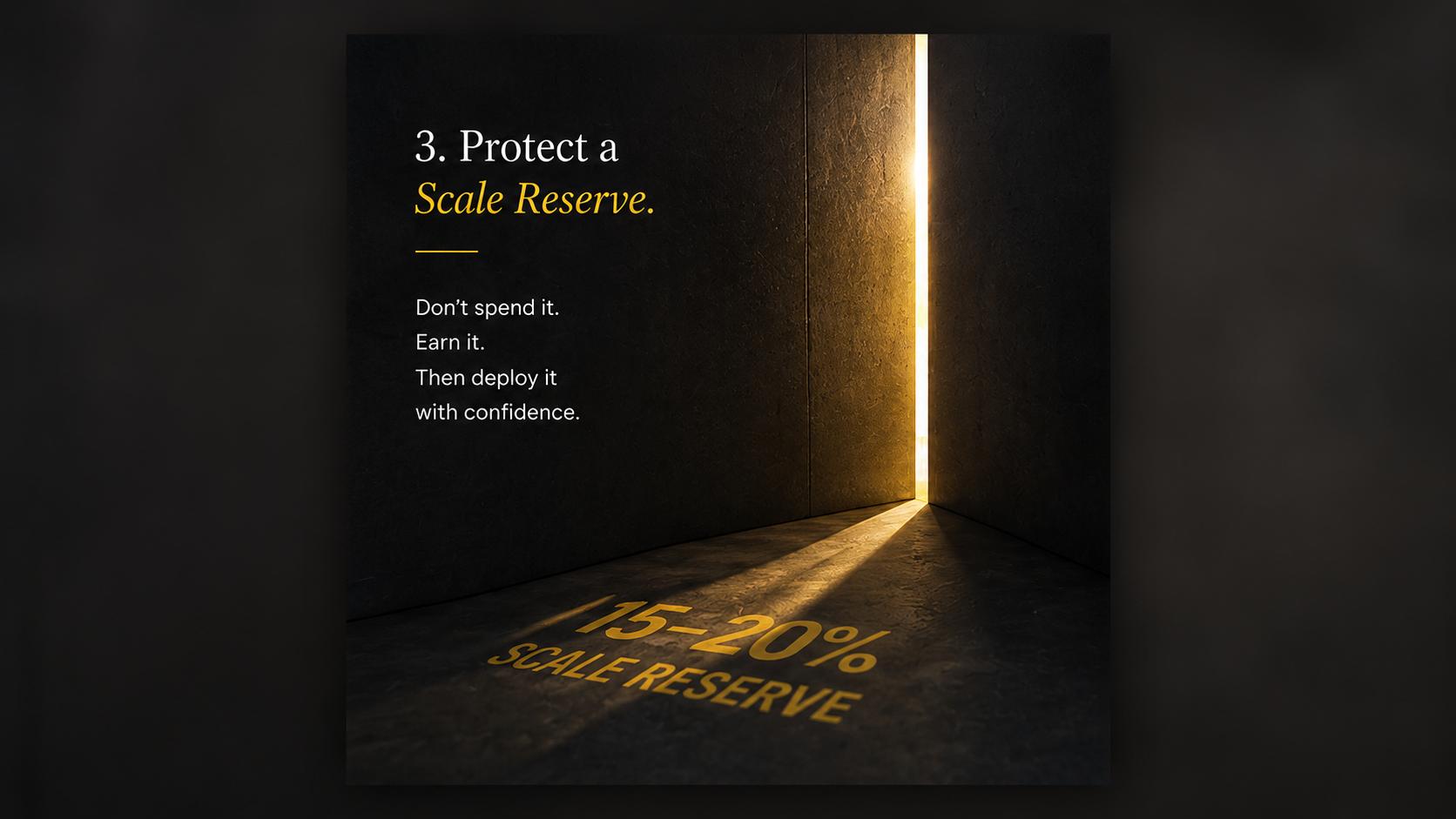
Scale reserve. This is the layer founders skip, and it's the one that matters most. It's capital that is not automatically spent. It sits unallocated until an experiment produces enough evidence to deserve more investment. If a creator's content is converting at twice the rate of your other tests, the scale reserve is what lets you move fast without a fresh conversation about "should we increase the budget" — the increase was already planned, contingent on exactly the evidence you just got.
Most founders commit 100% of their marketing dollars before the month even starts. That feels responsible — it isn't. It means that when something works, you have to wait for next month's budget to react to it, and by then the moment, the creator, or the audience may have moved on. Holding back even 15–20% of the total budget as a scale reserve is what lets your best-performing bet get funded the week it proves itself, not the quarter after.
Why Two Founders With the Same $10,000 Build Completely Different Budgets
There is no universal split — no "40% paid, 30% creator, 30% organic" rule that works across businesses, because the right allocation depends entirely on what's already been proven and what constraint you're solving. Here's what that looks like in practice.
Founder A has retail distribution — a regional grocery chain and a few independent accounts — but trial is weak. Shoppers aren't picking the product up. For Founder A, most of the budget should go toward in-store trial mechanics and localized awareness: sampling, demos, retailer media where available, and creative that's built to work at shelf-speed — three seconds, one reason to try it. A large national paid social budget is close to wasted here; the constraint isn't awareness at scale, it's trial at the point of purchase.
Founder B runs primarily DTC and already has a strong conversion rate on the traffic they get — but there isn't enough of that traffic. For Founder B, the constraint is top-of-funnel volume, which makes paid media and creator-driven traffic the higher-leverage bet, because the site is already proven to convert what it receives. The learning question here isn't "does our funnel work" — it already does. It's "which audiences and messages bring in more of the traffic that converts like the traffic we already have."
Founder C has plenty of creator activity — a growing list of relationships and a steady stream of content — but no system for identifying which posts are actually working or amplifying them. For Founder C, the smartest next dollars aren't new creator relationships at all. They're measurement and a whitelisting or Spark Ads process that lets the brand find the two or three posts already outperforming the rest and put paid dollars behind them. Buying more of an untracked asset just produces more untracked content.
Same budget size, three entirely different allocations — because the allocation follows the constraint, not a template.
Paid, Organic, and Creator Work as One Loop — Not Three Budgets
This is where most first-time budgets fail, even when the math above is right. Founders build genuinely smart line items for paid, organic, and creator/influencer work — and then run them as three disconnected efforts, often through three different people or partners who never see each other's results.
Each channel is actually built to do something specific for the others:
Organic is where you find out, cheaply, what's worth paying to say louder. It surfaces which messages create real interest, which questions consumers keep asking in the comments, which hooks get watched all the way through, and it builds founder or brand authority that later paid creative can borrow credibility from — all before you've spent a media dollar.
Creators add something brand-owned content cannot manufacture on its own: third-party language, credibility, and creative that feels native to the consumer. The strongest creator work should be briefed with reuse and amplification in mind, so a winning piece can become both proof of a message and fuel for paid media.
Paid is where you find out if a proven message holds up at scale — and where you can put real dollars behind whatever organic or creator content has already shown signal, instead of guessing at brand-new creative cold.
The loop closes when the data flows both directions instead of one. A winning paid result should inform the next organic post, not just get reported and filed. Organic engagement and comments should shape the next creator brief, so creators aren't guessing at what to say. Creator content that performs should become the next round of paid creative, tested at scale instead of assumed to work. And conversion data — not likes, not views — should be the shared scoreboard all three are measured against.
In practice, that means one shared document, not three separate reports: one consumer hypothesis being tested, one core message in market at a time, one clear next action you want someone to take, and one weekly read on what's working that gets shared across whoever runs paid, whoever runs organic, and whoever manages creators — even if that's one person wearing three hats, which it usually is at this stage.
Make the Money You're Already Spending Work Harder First
Before you ask for more budget, audit what you're already spending. Almost every early-stage brand I've reviewed has more waste in its current marketing spend than it realizes — not from bad decisions, but from decisions made in isolation.
Look for these specific patterns:
Paying multiple partners to produce nearly identical assets — a freelancer, an agency, and an in-house effort all separately building creative for the same message.
Content that's used once and disappears. A great organic post that never becomes a paid test. A creator video that runs for one week and is never touched again, when its usage rights were paid for and could support three more months of paid amplification.
Paid creative built with zero input from what's already worked organically — starting from a blank page every time instead of starting from a message that's already earned attention.
Retainers with no attached output or business question. If you can't say what decision a monthly retainer is supposed to inform, it's not a learning investment — it's a subscription.
Small budgets spread across too many channels to produce a real signal on any one of them.
Tests run with no decision rule attached, so a result comes in and nobody knows whether it means "do more" or "stop."
Winning tests that don't get more capital, because the scale reserve discussed above doesn't exist and the next round of funding is locked up in channels that already proved themselves less effective.
The goal isn't to cut marketing spend. It's to raise what each existing dollar produces before adding new dollars on top of the same structural waste. One well-briefed creator relationship, treated correctly, can generate organic proof of a message, a piece of paid creative, and a data point about audience language — three outputs from one relationship, instead of three separate line items to get the same three things.
The Four Decisions Every Dollar Eventually Faces
Every test you fund should have a predetermined answer to what happens next, decided before you see the results — not after, when you're emotionally invested in a number.
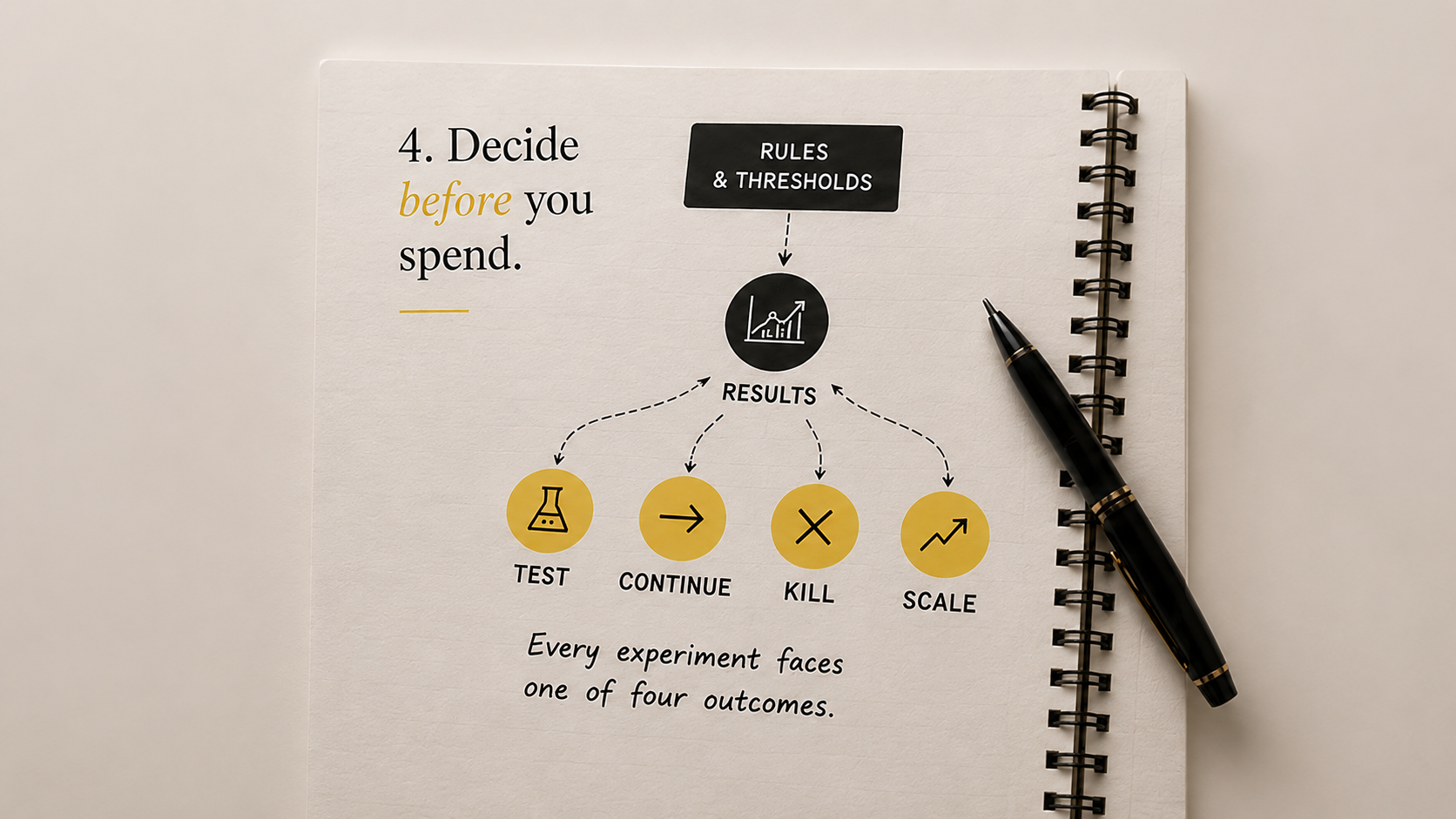
Test. A deliberately small, time-boxed spend built to answer one specific question, with a defined point at which you'll look at the result.
Continue. The result was inconclusive or directionally positive but not yet strong enough to warrant more capital. Keep it running at the same level and gather more data.
Kill. The result answered the question, and the answer was no. Stop the spend and redirect the capital — this is a good outcome, not a failure, because it protected the scale reserve for something that will actually earn it.
Scale. The result cleared a bar you set in advance, and the scale reserve capital is released. This decision should already have criteria attached before the test started, not be negotiated after the fact based on how good the number feels.
Write these rules down before you spend the money, not after. A founder who decides in advance what a good result looks like makes faster, less emotional decisions than one deciding in the moment — and a written rule is also the fastest way to have this conversation with a co-founder, investor, or fractional partner without re-litigating it every time.
The Traction Story Investors Actually Want to See
If there's future fundraising on the horizon, this is where your budget decisions and your pitch deck become the same document.
The fundraising conversation is increasingly about quality of growth, not the amount of activity around it. Founders need to show that they understand what is driving demand, what happens after trial, and whether the economics can hold as the business scales.
What that means in practice: investors are not rewarding the things a founder's dashboard often highlights most proudly.
What they've stopped rewarding: follower counts, impressions, a single viral creator moment, an isolated ROAS screenshot from one good week, or "we grew awareness." None of these tell an investor whether growth is repeatable or rented.
What they're looking for instead depends on the business model, and conflating the two is a common and costly mistake:
For a DTC-heavy business, the relevant evidence is CAC relative to LTV and repeat rate, payback period, and — critically — how much of total growth is coming from paid spend versus organic and repeat demand. Multiple 2026 consumer-investing sources make the same point: investors increasingly discount revenue that's entirely paid-spend-driven, because it tells them nothing about whether the brand can grow without that spend continuing indefinitely.
For a retail-heavy CPG business, DTC-style metrics like CAC and LTV are often close to meaningless — forcing them into a pitch because they're familiar signals investors want elsewhere is a mistake. What matters instead is velocity (units sold per point of distribution per week), repeat and reorder behavior at the retailer level, contribution margin after trade spend, and evidence that a message or promotion that worked in one region or retailer also works in a second one. That last point is what separates a lucky result from a repeatable one.
For most growth-stage brands, the truth sits somewhere between the two, and the strongest traction story acknowledges that directly instead of forcing a single metric to carry the whole pitch.
The version of the story that lands with investors sounds like this: "We know where our growth is coming from, what it costs us to get, what happens after someone tries us for the first time, and where the next dollar of capital would produce the most additional growth." That sentence is worth more in a fundraising conversation than "we spent $50,000 and generated eight million impressions" — because it's the sentence that shows an investor you're already running the capital allocation system they're about to fund the next round of.
A Practical First 90 Days
This is one way to build and evolve the system — not a rigid template, but a sequence that works for a founder starting from scattered spend and no formal process.
Days 1–30: Get honest about where you actually stand. Inventory every current marketing expense — freelancers, tools, creators, paid platforms, samples, events — and write down what business question each one is supposed to be answering. Most won't have one; that's the point of doing this. Establish your baseline economics: current CAC if you have paid history, current gross margin, current repeat rate if you're far enough along to have one. Identify the one or two unanswered growth questions that matter most right now, and design low-cost organic and creator tests to start answering them before committing paid dollars.
Days 31–60: Follow the signal. By now you should have real, if early, data on which messages and audiences are producing a response. Use paid dollars selectively to validate or amplify the strongest of those signals rather than launching new, untested creative. Reuse organic and creator winners as the starting point for paid creative instead of building from scratch. Kill the bets that clearly aren't working — this is where the "kill" rule from earlier gets used for real, and where the discipline of writing the rule down in advance pays off. Document what you're learning in a form someone other than you could read and understand.
Days 61–90: Reallocate and pressure-test. Move real budget — not a token increase — toward the areas that have earned it, using the scale reserve you built in. Test whether the economics hold as spend increases; a message that converts well at $500 doesn't automatically convert the same way at $5,000, and this is where you find out. Watch specifically for diminishing returns, which tell you where the ceiling on a given channel or audience currently sits. By day 90, you should be able to describe your traction story in the terms an investor actually cares about — and you should have a clear, evidence-based view of what deserves the next increment of capital.
The Goal of the First Budget Isn't to Look Like a Bigger Brand
It's tempting to build a first marketing budget that mimics what a much larger, funded competitor is doing — a bit of everything, spread thin, because that's what "real" marketing programs seem to look like from the outside.
That's the wrong goal. The goal of your first marketing budget isn't to look like a bigger brand. It's to learn enough — about your consumer, your message, your channels, and your economics — that your second budget is easier to build than your first one was. Every dollar in that first budget is doing its job if it moves you closer to that outcome, whether the specific test it funded worked or not.
Founders who treat their budget this way don't just spend more efficiently. They walk into their next round of capital, internal or external, with an answer instead of a hope.
Need to turn scattered marketing spend into a real allocation system?
We've sat on the other side of this exact budget conversation — inside PepsiCo and Frito-Lay portfolios, and now embedded directly with growth-stage founders building the same discipline with a fraction of the capital. If you're trying to turn a pile of scattered marketing expenses into a real capital allocation system, that's the conversation worth having.
→ Let's talk: atomos.us/contact