More than 91% of U.S. food and beverage sales still happen in physical stores, according to EMARKETER. Meanwhile, U.S. retail media spending is forecast to reach $74.4 billion in 2026, with retailers selling advertising well beyond the sponsored search placements that first defined the channel.
Put those numbers side by side and the pitch sounds obvious: shoppers buy in stores, so brands should spend more media dollars there. It is an appealing argument, particularly for an emerging brand looking for the next growth lever.
But sales share has never been a media allocation rule. A purchase can happen at the shelf while the decision to buy was made days earlier, through a recommendation, a creator's video, or a familiar brand experience. The location of a transaction is not necessarily the point of persuasion.
For a growth-stage CPG brand, the better first question is not how much retail media to buy. It is what business problem the next dollar is meant to solve. Retail media offers inventory and access to shopper data. Strategy determines whether either is worth paying for.
The channel is growing faster than the choices are getting clearer
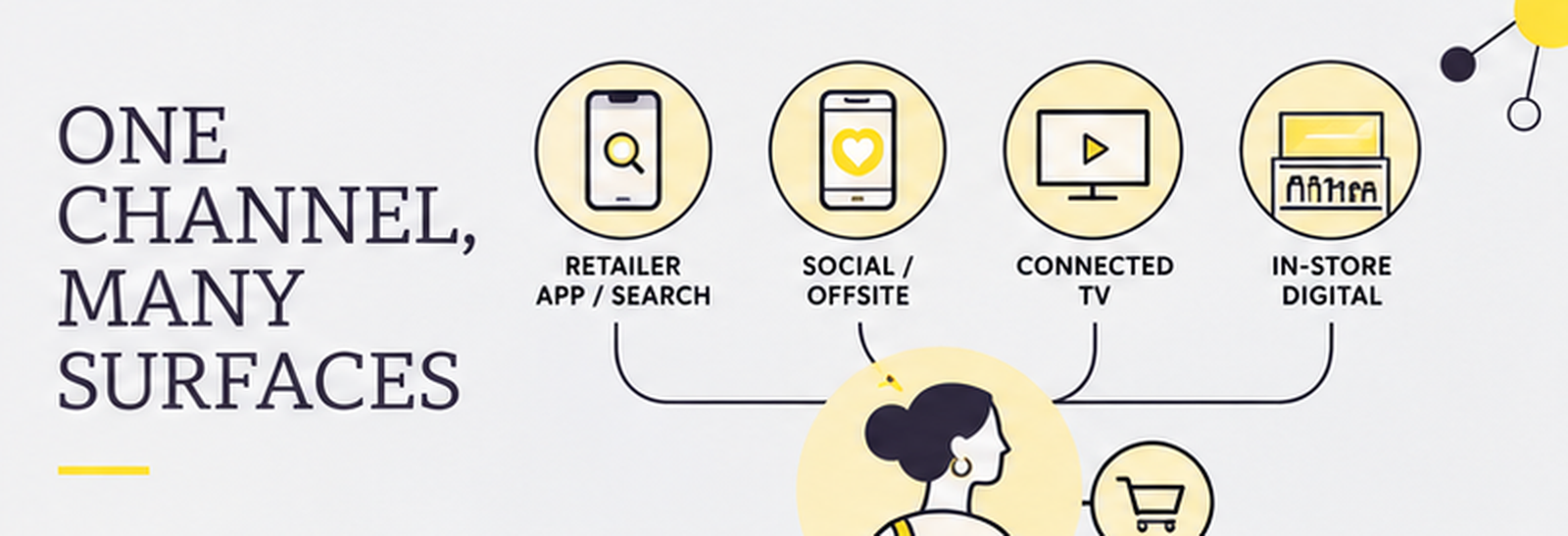
Retail media now extends across retailer websites and apps, off-site advertising informed by shopper data, connected TV, and new surfaces inside physical stores. For a large CPG company, that can create useful ways to build a connected shopper journey. For a smaller team, it creates another set of vendors, formats, budgets, and dashboards to manage.
It is also worth remembering who benefits from that expansion. Retailers have compelling reasons to monetize more of their shopper relationships. In Walmart's fiscal second quarter reported in August 2026, Walmart Connect advertising revenue in the U.S. grew 43% excluding Vizio, while Walmart U.S. comparable sales rose 2.6% excluding fuel. Those are different business measures, not a one-to-one comparison. Together they illustrate how rapidly advertising has become a growth business inside retail.
That does not make retail media a bad investment. It means the offer is designed and sold by a business with its own priorities. A brand still needs an independent answer to a basic question: what will this placement do that the next-best use of our budget cannot?
A store is not just another screen
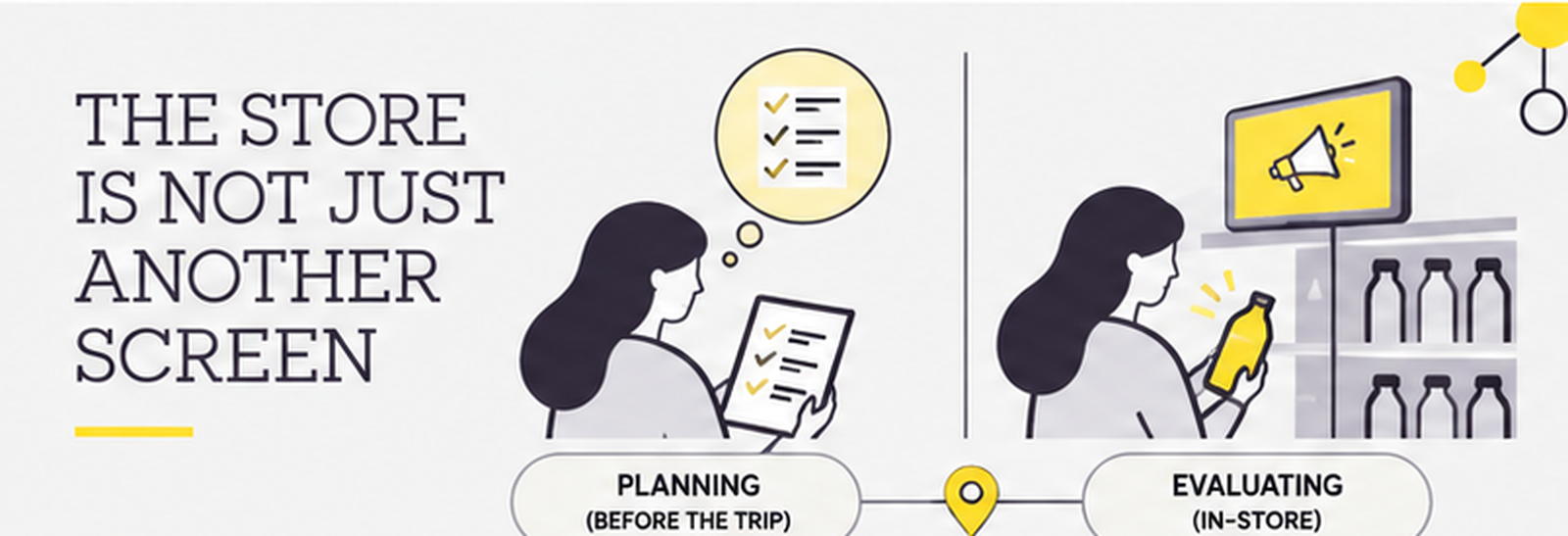
In-store retail media can mean digital endcaps, audio, smart carts, shelf displays, and other placements near purchase. But the shopper at a beverage cooler has a different task from the shopper following a grocery list or browsing an unfamiliar category. Exposure alone tells us very little about whether the message arrived at a useful moment.
Scale is uneven, too. Albertsons announced an expansion of its in-store display network during 2026, while still operating across more than 2,200 stores. A brand's actual distribution has to overlap the retailer's media footprint before an in-store screen is even a relevant option. National market size does not tell a founder whether the right shoppers will see a campaign in the right doors.
This is especially important in Food & Beverage, where the constraint may be household penetration, first trial, price-pack fit, or units per store per week. A retail media placement might support one of those jobs. It cannot substitute for fixing an item that is poorly positioned, hard to find, priced incorrectly, or not earning repeat purchase.
The consumer does not experience your budget silos
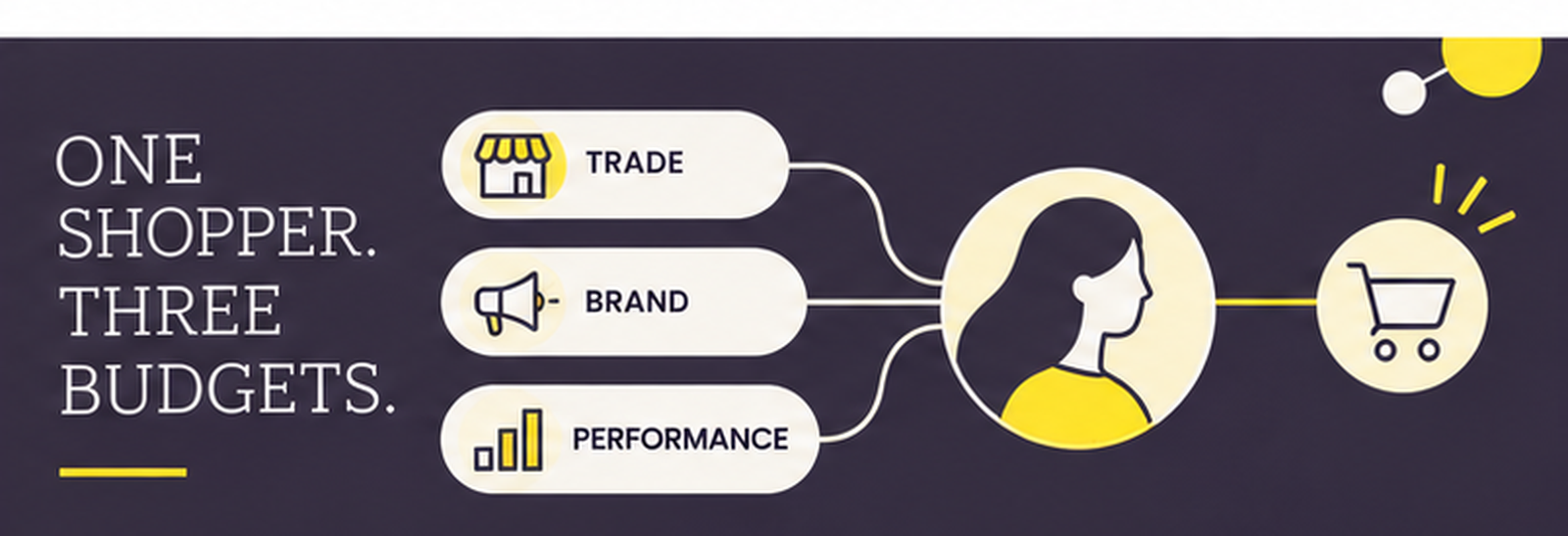
A shopper might encounter a creator's review, a retailer app offer, an in-store display, and the product on shelf in the same week. To that shopper, it is one brand. Inside the business, those touchpoints may be split between trade marketing, shopper, sales, performance media, and brand teams, each optimizing a different scorecard.
In an enterprise organization, those silos are difficult but visible. At a Series A or B brand, the problem can sit inside a much smaller group: a founder, a sales lead, and a marketer making different commitments against the same limited budget. The risk is not simply overlap. It is that no one owns the trade-off between improving retail execution, generating trial, and buying another media package.
Some spending is also part of a broader retailer relationship. A campaign may support a launch or signal commitment to an important account. That can be a valid commercial choice, but it should be evaluated as such. If the real goal is retailer confidence or distribution support, calling the result a pure consumer-acquisition investment only hides the decision.
A return on ad spend is not the whole answer
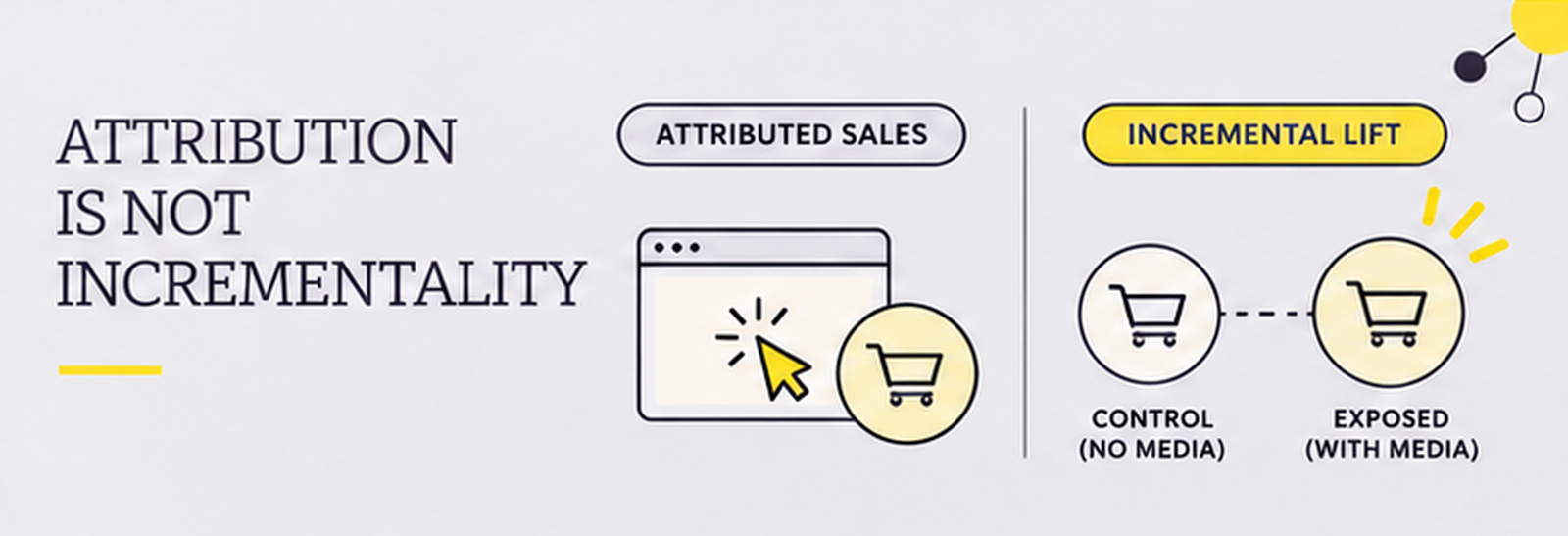
Retail media's appeal has always included closed-loop measurement: a retailer can link exposure to transaction data in ways many other channels cannot. But attribution and incrementality are different questions. Attribution connects an impression and a sale. Incrementality asks what would have happened without the ad. Neither automatically tells a brand what it gave up by choosing that investment.
Albertsons offers an instructive example. In a Mondelēz campaign for Sargento Cheese Bakes, its matched-market analysis reported a 14% in-store sales lift and a $2.41 incremental return on ad spend. That is meaningful evidence that retail media can play a role in driving sales. It is not proof that every brand should buy in-store screens. The campaign also used onsite and offsite placements, and the measurement was conducted through the retailer's own media business. The results should be read in that context.
Even a positive incremental return is not the end of the budget conversation. Revenue return is not profit, and a good channel-level result may still be less valuable than addressing a more urgent constraint in distribution, sampling, pricing, or repeat. Better measurement helps answer whether something worked. Leadership must still decide whether it was the right thing to do.
Four questions to answer before buying retail media
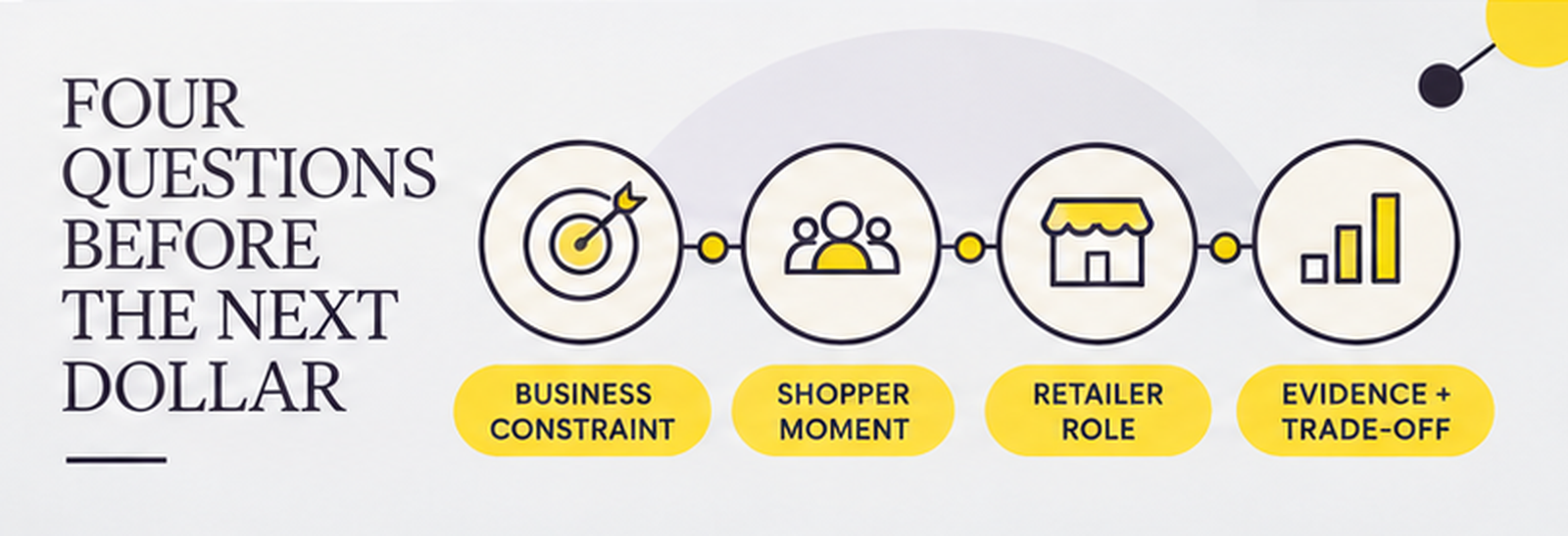
1. What business constraint are we solving? Define the primary job: awareness, trial, shelf conversion, velocity, repeat, launch support, or retailer confidence. If the brief promises to solve all of them, it is not yet a decision. The answer should shape the channel, creative, and success metric.
2. Where does the shopper make the decision? For one category, discovery happens before the store; for another, the shelf and price-pack do much of the work. Choose the moment you need to influence, then decide whether onsite search, offsite media, sampling, an in-store placement, or a different intervention is the right lever.
3. What role does this retailer play in our growth? A retailer can be the core volume driver, a launch partner, a strategic expansion account, or a relatively small test market. Those roles call for different commitments. The plan should reflect both the brand's economics and the retailer relationship, not a generic media package.
4. What evidence will change our decision—and what are we not funding? Agree in advance what would lead the team to scale, adjust, or stop. Use holdouts or matched-market testing when feasible; examine incrementality and contribution economics, not only attributed revenue. And write down the alternative use of the dollars. Opportunity cost belongs in the brief, not only in the postmortem.
Those four questions turn retail media from another channel on a plan into a portfolio of explicit, testable bets. They also expose when a brand should not buy the placement yet.
The job of the next dollar
The store is becoming a media channel. That can create real opportunities for CPG and Food & Beverage brands, particularly when inventory reaches shoppers at a meaningful decision point. But more screens, more retailer data, and better dashboards do not create a growth strategy. They create more options.
The advantage belongs to the brand that knows which choice matters most right now. When marketing leadership aligns the consumer problem, retailer economics, execution, and measurement, retail media can amplify a strong plan rather than become a substitute for one.
Before you buy another placement, ask a more useful question: what job is this dollar supposed to do? If your team needs senior marketing leadership to make those trade-offs, explore how átomos works with growing CPG and Food & Beverage brands.
ÁTOMOS — FRACTIONAL CMO FOR FOOD & BEVERAGE
We bring big-CPG playbooks to growing food and beverage brands.
We embed inside your business, read your category the way large CPG does, and help you move with clarity and speed — without the full-time cost.
→ Let's talk: atomos.us/contact
-
Advertising sold by retailers in or immediately around their physical stores, such as digital screens, in-store audio, smart carts, and digitized displays. It is one component of the broader retail media ecosystem.
-
Potentially, but only after identifying the specific business constraint, the shopper moment, the relevant retailer footprint, and an appropriate measurement plan. Retail media should compete with other investments for the same budget.
-
No. Return on ad spend compares attributed or incremental revenue with advertising cost, depending on the methodology used. Incrementality estimates the additional outcome caused by an intervention relative to what would have occurred without it.
-
Choose metrics that reflect the job to be done: new-to-brand buyers and trial for acquisition, sales per store for velocity, repeat purchase for retention, or incremental contribution for commercial efficiency. Where possible, use test-and-control designs and include profit and opportunity cost in the investment decision.