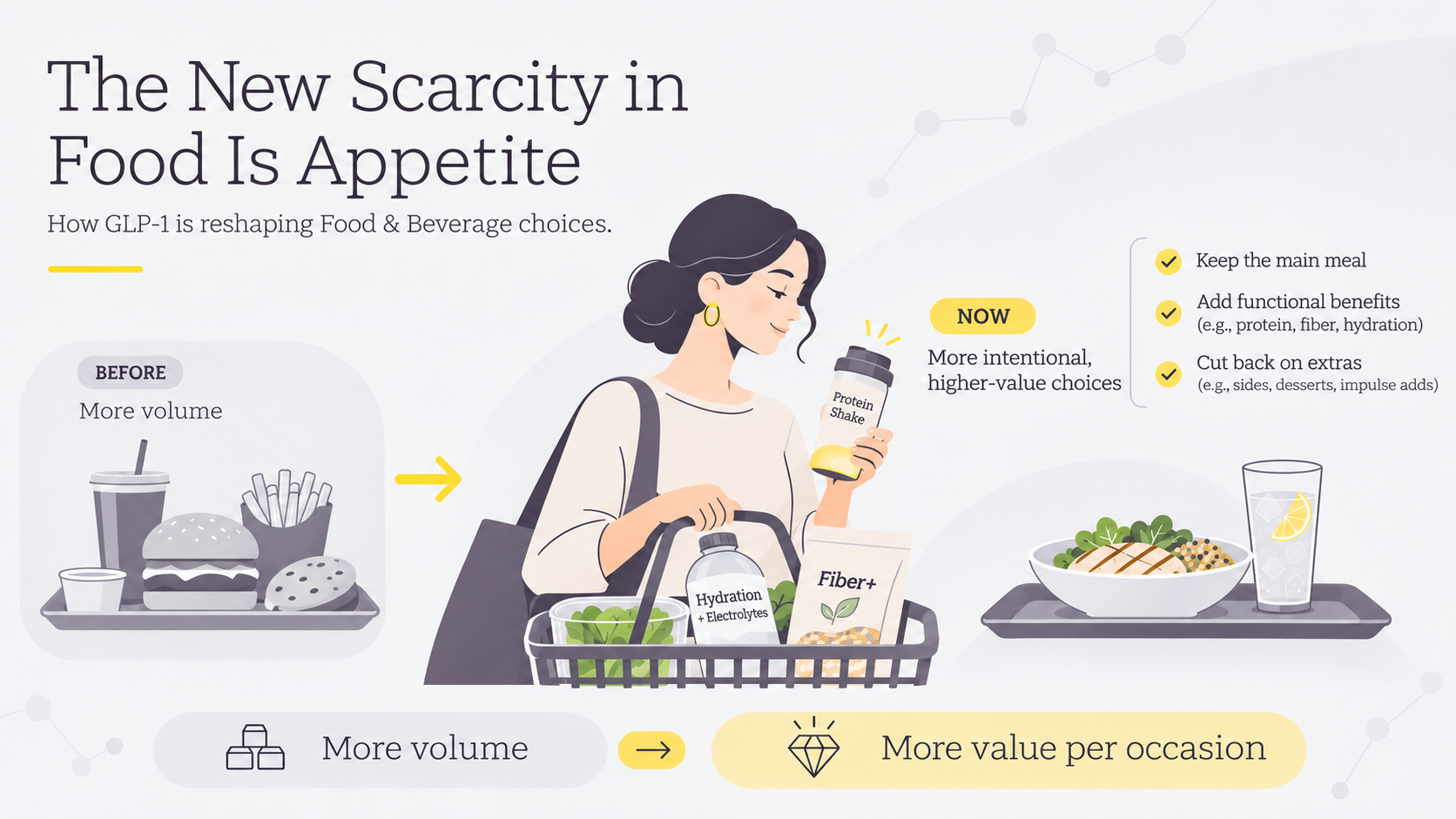
The main dish may stay on the order. The fries and second drink may not.
That sounds like a small change until you consider how many food and beverage businesses count on the extra item.
GLP-1 medications, prescribed for diabetes and weight management, can reduce appetite and cravings. Much of the public conversation has focused on how many calories people will stop eating. For food brands, the more important question is what happens to the purchases that once felt automatic.
A peer-reviewed Journal of Marketing Research study led by Cornell researchers found that households adopting GLP-1 medications spent 5.3% less on groceries within six months. Spending on savory snacks fell 10.1%. And in EY-Parthenon’s 2026 survey, users reported fewer snacks and more protein, produce and functional beverages. One study looks at actual transactions; the other asks people about their behavior. The methods differ, but the direction is telling.
This is no longer a fringe consumer behavior. A late-2025 KFF poll found that 12% of U.S. adults were currently taking a GLP-1 for weight loss or a chronic condition. Not every shopper is affected in the same way, but the group is large enough that food and beverage leaders should pay attention.
The emerging challenge is not simply to sell fewer ounces. It is to understand what consumers still choose when they have less appetite for everything else.
The basket changes before the occasion disappears
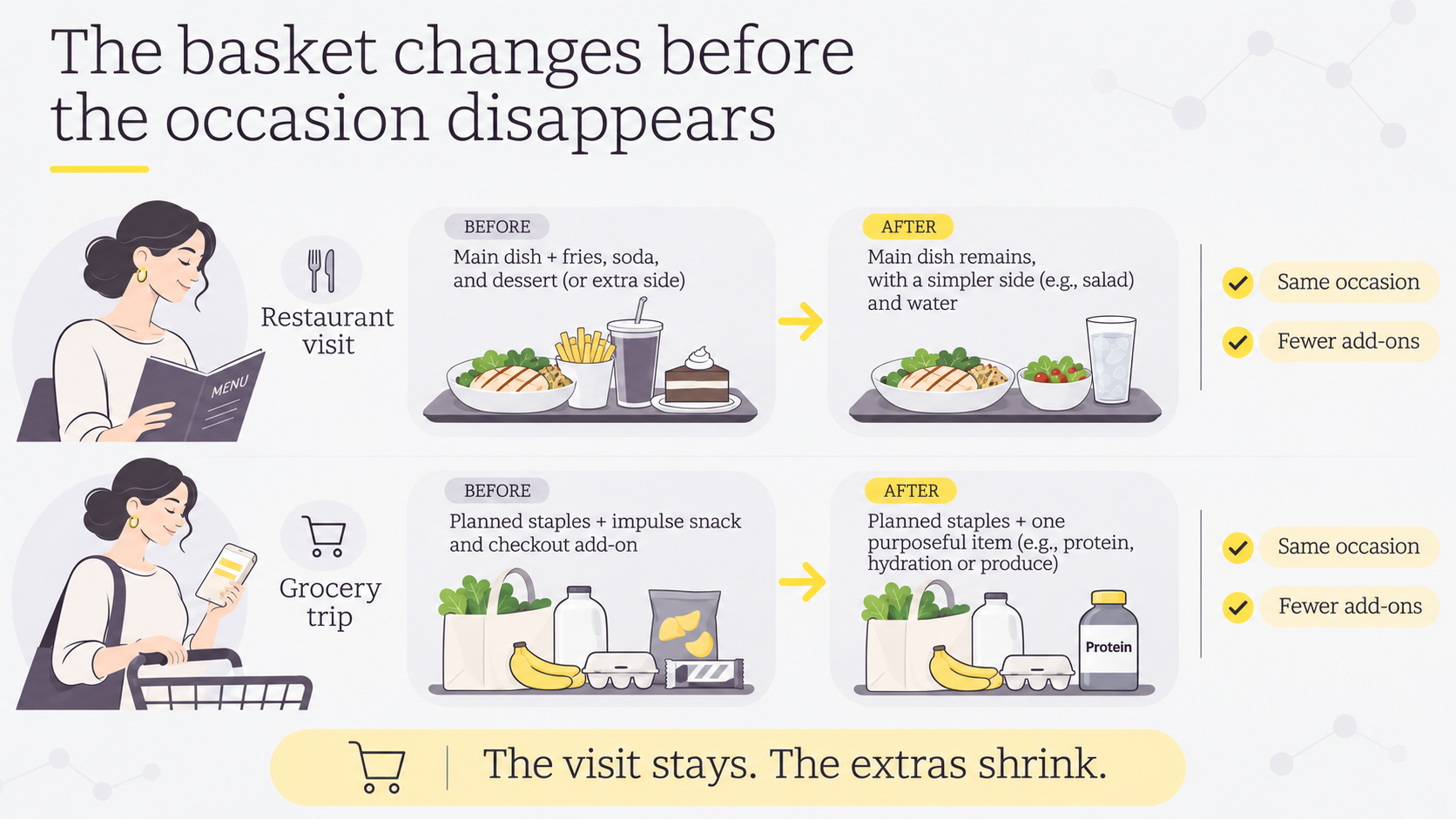
Consider the restaurant visit. Circana’s January 2026 research found that GLP-1 users kept visiting restaurants at relatively steady rates during their first year on treatment, but ordered about 1% fewer items per trip. Main dishes held up better than sides, snacks and breads, while alcohol orders came under pressure.
A separate Cornell-led analysis found spending at fast-food chains, coffee shops and other limited-service restaurants fell 8% after GLP-1 adoption. Those are different measurements from different studies. Taken together, they suggest a restaurant can keep the customer and still lose some of the sale.
That matters beyond foodservice. Imagine a grocery shopper who still buys breakfast and dinner essentials but passes on the unplanned snack or the drink added at checkout. This is a hypothesis brands need to test against their own purchase data, not a universal outcome proven by the restaurant research. But it is the right question to investigate.
It may also change whom a brand competes with. If someone chooses a functional beverage instead of soda, or yogurt instead of a sweet snack, the real competition is not limited to products in the same aisle. It is whatever product best meets the need in that moment.
More protein is not the whole strategy
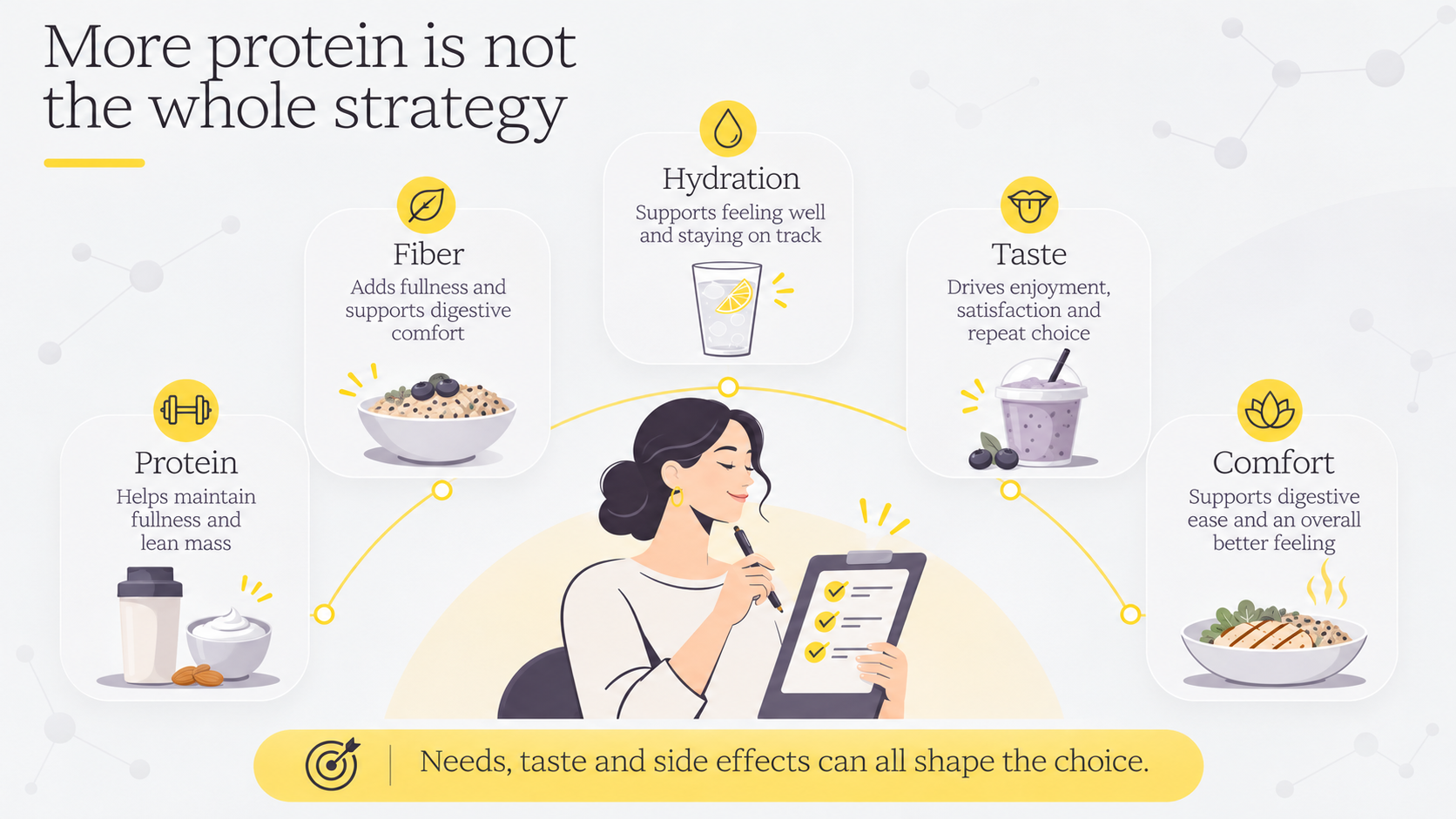
The shift toward nutrition is visible in the research. In EY-Parthenon’s 2026 survey, 63% of GLP-1 users said they ate fewer sweet snacks and 57% fewer salty snacks. At the same time, 61% said they consumed more protein and 44% more functional beverages. Numerator’s purchasing panel found that weight-loss-focused GLP-1 users spent 38% more on protein shakes than comparable non-user households.
It would be easy to read these numbers and conclude that the answer is simple: add protein, shrink the portion and put a GLP-1 claim on the package.
But what is the customer actually looking for?
For one person, it might be enough nutrition in a portion they can comfortably finish. For another, the reason to choose a product may be convenience, great flavor or a small treat that feels worth having. Less appetite does not automatically mean less interest in pleasure, taste or food culture.
A smaller package is not a growth strategy by itself. Nor is a protein claim. Food brands need to understand which benefit makes the product relevant, and whether people will buy it again. The evidence does not yet establish that GLP-1 users will consistently pay more per ounce for smaller formats, so that opportunity needs testing rather than assumption.
Protein may be getting most of the attention, but fiber belongs in this conversation, too. At átomos, we've helped clients incorporate fiber into their product offerings. That experience reinforces an important product-development principle: useful nutrition has to work alongside taste, convenience and the overall experience—not simply become another claim on the package. In the context of GLP-1, it raises a practical question for brands: how can we deliver meaningful benefits in a portion someone actually wants to finish?
What major food companies are testing
The largest CPG companies are already experimenting with different answers. Their choices are instructive, even though public data is not yet sufficient to call every launch a commercial success.
Conagra took the simplest route. Its Healthy Choice brand added an “On Track” badge to 26 existing products, helping shoppers identify options aligned with its nutrition criteria without first changing the recipes. Nestlé went further with Vital Pursuit, a frozen-food brand built around portion size, protein and other nutritional needs relevant to consumers using weight-management medication.
Danone designed a compact product with a specific job to do. Oikos Fusion delivers 23 grams of protein and 5 grams of prebiotic fiber in a seven-fluid-ounce drink. PepsiCo’s Propel Clear Protein, launched in 2026, combines 20 grams of protein with fiber and electrolytes in a 90-calorie serving.
These are different responses to the same underlying challenge: make a product useful enough to be chosen when consumers want less. One brand makes an existing benefit easier to recognize. Another changes the portion. Others combine benefits in a compact format.
For emerging brands, the lesson is not to copy a large company’s latest product. It is to understand the consumer need well enough to decide whether the right response is clearer positioning, a better format, a reformulation—or no product change at all. The launches show where companies are investing, not yet which bets will deliver superior repeat purchase, sales or margin.
GLP-1 is also changing the conversation at retail
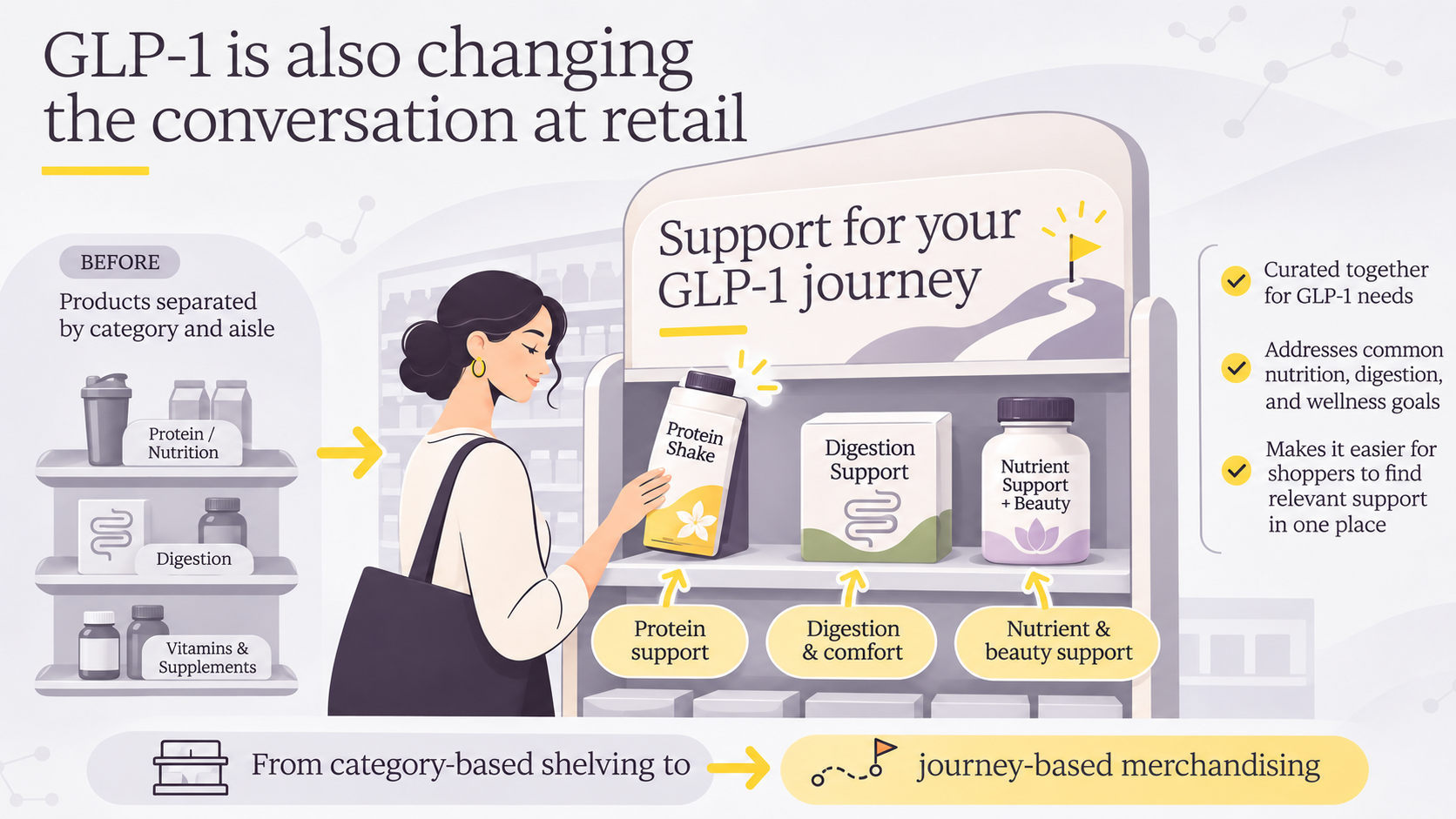
A sign spotted at a Walgreens store in November 2026 read, “Support for your GLP-1 weight-loss journey.” It featured a Premier Protein shake, Tums Chewy Bites and a hair-growth supplement. These are products from different categories, yet the retailer's message brought them together around one consumer journey rather than one traditional aisle.
One in-store sign does not establish a nationwide strategy or prove that this approach drives sales. But it offers a concrete example of how GLP-1 could influence not only what companies make, but also how products are presented and discovered. For food and beverage brands, the opportunity may be as much about making an existing benefit easy to recognize as inventing something entirely new.
Four questions emerging food brands should ask now
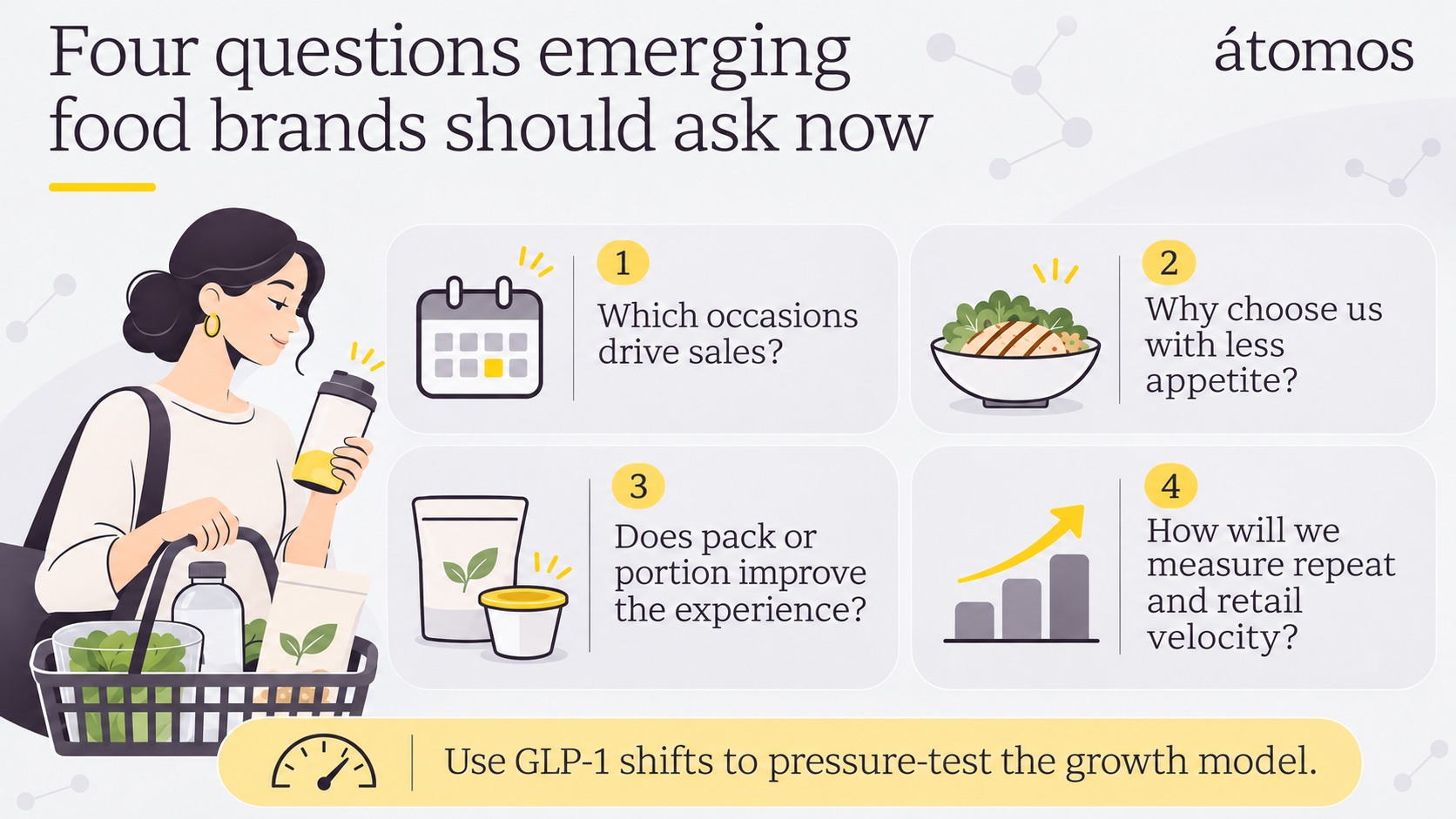
A growth-stage company does not have unlimited room for trial and error. Before committing money to a new SKU, package or claim, leadership teams can use the GLP-1 research to pressure-test four assumptions.
1. Which eating and drinking occasions actually drive sales?
Think in everyday moments, not just product categories: a quick breakfast, a midafternoon snack, a drink with lunch, a treat on the way home. Which are planned purchases, and which depend on consumers buying something extra? If most growth comes from frequent, low-consideration snacking, that deserves a closer look. Do not assume every snack or drink faces the same risk.
2. Why would someone choose our product with less appetite?
Ask consumers what they would keep buying if they wanted smaller portions or fewer eating occasions. Is your advantage taste, convenience, protein, hydration, comfort or something else? If the answer is unclear, a new nutritional claim will not solve the underlying positioning problem. Talk to consumers before investing in a formulation change.
3. Could a different pack or portion make the product more useful?
Test a smaller pack, a single-serve option or a different product format only when it solves a real need. Compare not just the price per ounce, but whether people feel satisfied, buy again and consider the product worth the money. A smaller package with no additional benefit is likely to feel like paying more for less.
4. How will we know whether it works?
Look beyond social buzz or first-week sales. Track trial (who buys once), repeat (who comes back) and retail velocity (units sold per store per week), alongside margin and feedback from actual shoppers. For brands sold through retailers, this is also a conversation with buyers about which products are gaining or losing space in the basket.
These are not entirely new brand-building questions. GLP-1 makes them harder to ignore by challenging assumptions about how much people want, how frequently they buy and which products earn a spot in their day.
The GLP-1 customer is not one fixed consumer
Brands also need to plan for behavior changing over time. A JAMA Network Open study of more than 125,000 U.S. patients with overweight or obesity found that 53.6% discontinued GLP-1 treatment within one year, although some later restarted. Numerator observed that candy and baked-goods purchases often rebounded within three to six months after treatment stopped, while higher spending on fresh produce and meat tended to persist.
A person taking GLP-1 for diabetes may have different goals from someone using it primarily for weight management. Someone starting treatment may also buy differently from someone who has used it for months or stopped. “GLP-1 users” is too broad to be the only consumer segment guiding a brand’s strategy.
The stronger long-term opportunity may be to solve needs that remain relevant beyond any medication: satisfying portions, genuinely useful nutrition, convenience, good taste and a clear reason to choose the product again.
The growth question has changed
For decades, food and beverage companies have pursued growth by expanding occasions, increasing frequency and earning the extra item in the basket. Those levers will not disappear. But GLP-1 is a reminder that the consumer, not the growth plan, decides how much an occasion can hold.
Brands that respond well will not start with a claim. They will start with evidence: what people are choosing, why they are choosing it and what they are leaving behind. Then they will use those insights to make better decisions about products, packs, positioning and how to measure growth.
If your customer wanted less food overall, what would make your product one of the things they still chose?
At átomos, we help growth-stage food and beverage teams turn shifts in consumer behavior into clear brand and business decisions. If your portfolio is facing that question, let's talk.
-
A Cornell-led study found that grocery spending fell 5.3% within six months of adoption among households with a GLP-1 user. The effect varies by category and can change as treatment continues or stops.
-
No. Research shows pressure on some sweets, salty snacks, soft drinks and alcohol purchases, while demand for protein and functional options increases. Each brand needs to assess its own consumer, occasions and reasons to buy.
-
Not automatically. First test whether consumers need a different portion, stronger benefit, clearer positioning or entirely new product. A medication-specific claim is not a substitute for consumer insight.
-
Alongside sales and distribution, watch trial, repeat purchase, units sold per store per week (retail velocity), margins and which occasions the product wins. Those measures reveal more than trend-driven awareness alone.
ÁTOMOS — FRACTIONAL CMO FOR FOOD & BEVERAGE
We bring big-CPG playbooks to growing food and beverage brands.
We embed inside your business, read your category the way large CPG does, and help you move with clarity and speed — without the full-time cost.
→ Let's talk: atomos.us/contact