When a CMO search starts to feel too long, the frustration usually is not with the search itself.
It is with everything the business still needs to decide while the seat is open.
Retail resets arrive on schedule. An agency scope needs approval. The annual plan is half-built. A launch needs someone to say yes or no. The team still needs direction, and sales, finance and operations still need a senior marketing counterpart. For omnichannel CPG brands, retailer timing, e-commerce performance and DTC spend do not pause for the search.
A good search for a permanent marketing leader is worth doing properly.
The mistake is assuming the company has to wait for the outcome before anyone senior can own marketing again.
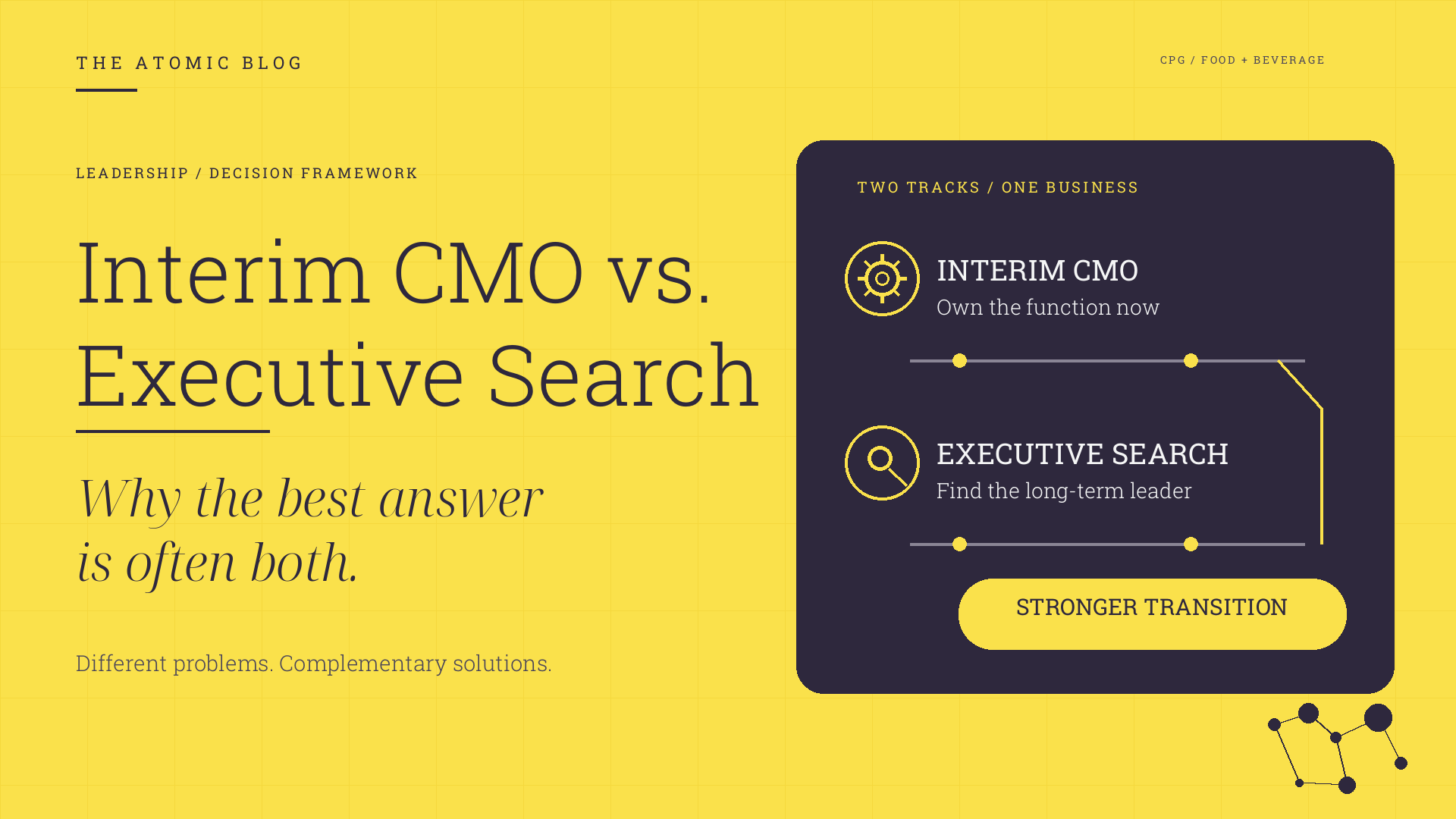
A search firm solves a hiring problem. An interim CMO solves an operating problem.
The roles are different by design.
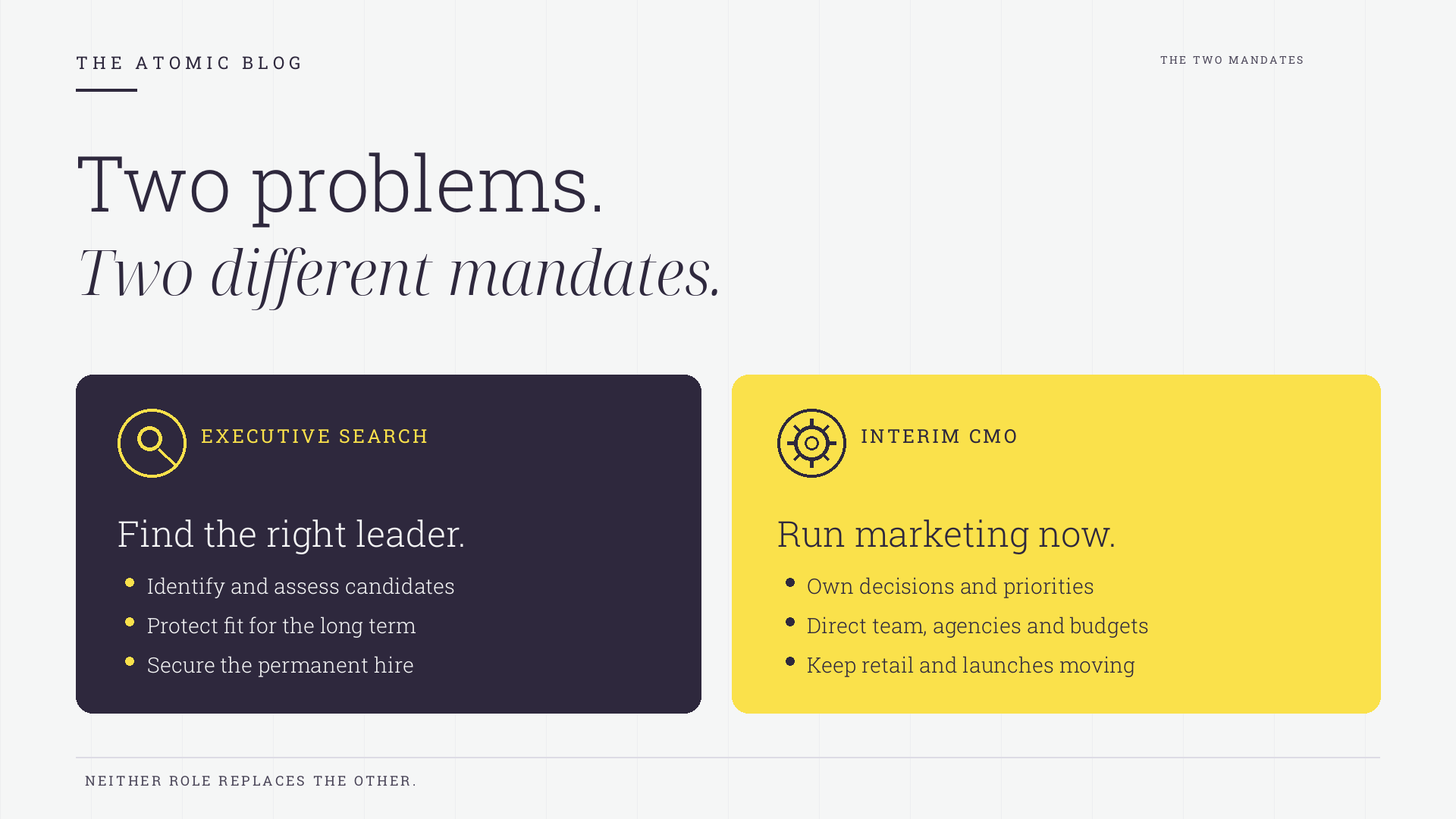
An executive search partner is responsible for identifying, assessing and helping secure the right long-term leader. That requires a strong candidate network, disciplined evaluation and patience around fit.
An interim marketing executive has a different job: run the function while that process happens.
That means making day-to-day decisions, directing the team, managing agencies and budgets, keeping launches and retail priorities moving, and maintaining alignment with sales, finance and operations.
Neither role substitutes for the other.
A search firm cannot approve the promotional plan. An interim leader should not turn a temporary mandate into a permanent strategy built around their own preferences.
When companies treat the two as alternatives, they create a false choice: wait for the perfect hire with no one steering, or rush the hire because the operating pressure has become uncomfortable.
What starts to break when the vacancy lasts?
Leadership gaps rarely fail all at once.
The first signs are usually small.
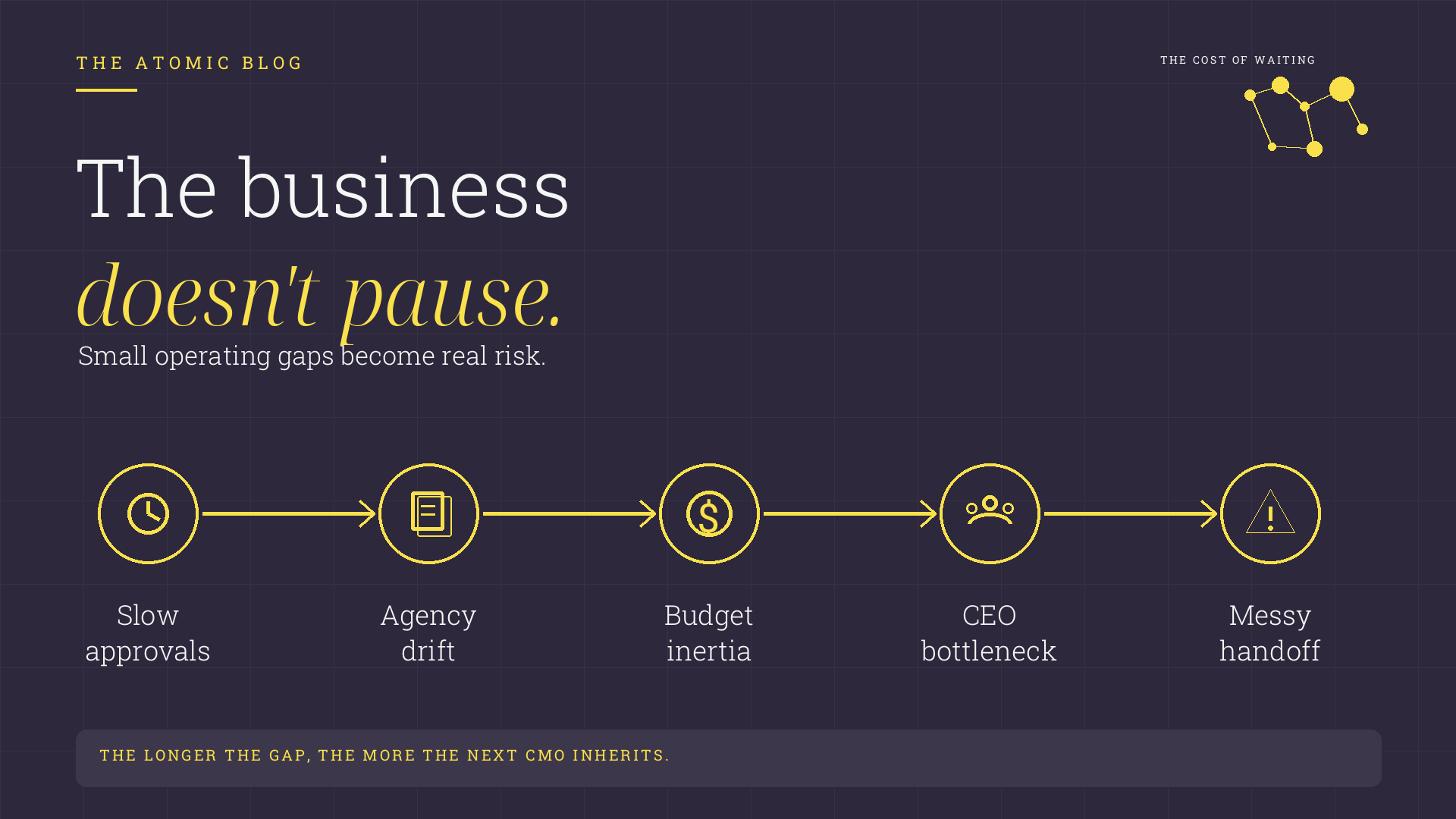
Approvals take longer because no one knows who can make the call. Agencies keep moving but the brief gets less clear. Budget continues to spend because stopping it would require a decision. Sales starts escalating directly to the CEO. Strong team members take on more responsibility but do not always get more authority.
The CEO gradually becomes the accidental head of marketing.
That can work for a short period. It becomes expensive when the CEO is now reviewing creative, mediating agency decisions, resolving cross-functional tension and carrying responsibilities that should sit with a senior marketing leader.
The longer the gap continues, the more of the new executive’s first months get pre-spent.
Instead of entering a stable function and setting direction, they inherit unclear priorities, accumulated decisions, agency friction and a team that has been operating around the vacancy.
Interim leadership and executive search should inform each other
A strong interim leader should not sit beside the search process as an unrelated workstream.
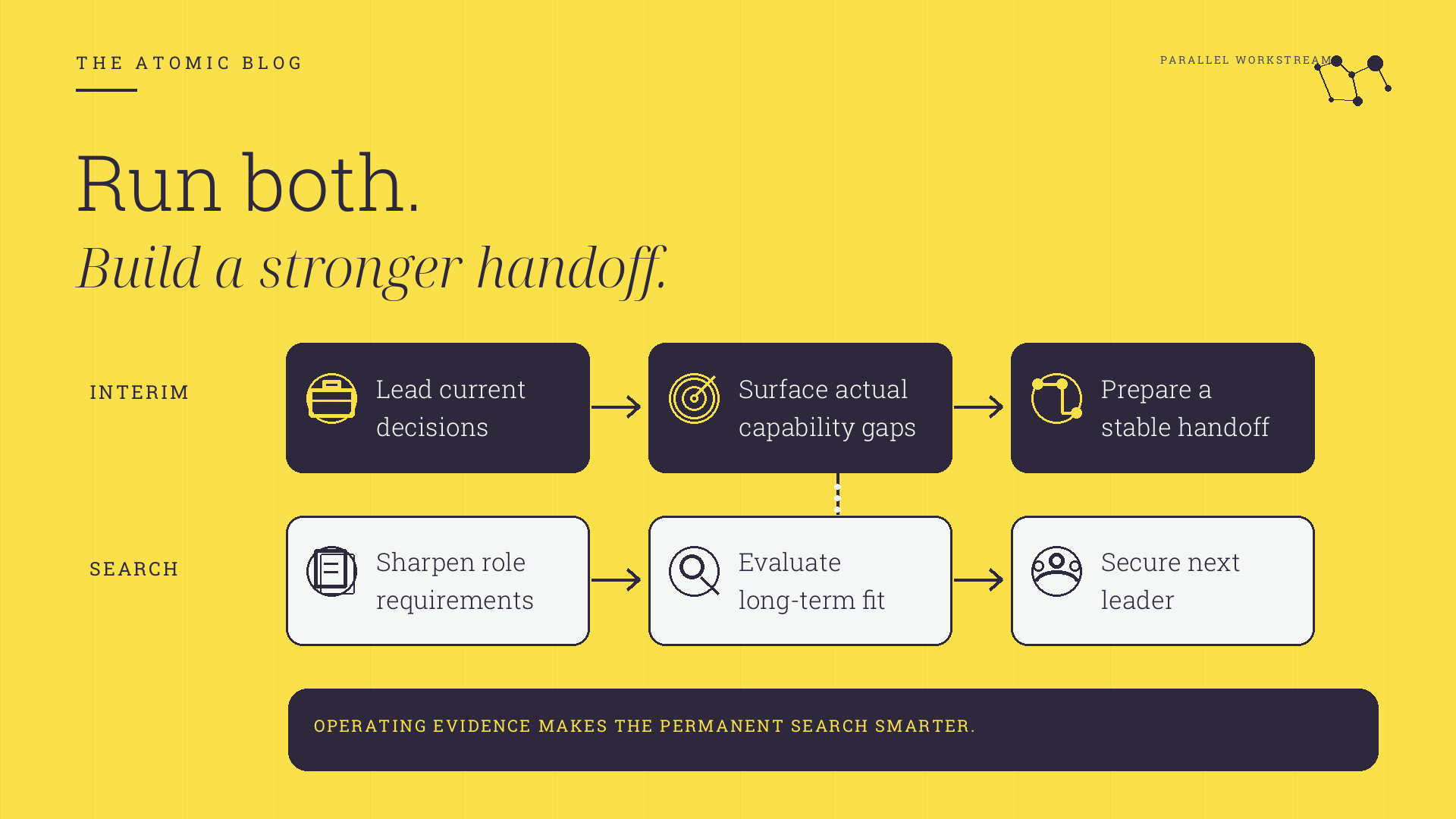
They can make the search better by giving the CEO a more current view of what the role actually needs.
The departing leader’s job description may say “brand builder.” The business may now need stronger commercial partnership, demand generation, portfolio discipline, operating systems—or a different combination of those capabilities.
An interim leader working inside the function can surface those needs from the work itself.
They can help sharpen the role brief, pressure-test the operating questions finalists will face and make the organization more ready for the incoming executive by clarifying roles, agency structures and open decisions.
The search firm and CEO still own the hiring decision.
The interim leader provides operating evidence that makes that decision more informed.
What should the interim leader actually own?
Ownership should be explicit.
In most cases, the interim marketing executive should hold decision accountability for the current function: active launches, retailer commitments, agency direction, budget management, team priorities and cross-functional marketing decisions.
What they should not own by default is the permanent leader’s future.
The interim mandate is to protect momentum, fix what is clearly broken and preserve options—not lock the next executive into long-term bets they did not help shape.
That distinction matters.
It is also what separates true interim leadership from fractional advisory support. Fractional support can provide senior perspective on a recurring basis. An interim executive temporarily holds the seat and is accountable for the decisions that come with it.
The question is not whether the company needs advice. It is whether the open role still needs an owner.
When does interim coverage make sense?
Not every leadership gap requires an interim CMO.
The CEO can reasonably bridge the vacancy when the search is likely to be short, the team has strong functional leaders who can operate independently, the calendar is relatively light and the CEO has both the marketing judgment and the bandwidth to cover the decisions that remain.
Interim coverage becomes more useful when the business cannot wait quietly.
That usually means active launches or retailer windows, an upcoming budget or planning cycle, agencies that need senior direction, decisions stacking up without a clear owner, a team that needs leadership rather than coordination, or a permanent role that needs to be redefined before the search can be sharp.
The point is not to add another layer.
It is to keep the marketing function accountable while the permanent hiring process takes the time required to find the right person.
A strong interim period should improve the eventual handoff
The best outcome is not simply that nothing broke while the search ran.
The function should be easier to inherit.
That means the incoming CMO can see what is committed, what is flexible, what is working, what is not, where the team is strong, where the gaps are, how agencies are structured and which decisions were deliberately left open for them.
A more organized function also gives the permanent candidate a clearer picture of the mandate they are considering.
The interim leader should leave behind context, not territory.
A practical decision framework for CEOs
If you are deciding whether to run interim leadership alongside an executive search, ask four questions:
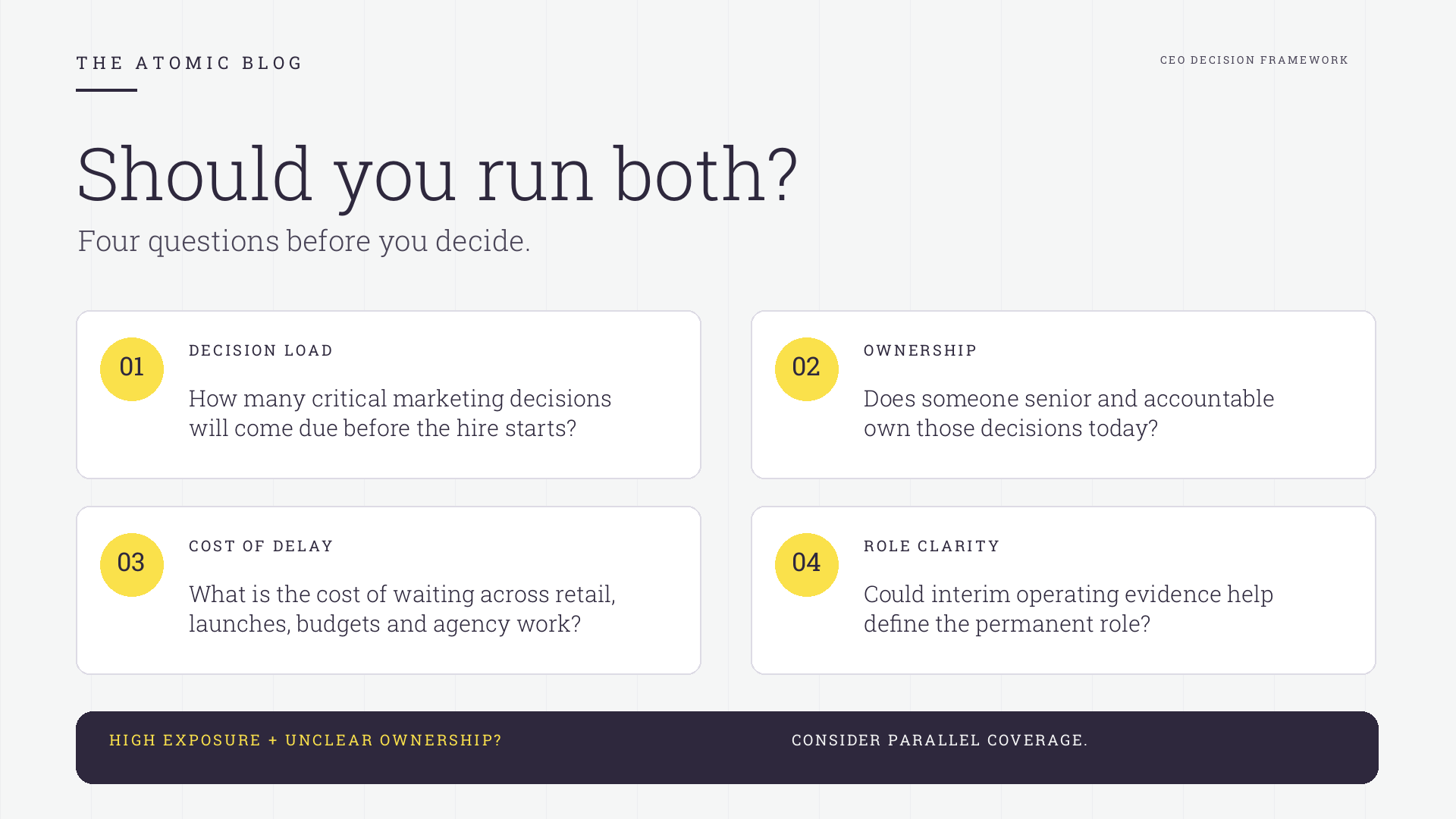
• How many consequential marketing decisions will come due before the permanent leader is likely to start?
• Does someone senior and accountable own those decisions today?
• What is the cost of delay in launches, retail windows, budget choices, agency performance or team stability?
• Would operating the function for the next several weeks reveal something important about what the permanent role should actually be?
If decision exposure is high and ownership is unclear, the two processes should probably run in parallel.
The search answers: Who should lead marketing next?
Interim leadership answers: Who is accountable for marketing until then?
Those are different questions. Strong companies solve both.
If your CMO search is underway but the business cannot pause, átomos can help assess whether interim leadership coverage makes sense and what the temporary mandate should own.
ÁTOMOS — FRACTIONAL CMO FOR FOOD & BEVERAGE
We bring big-CPG playbooks to growing food and beverage brands.
We embed inside your business, read your category the way large CPG does, and help you move with clarity and speed — without the full-time cost.
→ Let's talk: atomos.us/contact
-
Yes. They solve different problems. The search identifies the long-term leader while the interim executive owns current decisions, execution and team direction until that person starts.
-
Not when the mandate is clear. The interim leader should support role definition and organizational readiness without owning the final hiring decision or locking in long-term choices that belong to the permanent executive.
-
Interim leadership temporarily holds the seat with decision accountability across the function. Fractional support usually provides senior leadership or advisory capacity on a defined recurring cadence without necessarily taking full ownership of the open role.
-
CEO coverage can work when the gap is short, the team is experienced, the calendar is light and the CEO has the bandwidth and marketing judgment to make the necessary decisions without becoming a bottleneck.
-
Avoid treating the temporary role as permission to redesign the company around personal preferences. Protect momentum, fix exposed problems, clarify the system and preserve meaningful strategic choices for the incoming permanent leader.