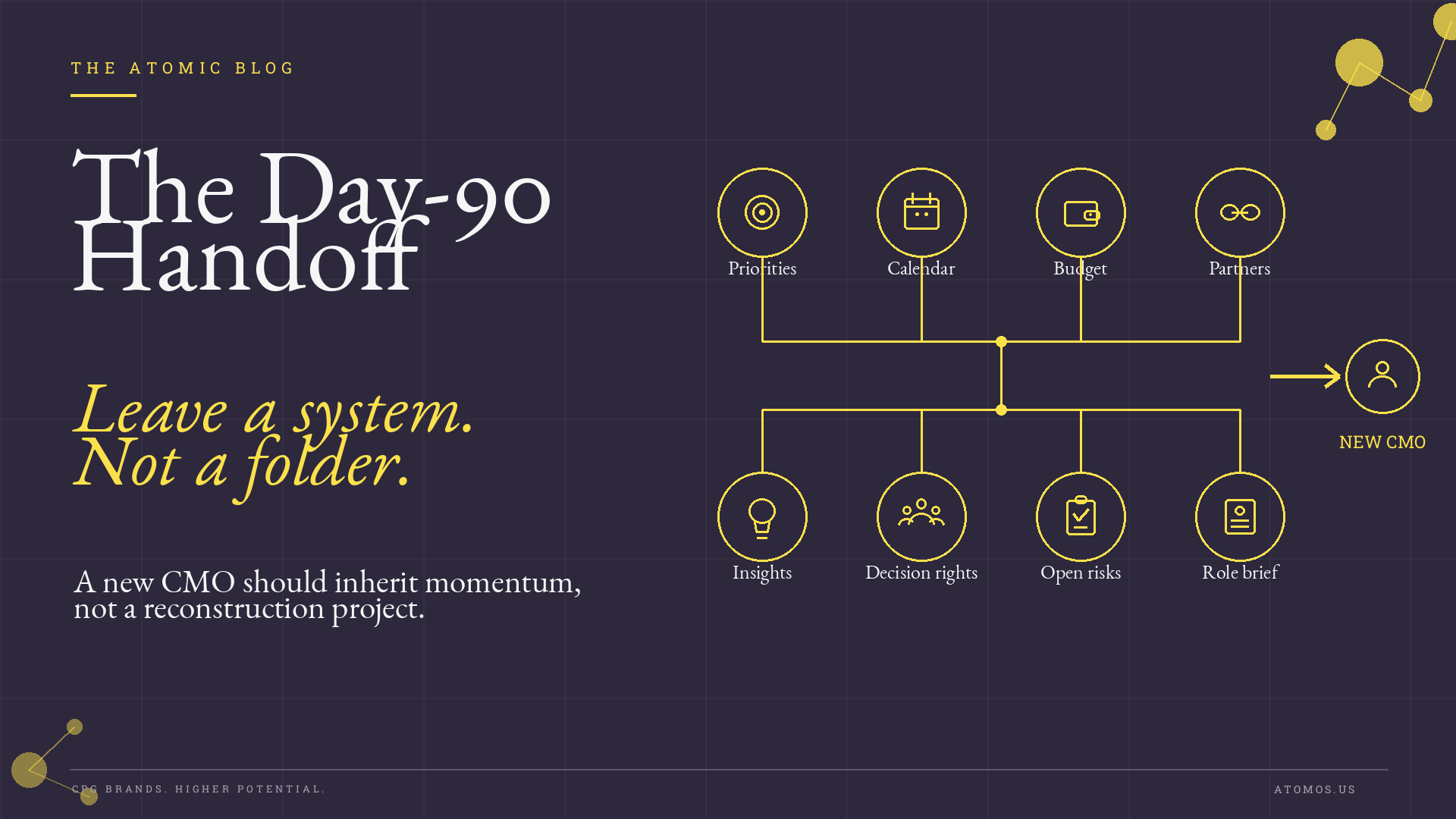
A new CMO should inherit momentum, not a reconstruction project.
Too often, the permanent executive arrives to find a set of slides, a list of agencies, a calendar with missing context and a vague sense of what is “in flight.” Their first quarter then goes to rebuilding the history of the function before they can lead it.
A strong interim marketing engagement should end differently.
The real handoff is not a presentation. It is the moment when the business no longer depends on the interim leader being in the room to understand priorities, make decisions or know why the system works the way it does.
That is what the Day-90 handoff should test.
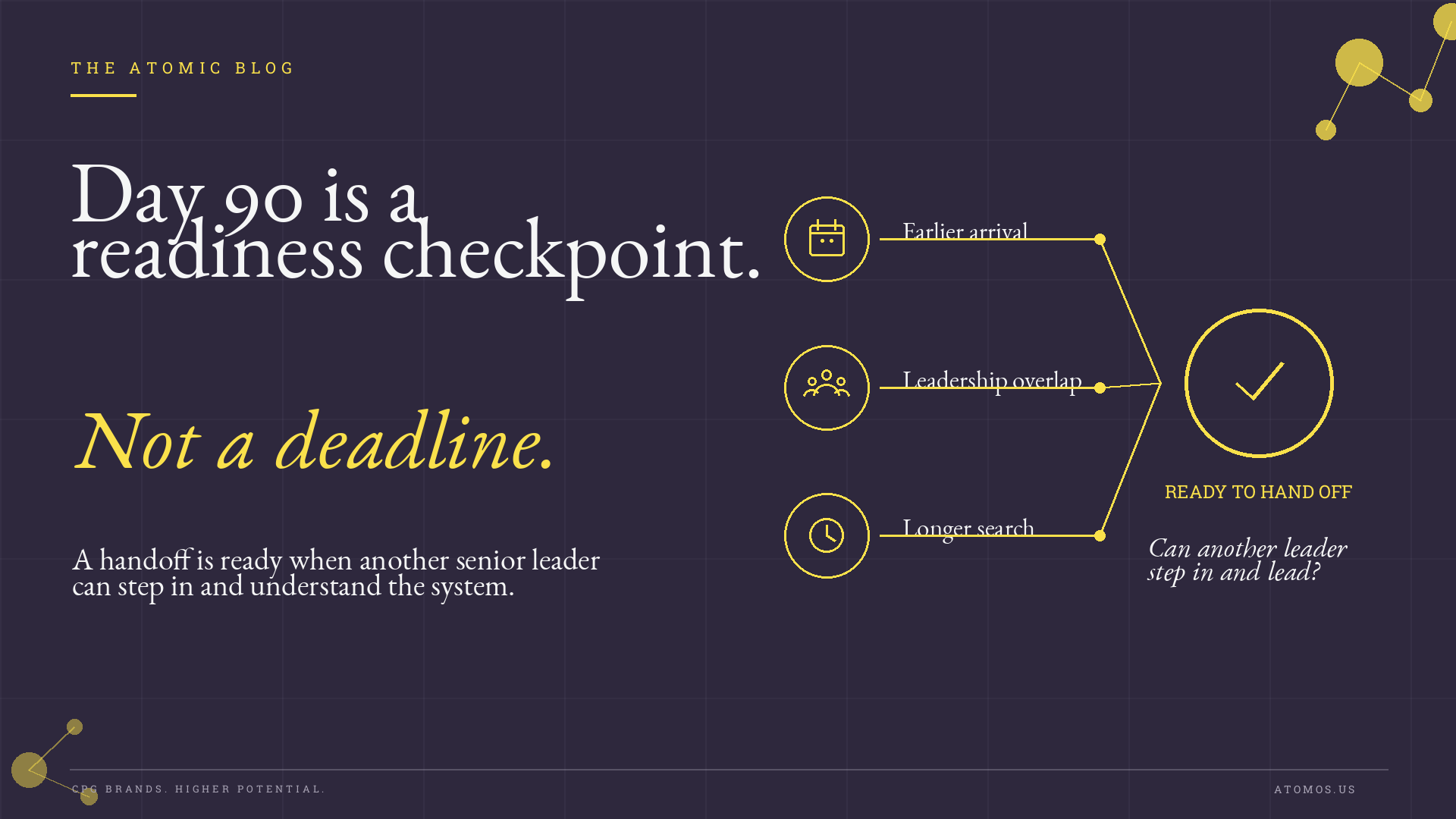
Day 90 is a readiness checkpoint, not a deadline
There is nothing magical about the 90th day.
A permanent leader may start earlier. The search may run longer. Some transitions overlap; others happen after a gap.
The value of the 90-day mark is that, by then, an interim marketing leader has usually seen enough of the function to move beyond surface-level stabilization. They have watched decisions move through the system, seen where the team gets stuck, understood the agency relationships, reviewed the calendar and formed a more grounded view of what the business actually needs.
That makes day 90 a useful leadership review:
Could another senior marketer walk in tomorrow and understand the system well enough to lead it?
If the answer is no, the handoff is not ready.
A handoff is an operating system, not a folder
A useful transition should make the implicit explicit.
That means documenting not only what the business is doing, but why; not only who is on the team, but who actually owns which decisions; not only what has been spent, but what remains flexible; and not only what is working, but which assumptions still need to be tested.
Eight core assets should be ready before the interim leader steps back.
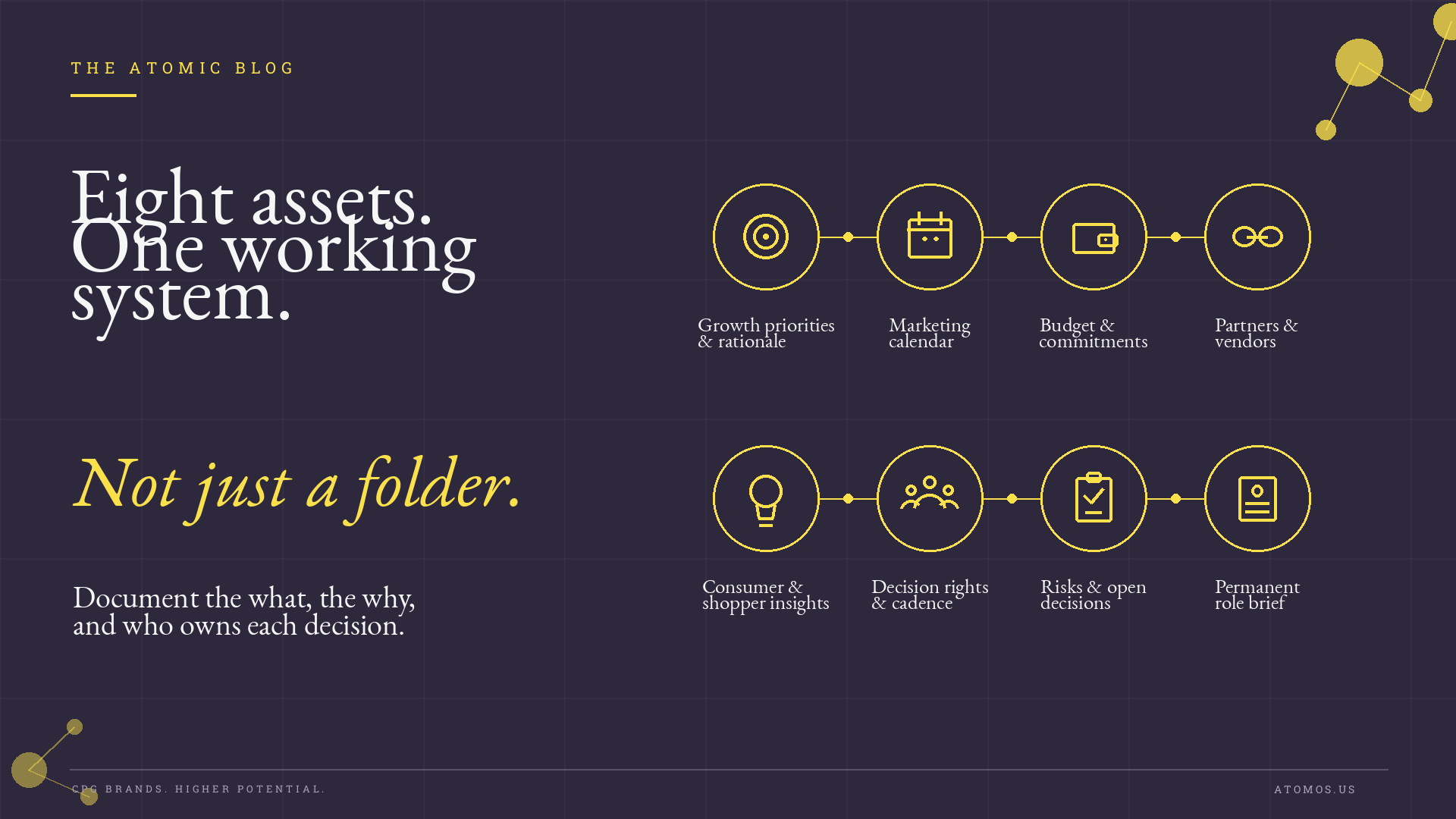
1. Growth priorities and strategic rationale
The incoming CMO should be able to see where the business expects growth to come from, which marketing priorities currently support that growth and which opportunities were deliberately deferred.
The rationale matters as much as the list.
Without it, the new leader can only accept or reject inherited priorities. With it, they can challenge the thinking intelligently and decide what still holds.
2. Annual and quarterly marketing calendar
The calendar should show more than dates.
Include launches, retail windows, promotional periods, planning milestones and major decision gates, along with lead times and named owners.
A calendar that shows “when” but not “who decides what by when” hides the operating work behind the event.
3. Budget, allocations and commitments
The new leader needs a clean view of spend to date, committed spend, flexible spend and the logic behind the major allocations.
Call out obligations that extend beyond the current quarter or year.
A budget handoff should make it immediately clear which dollars can still move and which ones are already spoken for.
4. Agency, vendor and partner map
Document who does what, the scope each partner owns, renewal and notice dates, key working relationships and an honest assessment of performance and fit.
The incoming leader should not have to discover six weeks later that a critical retainer renews next Friday or that a partner relationship depends on one undocumented personal connection.
5. Brand, consumer, shopper and commercial insight base
Centralize the evidence the function relies on: brand research, consumer learning, shopper data, retailer feedback, sales analysis and any other inputs shaping current decisions. For an omnichannel CPG business, that should also include retail velocity and retailer feedback alongside e-commerce conversion, DTC repeat and acquisition economics where relevant.
Equally important, label what the team believes but has not yet validated.
A new leader needs to know the difference between evidence and organizational folklore.
6. Team ownership, decision rights and operating cadence
Write down who owns what.
That includes functional responsibilities, decision rights, standing meetings and the rhythm connecting marketing to sales, finance and operations.
Also include a candid view of team strengths, capability gaps and development needs.
Org charts explain reporting lines. They do not explain how the work actually moves.
7. Active initiatives, metrics, risks and open decisions
For every meaningful workstream, document the owner, current status, success measure, major dependency and next decision.
Separate decisions the interim leader intentionally resolved from those deliberately left open for the permanent executive.
A good interim leader should reduce unnecessary ambiguity without stealing choices that belong to the person who will own the long-term strategy.
8. Permanent-role brief and onboarding recommendations
One of the most valuable outputs of an interim period is a better understanding of what the permanent seat really requires.
Capture what the role needs to deliver, the capabilities that matter most now, the key relationships the new executive should build early and a recommended first-30-day agenda.
This is not a script the incoming leader must follow.
It is a head start.
The transition itself needs an owner
Documents do not create a handoff by themselves.
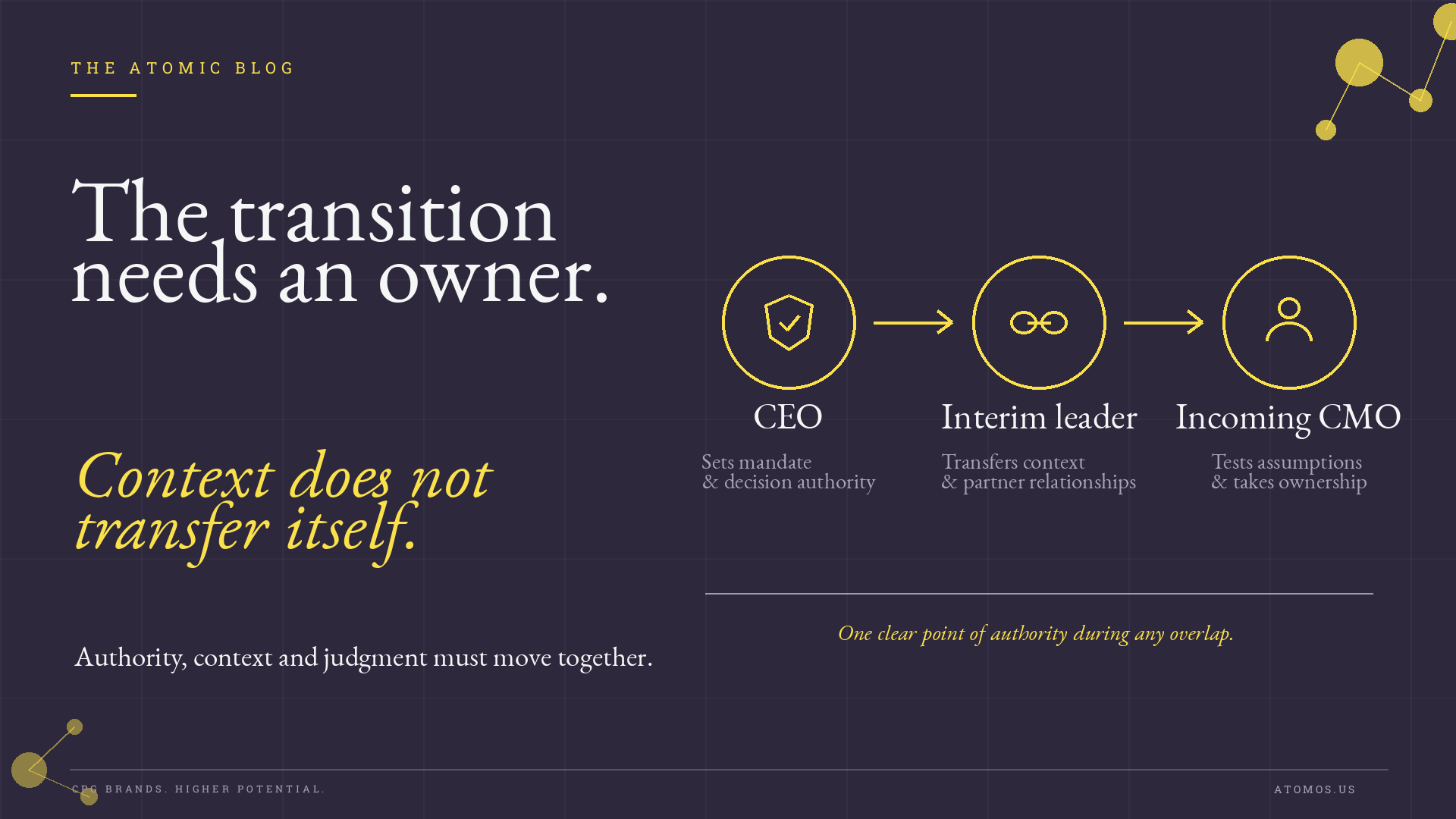
The CEO owns the transition outcome: setting expectations, making the incoming executive’s mandate clear and deciding when authority transfers.
The interim leader owns the context transfer. That means walking the successor through the system, not sending a folder and disappearing.
The team needs a clear message about who leads what during any overlap so they are not forced to choose between two executives. Agencies and key partners should receive direct introductions and an explicit point of contact.
The incoming CMO, meanwhile, should have enough room to listen, ask questions and test inherited assumptions before making major changes.
Context travels better through conversation than through documentation alone.
What should stay open for the permanent leader?
Interim leadership should create clarity without creating unnecessary lock-in.
That distinction is important.
The interim executive is there to hold decision accountability, protect momentum and fix exposed problems. They are not there to make every long-term strategic choice simply because the seat is temporarily theirs.
Some decisions should intentionally remain open if the business can afford to wait and the permanent leader should own the outcome.
The objective is a stable function with options intact.
That is also the difference between a strong interim engagement and a long consulting project: the system should become less dependent on the interim leader over time, not more.
The CEO’s handoff test
Before calling the transition complete, the CEO should be able to answer yes to each of these questions:
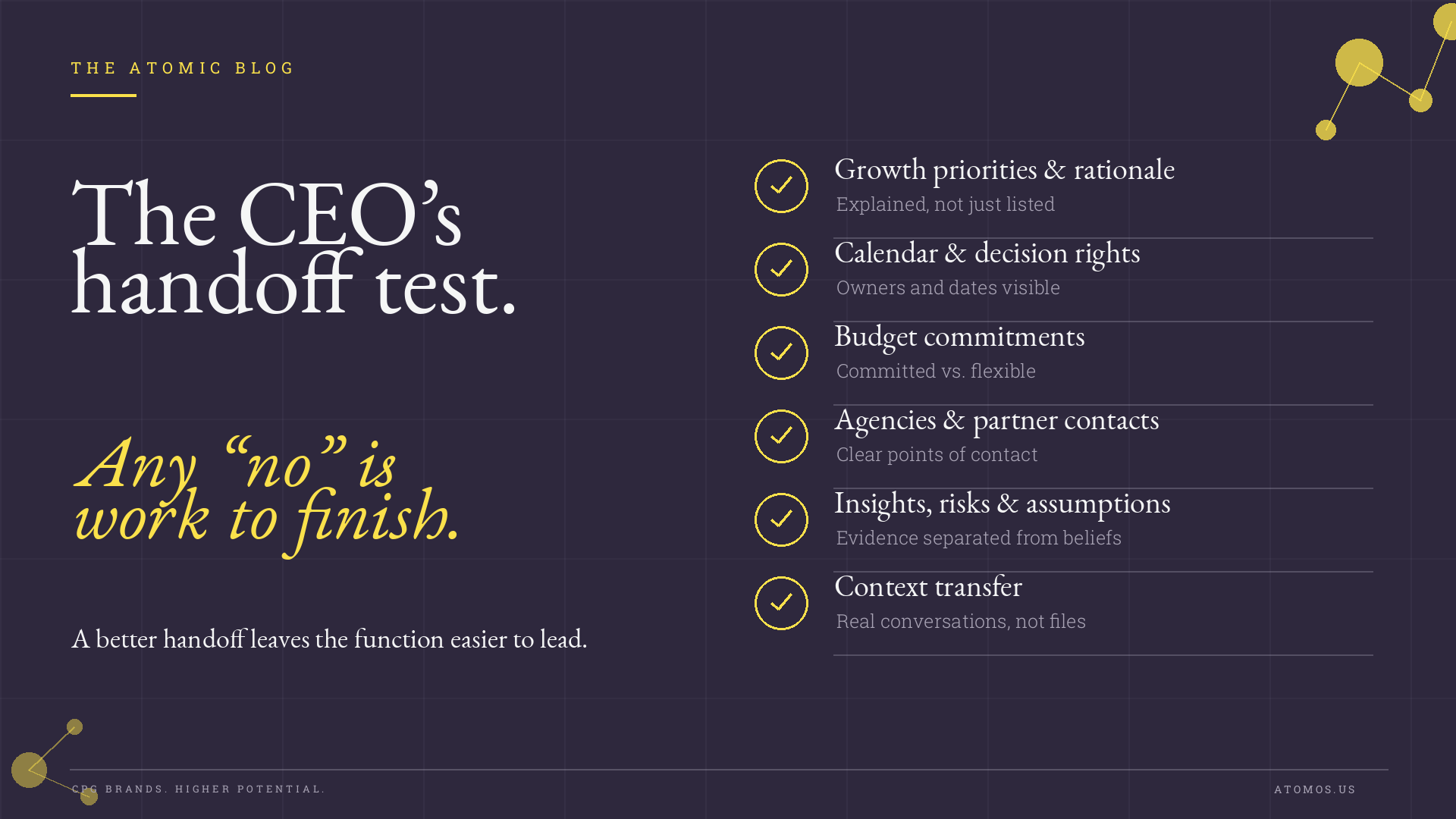
• Can the incoming CMO explain the current growth priorities and the reasoning behind them?
• Is the annual and quarterly calendar current, with owners and decision dates?
• Is the budget picture clear, including what is committed and what remains flexible?
• Do agencies and key partners know who their point of contact will be?
• Are the important consumer, shopper, brand and commercial insights centralized and easy to find?
• Are unvalidated assumptions clearly labeled?
• Are decision rights and operating rhythms written down and understood?
• Are active risks and open decisions visible, with owners attached?
• Does the permanent-role brief reflect what the business actually needs now?
• Has the interim leader spent real transition time with the successor, the team and critical partners?
Any “no” is work to finish.
The value of interim leadership should be visible on the day it ends
Keeping the calendar moving during a vacancy matters.
But the strongest interim engagements do more than prevent disruption.
They leave the marketing function easier to lead.
The incoming executive should not spend the first 90 days reconstructing what happened before they arrived. They should be able to understand the current system, challenge it from a position of context and start shaping what comes next.
That is the standard for a good handoff.
If your marketing leadership seat is covered but the transition is not yet designed, átomos can help structure the handoff so the incoming leader inherits continuity, clarity and room to lead.
ÁTOMOS — FRACTIONAL CMO FOR FOOD & BEVERAGE
We bring big-CPG playbooks to growing food and beverage brands.
We embed inside your business, read your category the way large CPG does, and help you move with clarity and speed — without the full-time cost.
→ Let's talk: atomos.us/contact
-
Start preparing before the permanent leader arrives. Once the search narrows and the transition becomes real, the interim leader should be organizing the materials, open decisions and relationship context the successor will need. Day 90 is a useful readiness checkpoint, not a required start date.
-
When possible, a short overlap is useful because context transfers better through discussion than documents alone. The CEO should define who holds decision authority during the overlap so the team is never managing two competing leaders
-
Avoid major strategic or structural changes before understanding existing commitments, team dynamics and the reasoning behind current priorities. Early listening helps separate inherited problems from decisions that simply need context.
-
At minimum: growth priorities and rationale, the marketing calendar, budget commitments, partner map, insight base, team and decision rights, active initiatives and risks, and an updated brief for the permanent role.
-
The incoming leader can understand the function without reconstructing it. Priorities are explicit, decision ownership is clear, risks and commitments are visible, and meaningful long-term choices remain available for the permanent executive to make.