
The resignation has happened. The business calendar has not changed.
Retail resets are still on the schedule. The agency retainer still renews next month. A launch that was supposed to be locked is waiting on a decision. Budget commitments are still moving, and the team is already looking for someone to tell them what matters most. For growth-stage CPG and Food & Beverage brands, that pressure is amplified by retail windows, trade commitments, innovation gates and DTC activity that continue whether the leadership seat is filled or not.
When a VP of Marketing or Marketing Director resigns, the instinct is to treat it as a hiring problem.
The more immediate risk is a decision-ownership problem.
An open seat can leave priorities, budgets, partners and approvals moving with no one clearly accountable for steering them. The first 30 days are not about replacing the person as quickly as possible. They are about protecting continuity while you decide what the business actually needs next.
The first risk is not the vacancy. It is unowned decisions.
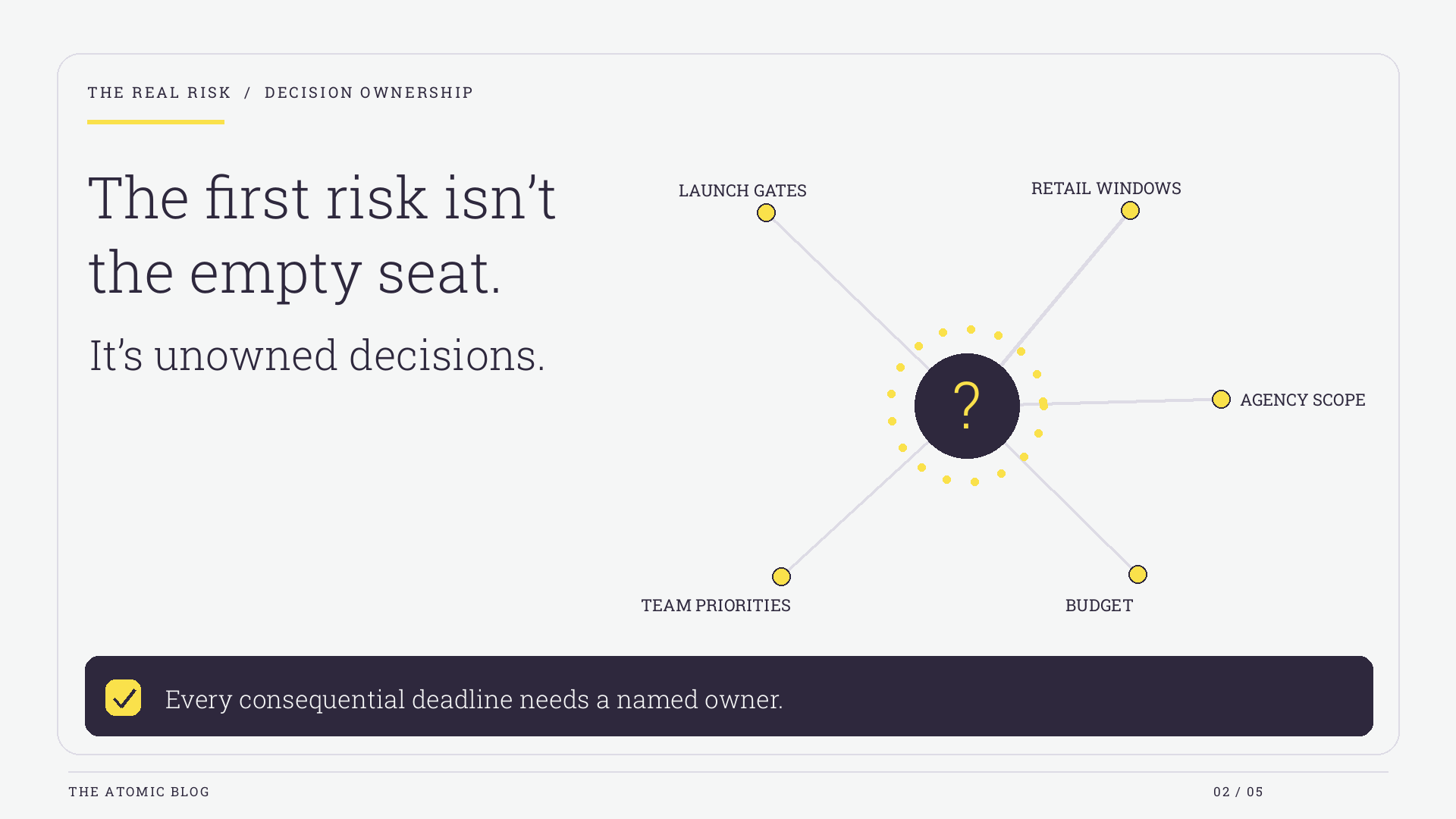
A leadership gap becomes expensive when consequential decisions keep arriving without a named owner.
That can mean a launch gate that slips because no one wants to make the call, an agency continuing work against an outdated brief, a retailer commitment that surfaces too late, or a team escalating everything to the CEO because the decision rights disappeared with the leader.
The goal of the first month is simple: make sure the function can still decide, not just operate.
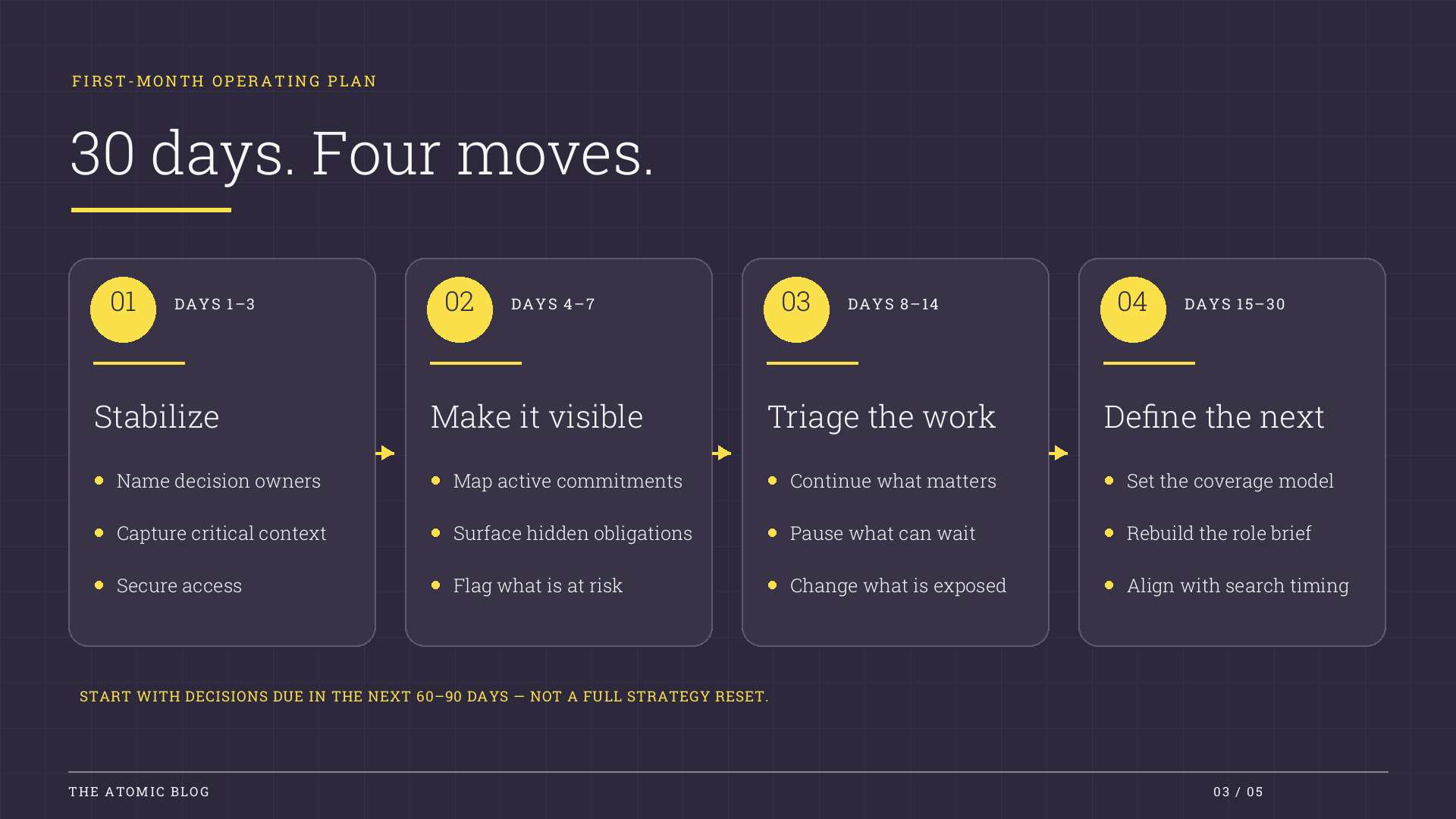
Days 1–3: Stabilize the decision flow
Do not start with a strategy review. Start with the next 60 to 90 days of decisions.
List every meaningful approval, commitment and deadline already in motion: creative approvals, retail windows, promotional sign-offs, agency deliverables, launch gates, research decisions, budget commitments and planning milestones.
Then assign a named temporary owner to each one.
A committee is not an owner.
The person covering a decision does not need to own the function permanently. They do need enough authority to make the call, escalate when necessary and keep the work moving.
Communication matters just as much. Tell the marketing team, key agency partners and sales leadership what changed, who is covering what and where questions should go.
If the departing leader is still available, use the notice period deliberately. Capture what lives in their head and inbox: open decisions, retailer context, partner history, risks, informal commitments and the logic behind current priorities.
Also confirm access. Ad accounts, agency portals, asset libraries, research platforms, approval workflows and shared drives are operational infrastructure. A leadership transition is the wrong time to discover that critical access sat with one person.
Days 4–7: Build one honest view of what is in flight
By the end of the first week, leadership should be able to see the full marketing load on one page.
That means active campaigns and launches, retailer and promotional commitments, agency scopes and renewal dates, budget spent versus committed versus flexible, major research or innovation workstreams, and the people the team depends on most.
Pay particular attention to commitments that were never formally documented. A verbal retailer agreement, an agency scope that expanded through email, or a launch assumption that everyone “knows” can become the biggest source of disruption after someone leaves.
You do not need a detailed audit yet.
You need a decision map: what is committed, what is flexible, what is at risk, when it matters and who owns it now.
Days 8–14: Decide what continues, pauses or changes
Once the landscape is visible, establish a simple operating cadence.
A short weekly marketing leadership meeting with the right cross-functional partners—usually sales, finance and operations—is often enough to keep decisions moving and surface conflicts early.
Then sort the work into three buckets.
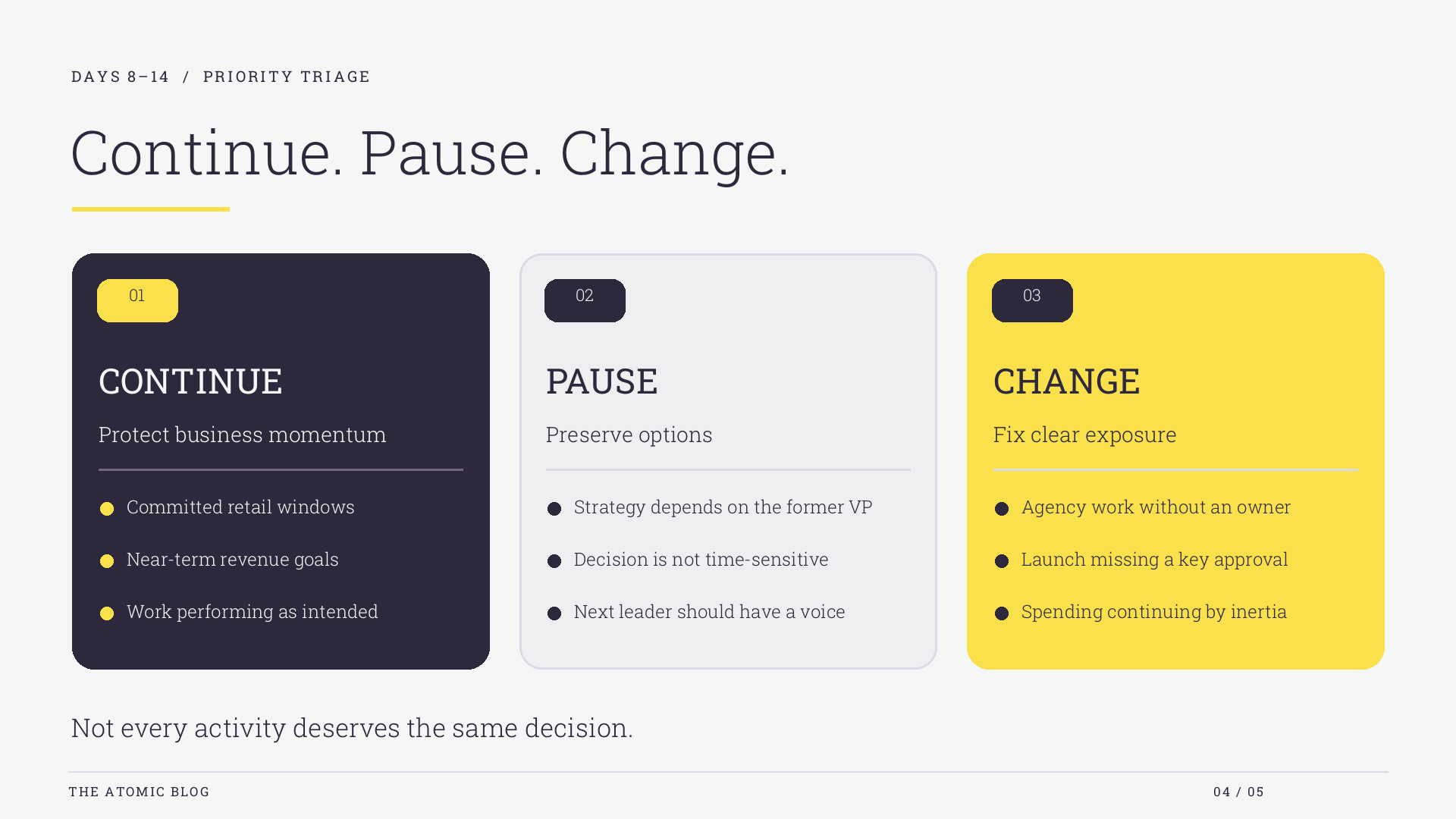
Continue what is tied to a committed retail window, launch or near-term revenue objective and is performing as intended.
Pause work that depends on a strategy only the departed leader understood, especially when the decision is not time-sensitive and preserving optionality is more valuable than forcing momentum.
Change only what is clearly exposed or broken: an agency relationship with no accountable owner, a launch missing a required decision, or spending that continues by inertia without a clear job.
This is not the moment for a wholesale strategic reset.
The job is to preserve momentum where it matters and preserve options where the next leader should have a voice.
Days 15–30: Define the coverage model and the permanent role
By the middle of the month, you should know much more about what the function is carrying—and what the next leader actually needs to be good at.
Do not automatically reuse the departing leader’s job description.
A growth-stage business may now need a different kind of marketing leader: a brand builder, a demand and commercial operator, a systems builder, or someone who can integrate those capabilities at a new stage of scale.
Define the permanent role around the work the business needs done next, not around the résumé of the person who left.
Then align the executive-search timeline with the coverage plan.
The search and the operating gap are two different problems. The search can take the time required to find the right long-term leader. The business still needs someone accountable for marketing until that person starts.
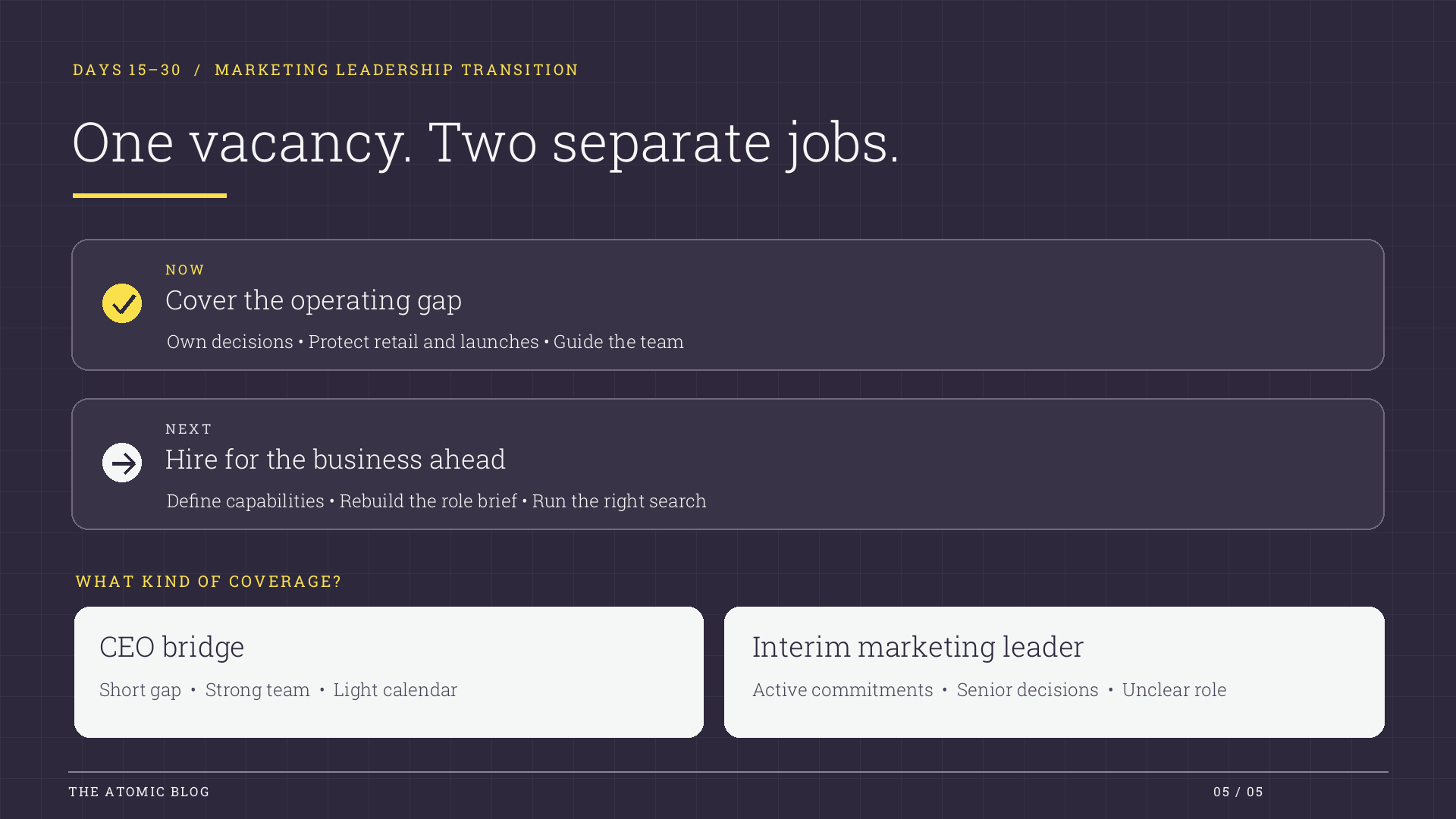
When should the CEO cover—and when should an interim leader step in?
Temporary CEO or founder coverage can work when the gap is likely to be short, the team has strong functional leaders, the calendar is relatively light and the CEO has both the marketing depth and the bandwidth to make the necessary decisions.
The tradeoff is obvious: the CEO becomes the bottleneck, and time moves away from the decisions only the CEO can make.
Interim marketing leadership becomes more useful when launches, retail windows, agency decisions or a budget cycle are active; when the team needs senior direction rather than coordination; or when the permanent role itself needs to be redefined before the search moves forward.
The point of an interim leader is not to become the permanent answer by default. It is to hold decision accountability, protect the business calendar and help the company reach the permanent hire with a clearer function than it had on day one of the vacancy.
The CEO’s first-30-day checklist
Before the month closes, make sure the business has done eight things:
• Named an owner for every consequential decision due in the next 60 to 90 days.
• Communicated the transition to the team, agencies and key commercial partners.
• Secured access to accounts, platforms, assets and approval workflows.
• Built one view of campaigns, launches, retail commitments, agency scopes and budgets.
• Surfaced verbal and undocumented commitments.
• Established a weekly decision cadence and sorted work into continue, pause or change.
• Defined what the permanent role must deliver before finalizing the search brief.
• Decided who is accountable for marketing between now and the new leader’s start date.
A resignation creates urgency. It should not create haste.
The companies that navigate the gap well separate the two jobs: stabilize the function now, then hire the permanent leader with enough clarity to make the right decision.
If your marketing leadership seat is open and the calendar is not waiting, átomos can help assess what is in flight, where decision ownership is exposed and what level of interim coverage the business needs.
-
Start by assigning named owners to every consequential near-term decision. If the gap is short, the team is strong and the calendar is light, the CEO or founder may be able to bridge it. When launches, retail windows, agency decisions or budget cycles are active, an interim marketing executive can provide senior decision accountability while the permanent search continues.
-
You can begin the search quickly, but define the role before treating the previous job description as the answer. The business may now need a different mix of brand, growth, commercial or operating capabilities than it did when the departing leader was hired.
-
Protect time-bound commitments and decision rights first: retail windows, launches, agency obligations, budget commitments and approvals that will come due whether or not the seat is filled.
-
Avoid turning the vacancy into an excuse for a broad strategic reset unless something is clearly broken. The priority is continuity, visibility and optionality for the incoming permanent leader.
-
It is most useful when the business cannot pause while the search runs: active launches, retailer commitments, agency decisions, budget planning, unclear role definition or a team that needs senior direction rather than temporary coordination.
ÁTOMOS — FRACTIONAL CMO FOR FOOD & BEVERAGE
We bring big-CPG playbooks to growing food and beverage brands.
We embed inside your business, read your category the way large CPG does, and help you move with clarity and speed — without the full-time cost.
→ Let's talk: atomos.us/contact