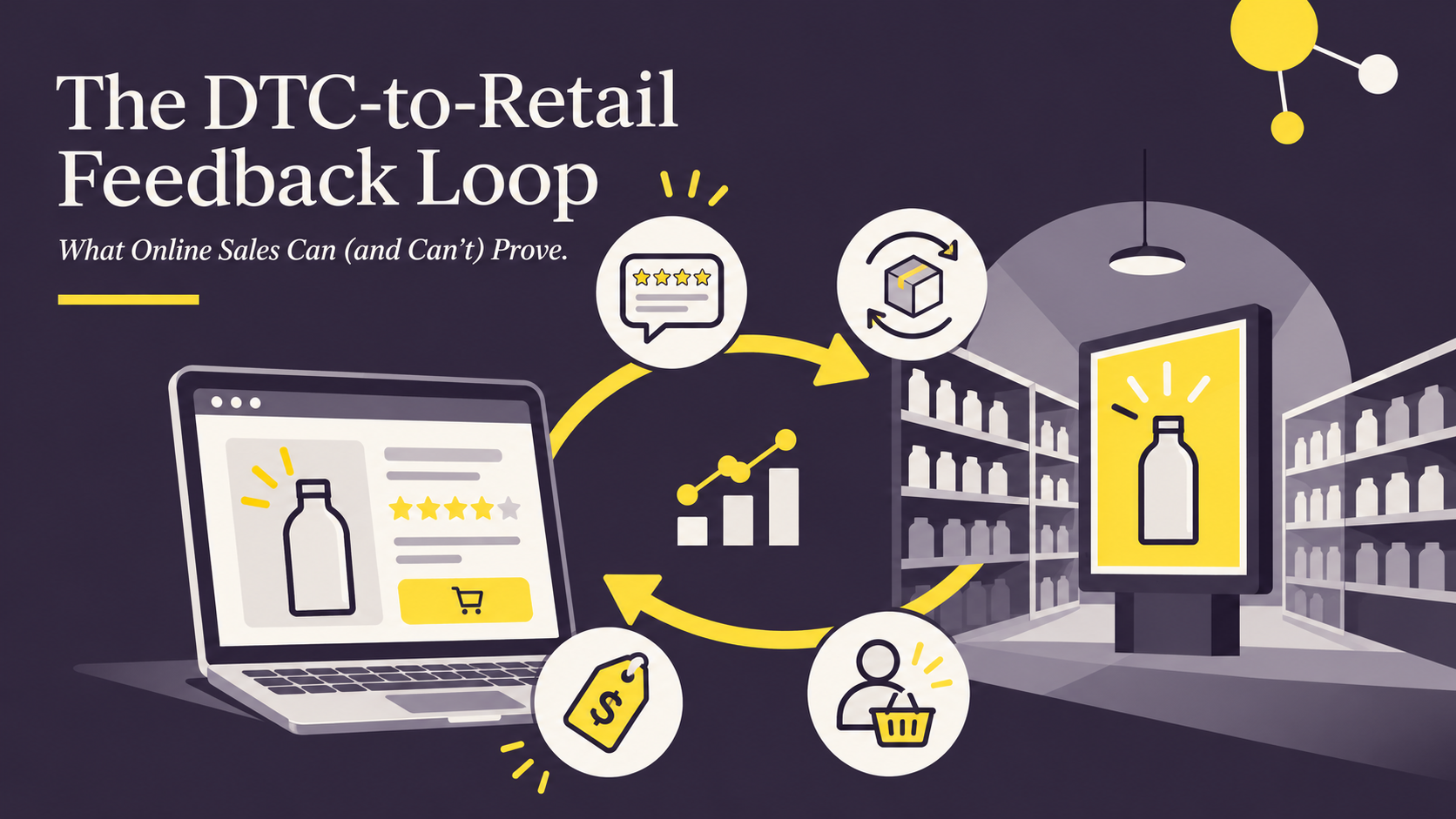
The new flavor is taking off online. Reviews are encouraging, orders keep coming in, and a buyer wants to know whether it could work across a few hundred stores. The founder is already pricing a larger production run.
That's the moment to ask a less exciting question: what, exactly, did those online sales prove?
A DTC customer may have found the product through a creator, bought a bundle at a launch discount, read three pages about the ingredients and checked out because shipping was free. A grocery shopper gets a few seconds in front of a shelf full of alternatives. The same product is being asked to win under very different conditions.
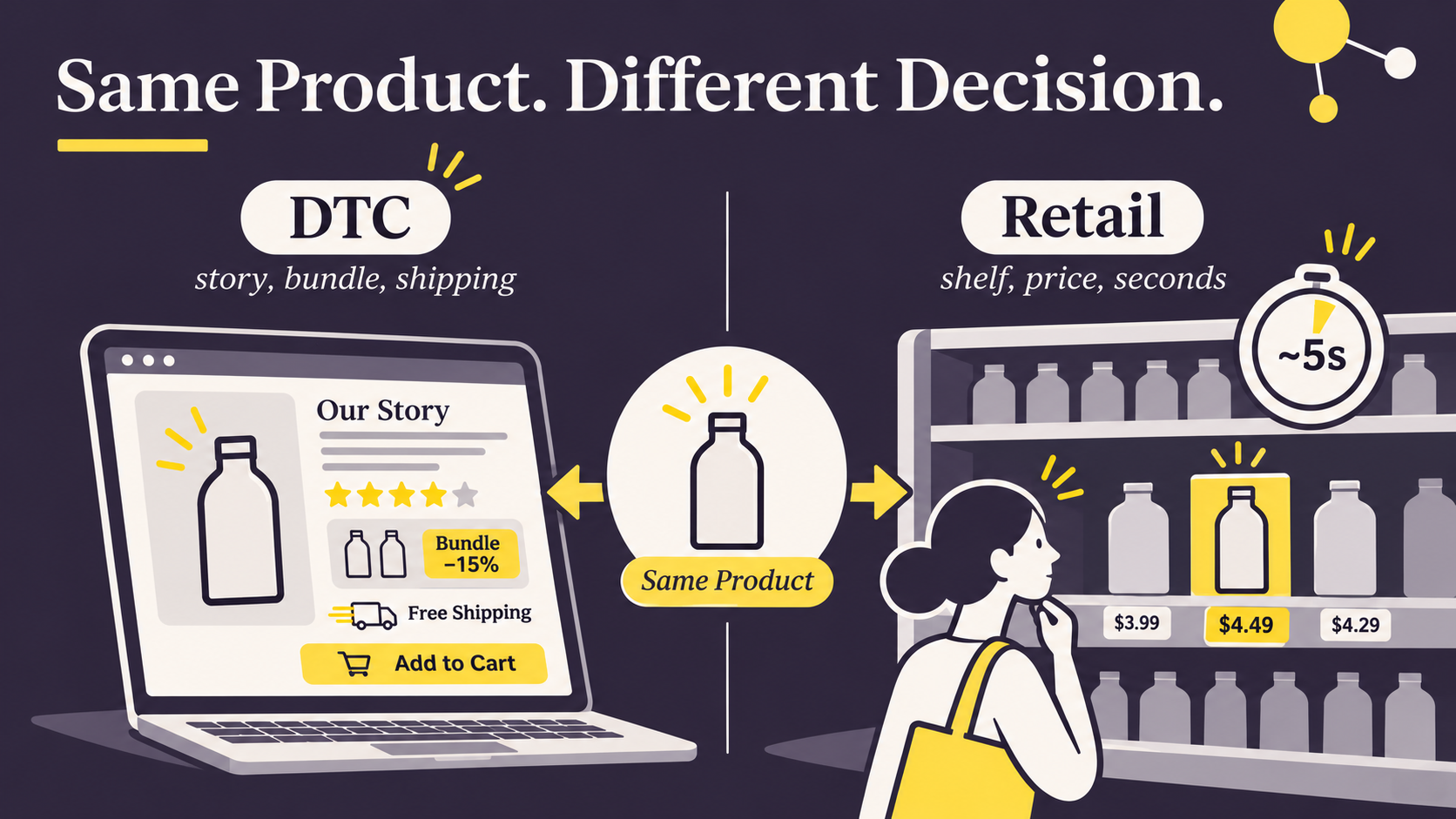
DTC can be one of the most useful sources of consumer evidence a growing food and beverage brand has. The mistake is treating that evidence as though it automatically predicts retail demand.
Start with the retail decision, not the DTC dashboard
Imagine the team is debating whether to lead a retail pitch with the original flavor or a newer SKU. The easy answer is to open Shopify and sort by sales. The better answer begins with the decision: what would have to be true for the new flavor to deserve limited shelf space?
That changes the test. Instead of asking which SKU had the most orders, ask which one earns repeat purchase among comparable buyers at a consistent price, without a promotion doing most of the work. Decide in advance what finding would lead you to launch, test locally or hold.
The strongest DTC programs are not collecting more data for the sake of it. They are making the next expensive decision less speculative.
Four online signals worth separating
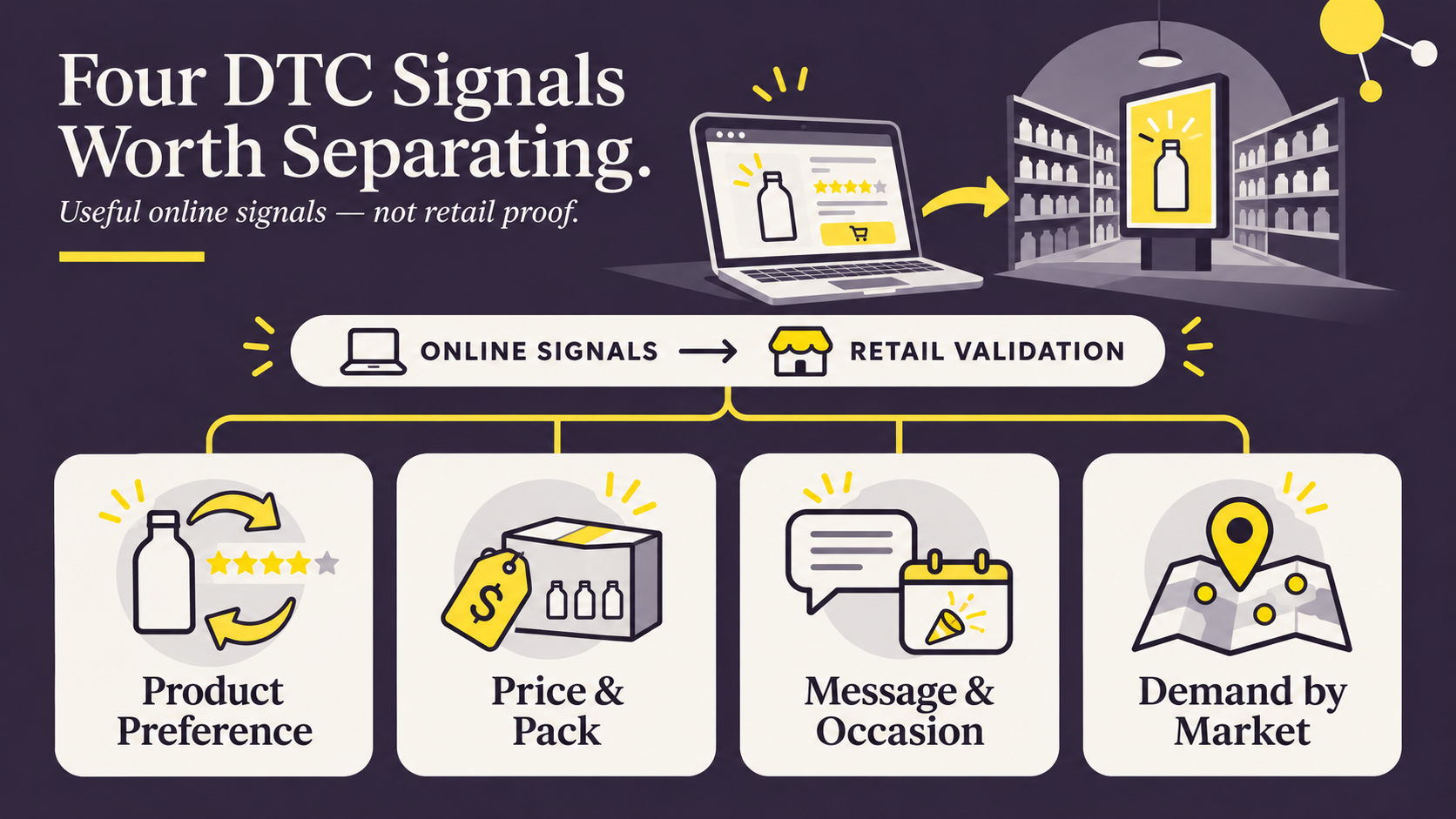
Product preference. First orders help identify what gets attention. Repeat purchases, where the category's consumption cycle allows them, can tell you more about what holds up after the novelty wears off. Neither is meaningful without looking at the offer and the customer group.
Price and pack architecture. DTC can show which bundles and formats consumers choose in that environment. But free-shipping thresholds, subscriptions and larger average baskets change the economics. An online multipack preference does not establish the right single-unit shelf price.
Message and occasion. Reviews, customer questions and creative tests can uncover why people buy and the language they use. They're a good shortlist for pack claims or in-store communication, but a product page has room to explain what a front panel has to communicate almost instantly.
Demand by market. Order and subscriber concentrations can help identify where a brand already has an engaged audience. They may also reflect where the brand spent the most media money. Before calling a ZIP code a launch market, compare it with awareness, household composition, retailer fit and marketing exposure.
What two brands have learned by crossing channels
Daily Harvest offers a useful example of what happens when the online signal meets the store. In a 2024 Retail TouchPoints interview, then-chief commercial officer Annie Streit explained that the company used DTC satisfaction and repeat indicators to inform its initial retail product approach. Once the brand had store-level learning, it found that flavor preferences varied by geography and began considering localized assortments. She also described how retail forced packaging to do more of the explaining that a website could handle online.
The important detail is that the brand didn't stop learning when it entered retail. Online behavior helped form the first hypothesis; retail performance helped refine it.
B.T.R. Nation illustrates another use. In a March 2026 Taste Radio conversation, founder Ashley Nickelsen discussed bringing online sales and subscriber concentration by ZIP code into retailer conversations. That's a stronger pitch than arriving with an enthusiastic customer testimonial alone. It still isn't the same thing as proof that a product will move at the retailer's expected rate.
Both examples point in the same direction: useful DTC evidence becomes more valuable when a team can state its limits and show how it plans to test the next assumption.
A five-step DTC-to-retail feedback loop
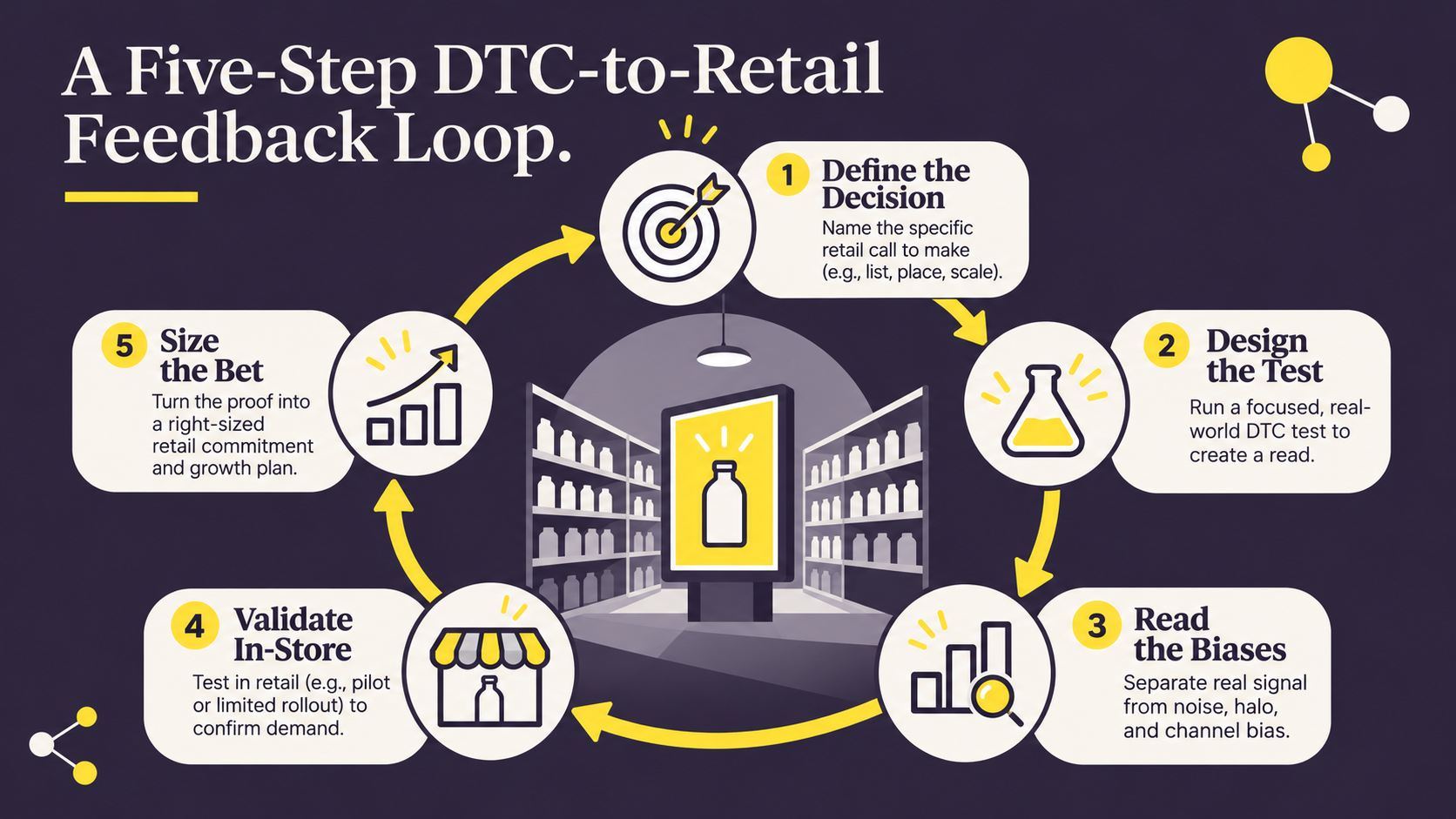
1. Define the decision. Write down the retail choice before launching the test: which SKU, pack size, claim, market or price architecture is in question? Agree on the conditions that would lead to a pilot, a change or a stop.
2. Design the test around the decision. Keep the comparison as clean as the business allows. Document pricing, acquisition source, offers, seasonality and the time consumers need to use and repurchase the product. A short launch spike is not a repeat-purchase study.
3. Read behavior alongside its biases. Separate first-time from returning buyers. Compare full-price and promotional cohorts when sample sizes permit. Check concentration by creator, acquisition channel and geography. If the evidence is thin, say so.
4. Test what will change in store. Put the pack next to competitors, examine shelf pricing and verify product comprehension without a landing page. Where possible, validate with retailer shopper data, demos or a controlled store pilot.
5. Size the commercial bet. Translate the learning into a launch plan with assumptions about retailer margin, trade support, inventory, velocity and the investment needed to create trial. Decide what early results would trigger an adjustment, more distribution or an exit.
Notice the order. The team decides what it needs to know, learns where it has access to evidence, then spends more only when the next question has become clearer. That's a far better use of DTC than presenting a promising sales chart as a retail forecast.
The decision matrix to use before the next buyer meeting
The table below is a working tool, not a statistical model. Each row connects an online signal to the retail-specific question it still leaves open.
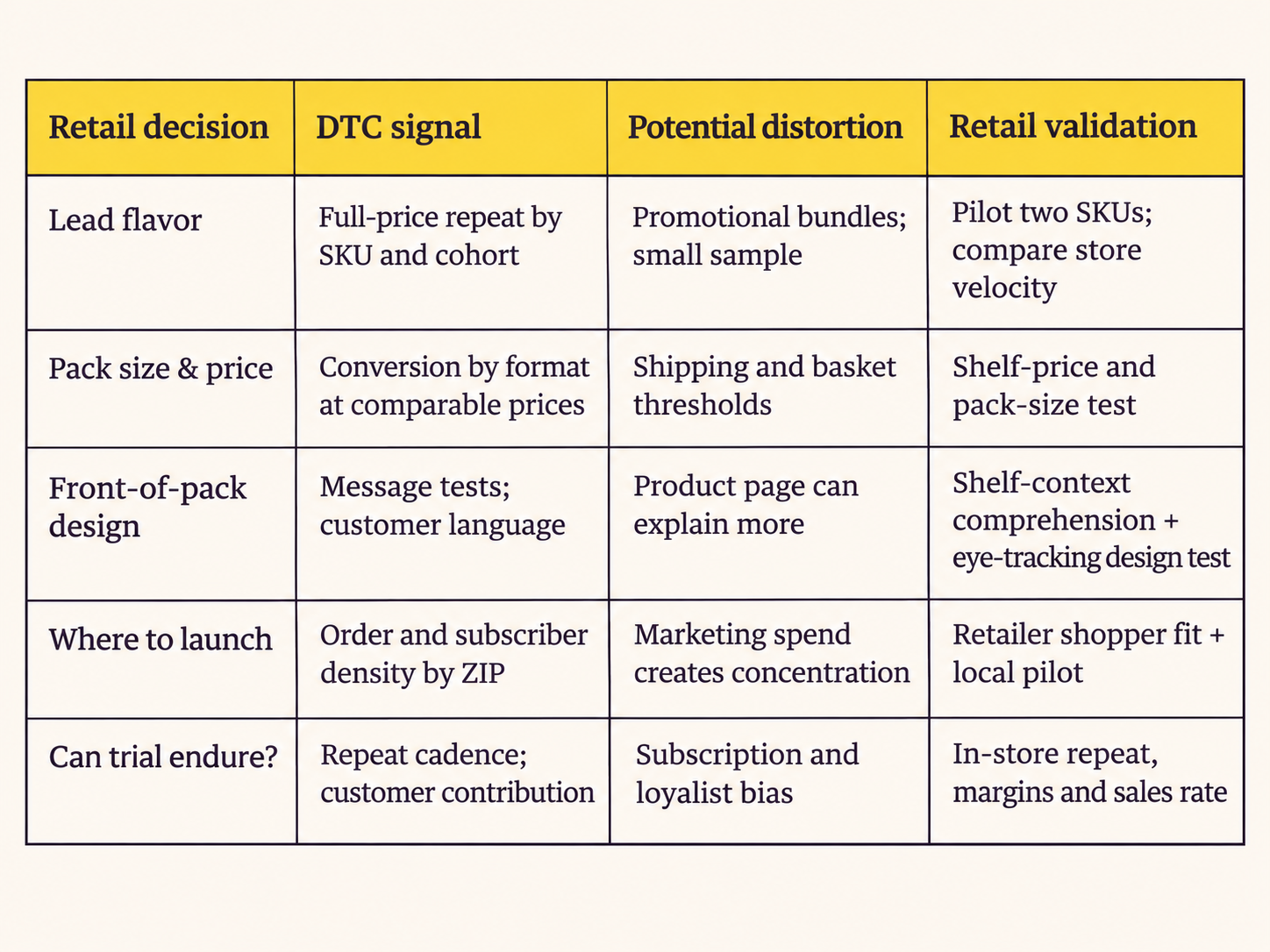
A practical rule: if you cannot explain what created the DTC result, you are not ready to use it as evidence for a much larger retail commitment.
A good online SKU can still be the wrong lead SKU
Consider a hypothetical better-for-you snack brand. A lemon SKU leads online orders, and the team wants it at the front of the retail line review. A closer look shows that lemon was heavily featured in a promotional bundle. Another flavor sold fewer units, but more comparable full-price customers bought it again after enough time had passed to replenish.
That doesn't prove the second flavor will win in grocery. It changes the quality of the question. The team can take both products into a small, relevant retail test, keep the DTC evidence labeled as directional, and judge the result against actual shelf conditions. It may still choose lemon, but it will know why.
The point is not to worship repeat rate either. Depending on the category, purchase cadence, sample size and product usage, even repeat can mislead. What matters is whether the evidence supports the decision you are about to make.
Give the retail buyer an honest evidence story
Buyers are responsible for shelf productivity and the economics of the category. A strong pitch needs more than proof that people clicked an ad. Circana's 2026 guidance for emerging brands emphasizes sales velocity, repeat behavior and category fit, while SPS Commerce's retailer-pitch guidance highlights expected velocity, retailer margin, promotional support and supply reliability.
For a brand without substantial store history, I would rather see one clear evidence page than twelve charts: who bought online, which behavior repeated, where demand appeared, which factors might have inflated it, what the product contributes to the category, and exactly what the retailer pilot is designed to prove.
Label DTC reorder rates and geographic density as proxies, not measured units per store per week. Follow with a test-and-support plan, including the circumstances under which you would scale. That combination demonstrates commercial judgment, even before you have a perfect dataset.
Know when to leave the website and test the shelf
Some decisions cannot be settled online. Packaging standout, variant navigation, shelf-price comparisons and impulse appeal depend on a shopper seeing the actual competitive set. A customer who loves an ingredient story on a website may never notice that story on a crowded shelf.
Those questions call for shelf-context research, whether physical or simulated, shopper observation, or a limited-market test. Eye-tracking can tell us what catches a shopper's eye and what gets missed. We pair it with comprehension and choice testing to understand whether the package actually communicates what matters.
We've seen both sides of this at átomos. With Chifles, a packaging refresh had weakened familiar visual cues that loyal shoppers used to recognize the brand. Eye-tracking and shelf research helped us diagnose the problem and guide a design evolution built around recognition.
Blue Monkey faced the other side of that decision. Before printing a new package for its U.S. retail push, we tested competing designs on a simulated shelf. One direction got noticed faster; another made flavors easier to find. We combined those strengths rather than choosing a design just because it looked good in a presentation.
Neither lesson came from an online sales dashboard. If packaging is the decision at risk, our guide to testing a CPG brand refresh explains why research that ignores the shelf can create false confidence.
Before the purchase order, make three columns
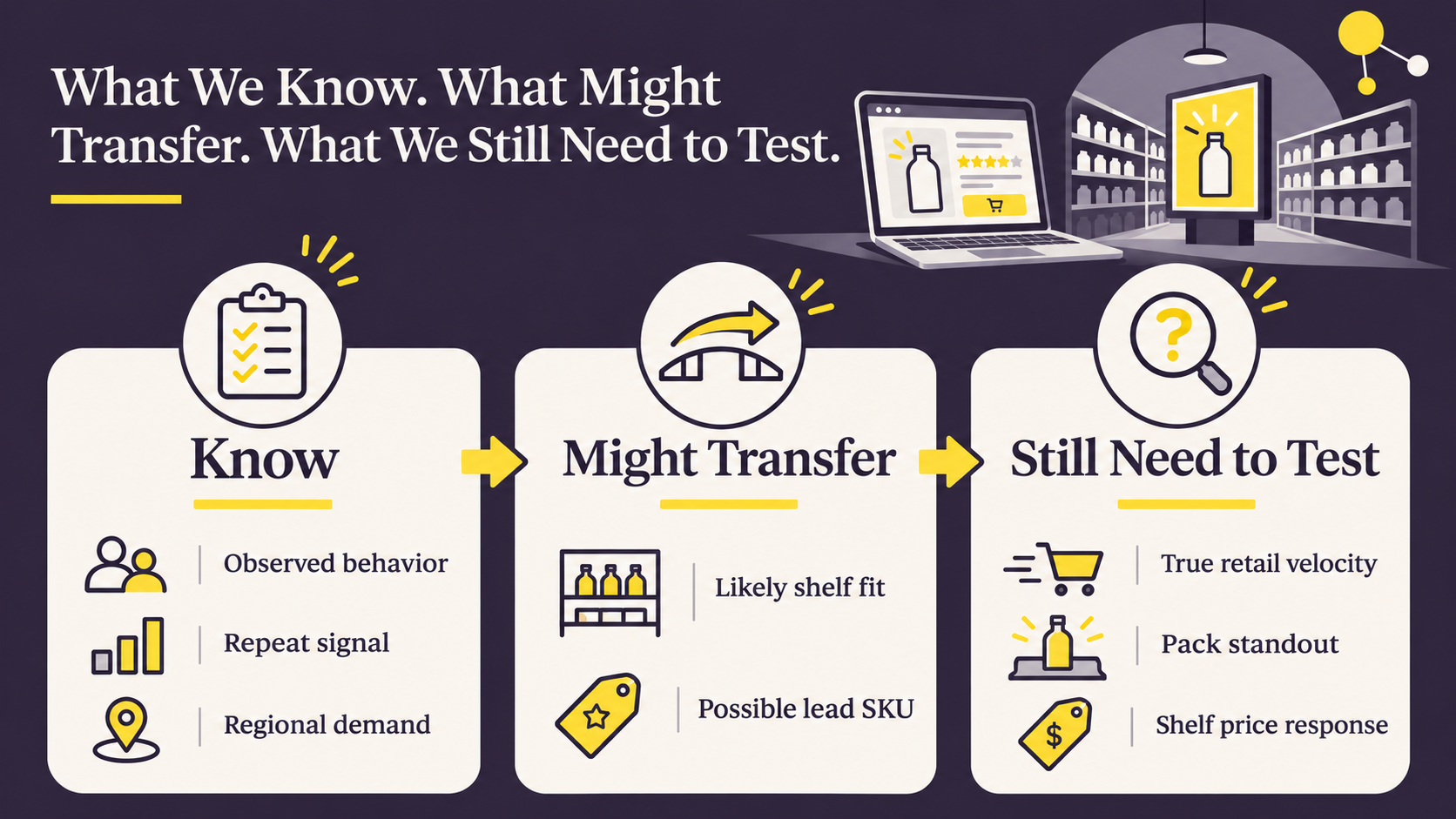
What do we know from observed behavior? What do we reasonably expect to transfer to retail? What are we still guessing?
The first column is evidence. The second is a hypothesis to validate. The third is a risk to price, test or postpone. A growth-stage team rarely has the budget to eliminate uncertainty, but it can stop pretending all three columns deserve the same level of confidence.
That's where senior marketing leadership earns its keep: connecting consumer learning to choices about portfolio, retailer, investment and execution. If you're preparing a retail launch or deciding what deserves the next round of spend, átomos can help turn the evidence you have into a plan you can defend. Explore our Strategy Sprint.
-
Not on their own. DTC shows behavior within an online audience, offer and purchase environment. Retail velocity is measured in the store. Use online results to develop hypotheses and then validate them against the retailer's category and shopper reality.
-
Product-level repeat behavior, time between orders, order concentration by geography, response to claims and cohort-level full-price purchasing can all help, provided the sample, offer and timeframe are stated clearly. They are directional proxies, not substitutes for units per store per week.
-
Compare purchases and subsequent repeat behavior across comparable cohorts with different promotional exposure, if your data supports it. Look for meaningful sample sizes and note whether the leading SKU changes after separating promotional orders. Do not treat the result as causal proof unless the test design warrants it.
-
When the decision depends heavily on the in-store environment, such as packaging standout, shelf price, product navigation or impulse selection. Use shelf research, demos or a limited-store pilot instead, and select the method that most closely reflects the decision at hand.