
The Selective Shopper: Why CPG Consumers Trade Up in One Aisle and Down in the Next
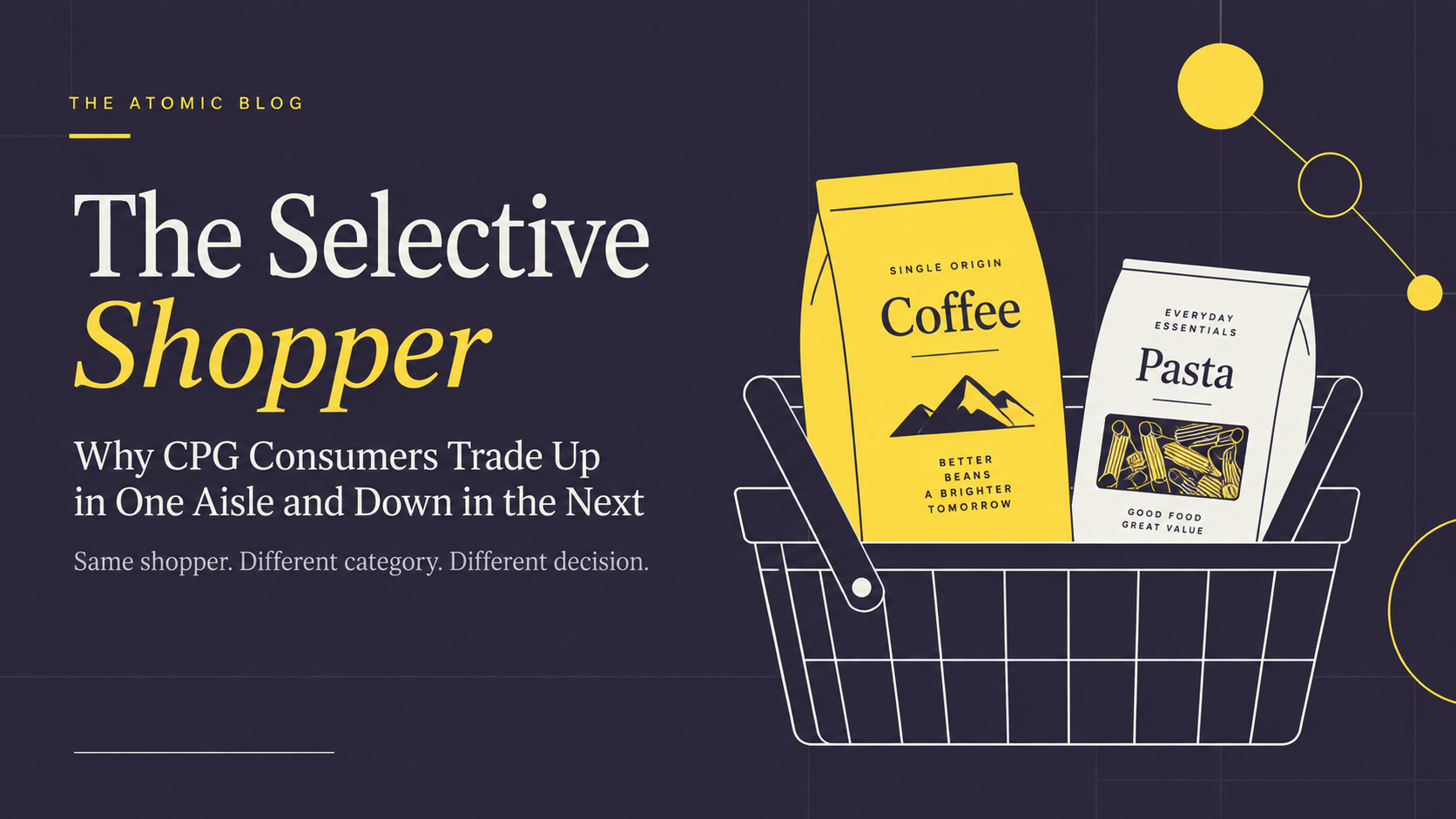
A shopper puts a $14 bag of single-origin coffee in the cart without checking the unit price. A few minutes later, the same person reaches for the store-brand pasta without a second thought.
Same income. Same trip. Same shopper. Two very different value decisions.
That is why I think the usual “trading up versus trading down” conversation misses something important.
NIQ and World Data Lab’s September 2026 “Tale of Two Consumers” research describes a barbell pattern across the $1.1 trillion U.S. FMCG market: growth is concentrating at the premium and value ends while the mainstream middle is under pressure. Their framing matters because this is not simply a story about one consumer becoming more premium and another becoming more value-oriented.
Shoppers are making different tradeoffs by category, occasion and perceived value.
For a growth-stage CPG brand, that changes the question.
It is not: Is our consumer trading up or trading down?
It is: Where, when and why does this shopper believe the premium is worth paying — and have we actually earned it?
The premium-vs-value binary breaks down in a real cart
One thing nearly two decades in Big CPG teaches you quickly is that the household is not the decision. The same household can behave very differently depending on what is being bought and why.
Broad consumer segments are useful. But they become dangerous when we use them as a shortcut for pricing power.
A shopper who spends freely in one category may be completely indifferent to brand in another. Someone who pays more for a product tied to taste, trust or ritual may happily choose the lowest acceptable option for a basic replenishment item.
That is why I would look at willingness to pay through four variables:
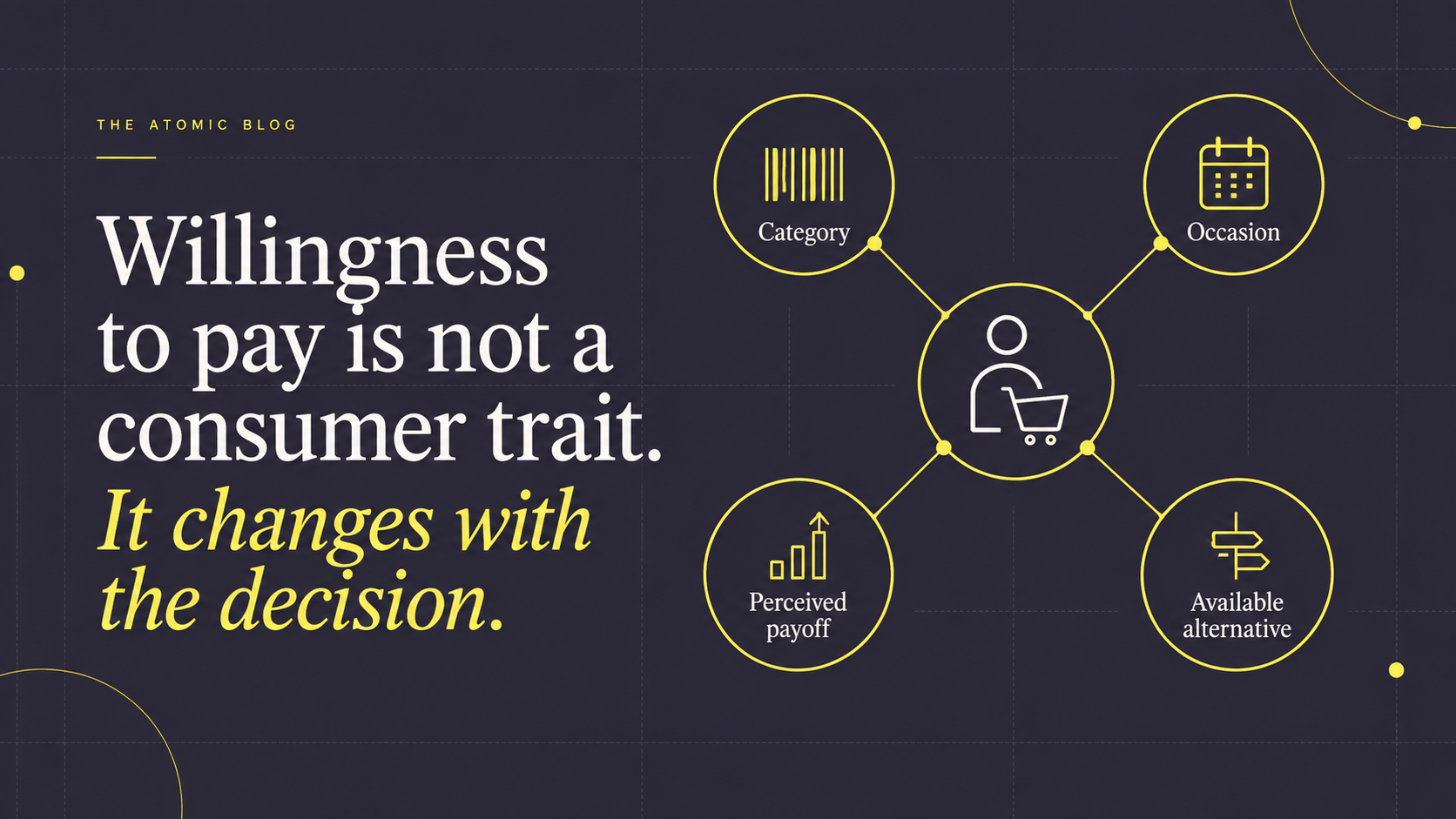
Category. Occasion. Perceived payoff. Available alternative.
Those four variables usually tell you more about the decision than a broad “premium household” or “value household” label.
And they explain why the middle is getting harder to defend. A mid-tier product can get squeezed when it is not cheap enough to be the obvious value choice and not meaningfully better enough to make the premium feel worthwhile.
The issue is not simply price. It is the reason to choose.
Where does the shopper refuse to substitute?
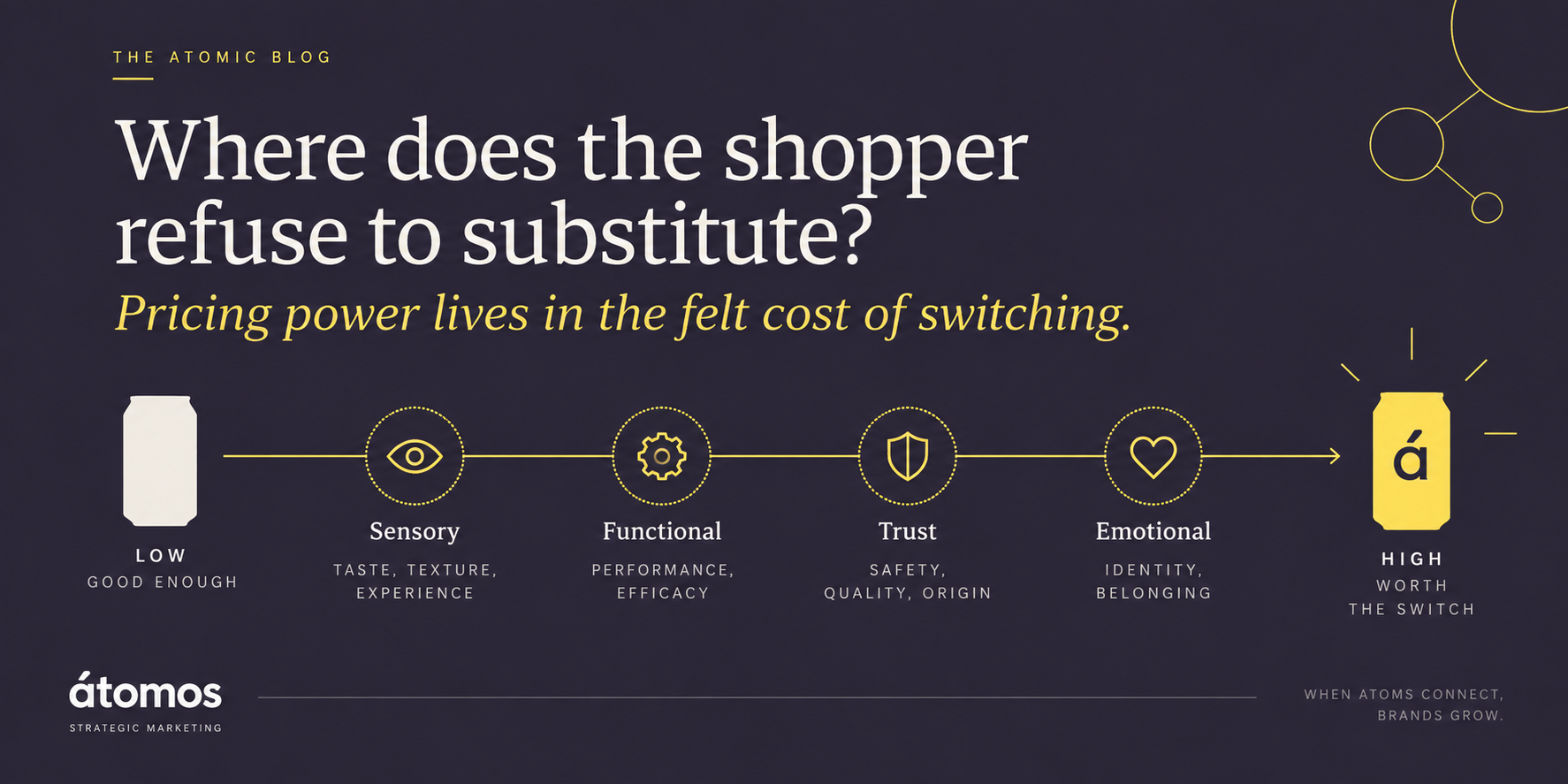
Not every category has the same permission to charge more.
The useful concept here is substitution cost. I do not mean an academic economic model. I mean the felt cost of switching to something else.
Sometimes that cost is sensory. The shopper believes the cheaper option will taste noticeably worse.
Sometimes it is functional. The product performs differently enough that the compromise is obvious.
Sometimes it is about trust or risk. The shopper does not want to experiment when the downside of getting it wrong feels meaningful
And sometimes it is emotional: ritual, identity, indulgence or an occasion where the product is doing more than simply meeting a functional need.
Where those costs are low, lower-priced alternatives become “good enough” very quickly.
That is what makes the category-level view so important. NIQ’s 2026 global retail work shows premiumization is more selective and strongest in quality-led categories, while value tiers can grow at the same time in other parts of the basket.
Same shopper. Different category. Different decision.
For a founder, the practical question is not just “are we differentiated?”
It is: Does the difference we are charging for make choosing the alternative feel like a real compromise?
A lot of brands have differentiation that is very real inside the building and almost invisible at the moment of purchase.
That gap is where pricing power disappears.
Occasion changes the value equation
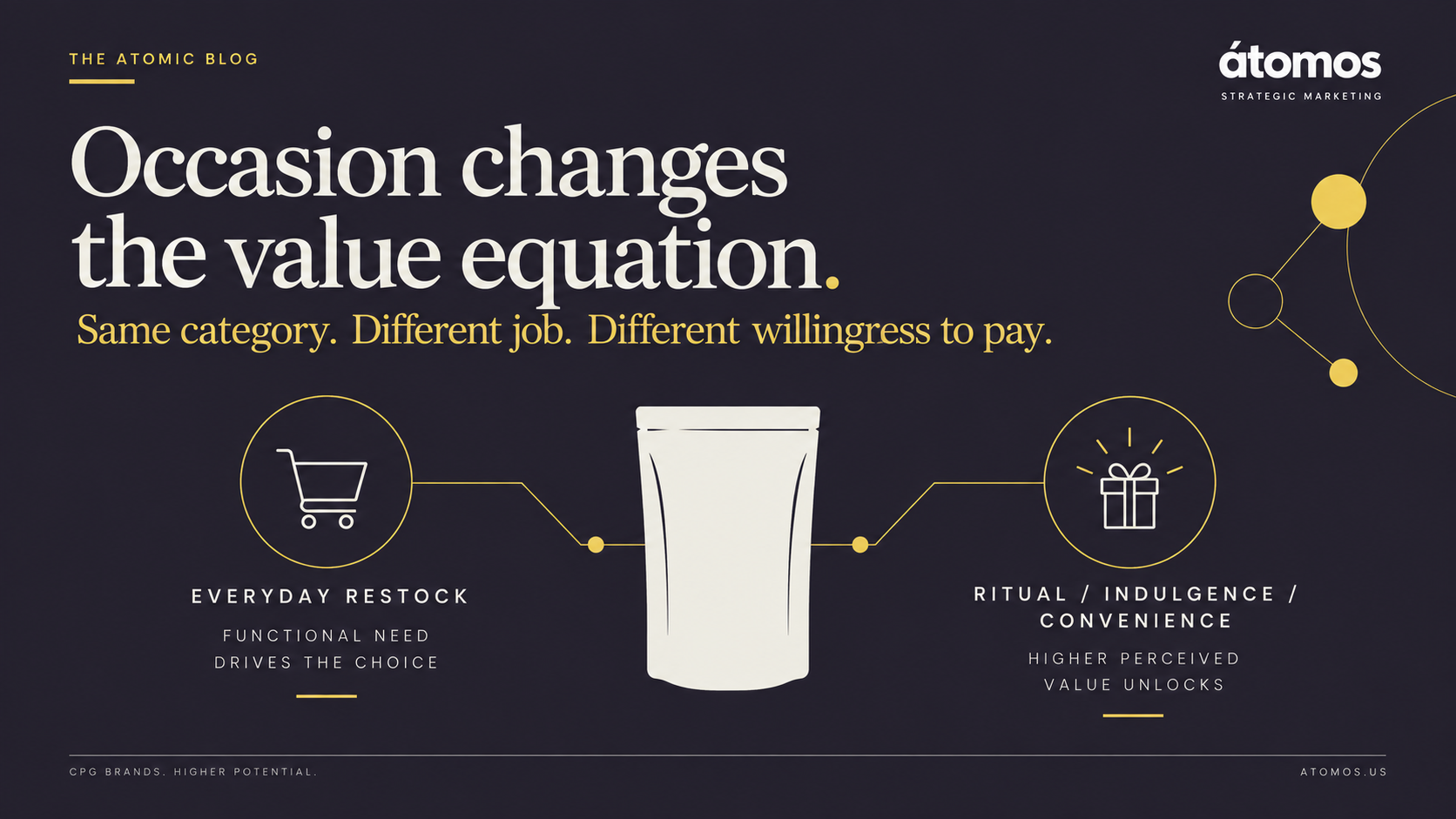
Category is only part of the story. Occasion can change willingness to pay inside the same category.
An everyday restock is not the same decision as an indulgent moment. A product bought for a guest, a child, a personal ritual or an on-the-go need can carry a very different value equation from the same type of product bought for routine household use.
This is also why “premium-coded category” can be misleading.
McKinsey’s 2026 ConsumerWise research found that health and wellness was named a top splurge category by only about 8% of consumers. That does not mean wellness is weak. It means a category can be important without automatically carrying permission to splurge.
For many shoppers, wellness behaves more like a baseline expectation than an indulgence
The broader point is simple: the job the purchase is doing matters.
A functional product bought as part of a daily routine and an indulgent product bought as a reward may sit next to each other on shelf, but they are competing against very different standards of value.
If a brand does not understand the occasion it is really winning, it is difficult to know what the shopper will pay for.
What private label actually tells us
Private label matters here, but not because every branded product is suddenly in a race to the bottom.
Circana reported U.S. private-label sales of roughly $330 billion in 2025, with Food & Beverage playing a major role in the expansion. The growth is meaningful, but the more interesting signal is who is choosing private label and why.
Simon-Kucher’s 2026 U.S. Global Shopper Study found that 44% of higher-income shoppers reported increasing their private-label purchases — ten points higher than lower-income shoppers in the same study. It also found meaningful adoption of premium private-label lines among higher-income consumers.
That complicates the old assumption that private label is mainly a financial compromise.
In many categories, it is now an intentional value decision.
The shopper can afford the branded product. They have simply decided the difference is not worth paying for.
That is the question I would want a team to answer with precision:
Where does substitution feel painless to our shopper, and where do they refuse to compromise?
Those are two very different lists.
Turning consumer insight into commercial decisions
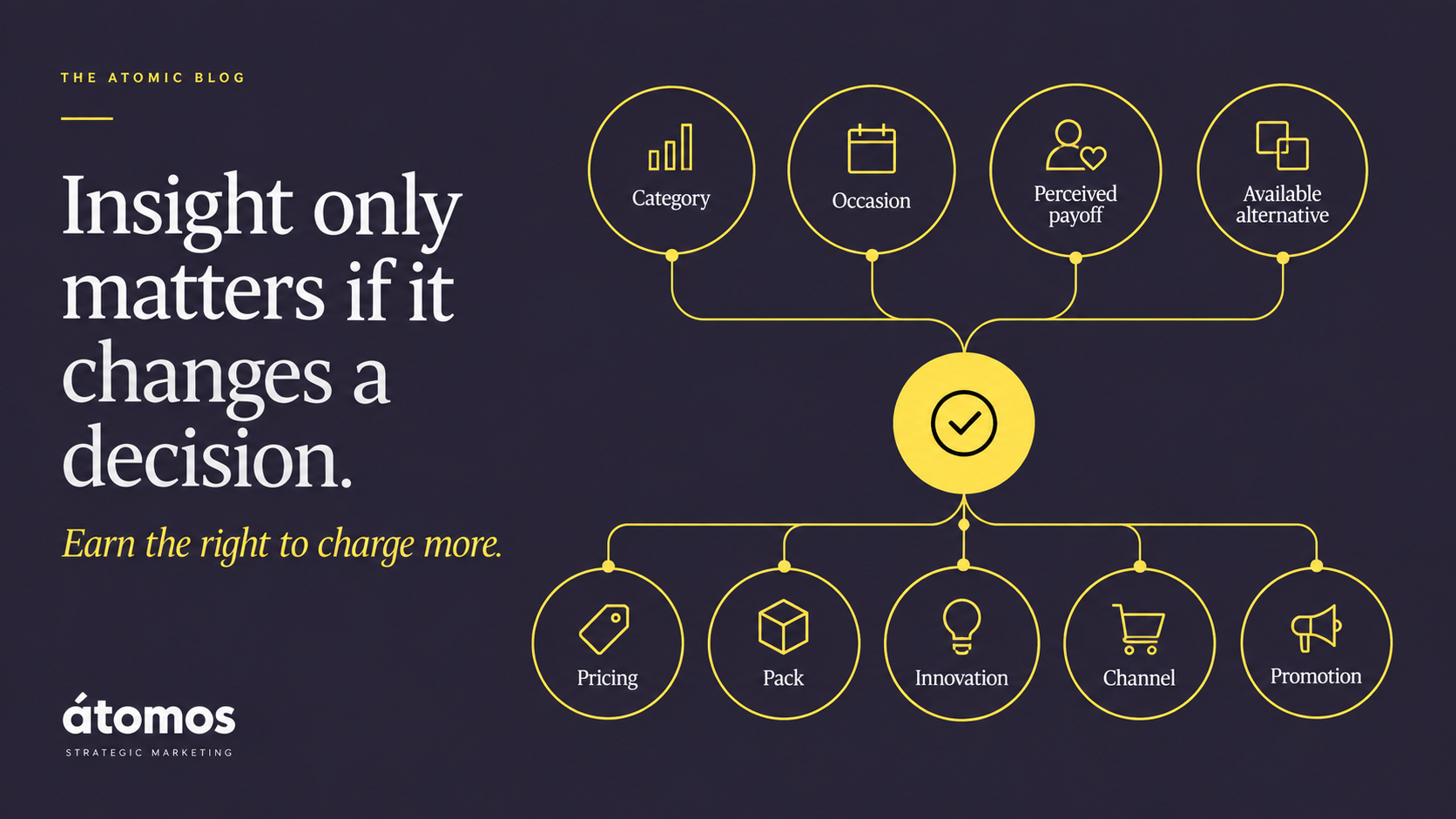
Consumer insight is only useful if it changes a decision. Once you take category, occasion, payoff and alternative seriously, several commercial choices look different.
Pricing and price architecture. Do not start only with what the category can “bear” or what the competitor charges. Start with the specific payoff that makes substitution less attractive. If that payoff is obvious at shelf or immediately in use, the brand may have more room to defend price. If it takes significant education to understand, the pricing strategy has to reflect that reality.
Pack and format. A format creates value when it changes the job being solved. A single-serve pack can command more per ounce if it unlocks convenience, portability or a personal occasion. A larger pack can win when the shopper is optimizing routine household value. The pack is part of the value equation, not just a margin calculation.
Innovation. Before adding another SKU, ask whether it creates new willingness to pay, opens a meaningful occasion or strengthens the product payoff. If it does none of those things, it may be adding complexity without adding defensibility.
Retail and channel. The alternative changes by channel, so the value equation changes too. A brand sitting next to a strong private-label assortment in mass grocery faces a different comparison than the same brand in specialty retail. The retailer story should reflect the occasion and competitive set in that channel, not simply repeat the brand positioning.
Promotion. Promotion can be useful when it lowers the barrier to trial for a product whose payoff becomes obvious after experience. It is less useful when repeated discounting is compensating for a premium the shopper does not believe in. In that case, the issue is not the promotion plan. It is the value equation underneath it.
A founder diagnostic: where do you actually earn the right to charge more?
Before making a pricing, innovation or marketing decision, I would want the team to answer five questions with evidence, not just conviction.
Where does our shopper refuse to compromise, and where will they substitute without a second thought?
What specific payoff are we charging for — sensory, functional, trust, identity, ritual — and is that payoff obvious enough for the shopper to value?
Which occasion creates our strongest willingness to pay, and are our product, pack and marketing built around that occasion?
If we removed the brand story, would the product experience still justify the price gap versus the next-best alternative?
What would have to become true for a lower-priced or private-label option to become “good enough” for our shopper — and how close is that today?
If those answers are fuzzy, that is usually the more important problem to solve before debating another price move or campaign.
The real question
Your shopper is probably willing to pay a premium somewhere in the basket.
The important question is not whether they are a “premium consumer.”
It is whether your category, your occasion and your product give them a reason to pay a premium for you.
That reason has to survive contact with the shelf, the alternative and the actual product experience.
Otherwise, the premium only makes sense inside your own building.
-
Selective premiumization describes a pattern where the same shopper pays more in some categories or occasions while choosing lower-priced or private-label options in others. Willingness to pay is not fixed across the basket.
-
The research cited in this article suggests private label is increasingly an intentional value choice, not only an affordability fallback. In categories where shoppers see little meaningful sacrifice in switching, even higher-income consumers may decide the branded premium is not worth paying.
-
Start with substitution. Where does choosing the alternative create a meaningful sensory, functional, trust or emotional compromise? The stronger and more obvious that compromise is, the more defensible a premium can become.
-
The same consumer can value a product differently depending on the job it is doing. Everyday replenishment, convenience, indulgence, gifting, wellness and personal ritual can create very different willingness-to-pay dynamics.
-
Use it to make sharper decisions about pricing, pack, innovation, channel, promotion and retailer storytelling. The goal is not simply to charge more. It is to understand where the brand genuinely earns the right to do so.
