Before You Cut the Marketing Budget: Find the Leak First

Picture the meeting. Sales are behind plan. Paid efficiency is slipping. Velocity at an important retailer has softened, and the buyer is asking harder questions about the next reset.
Someone asks the question that eventually shows up in every pressured P&L: What should we cut?
It is a reasonable question. It is also usually too early.
“Marketing isn’t working” is not a diagnosis. It is a headline that can be produced by very different problems: weak awareness, low trial, poor shelf conversion, weak repeat, bad distribution, availability gaps, pricing, promotion dependency, product experience, channel economics or a category that is simply moving against you.
Those problems should not produce the same budget decision.
Sometimes cutting is exactly right. But cutting should be the output of diagnosis, not the substitute for one.
One bad number can have many causes
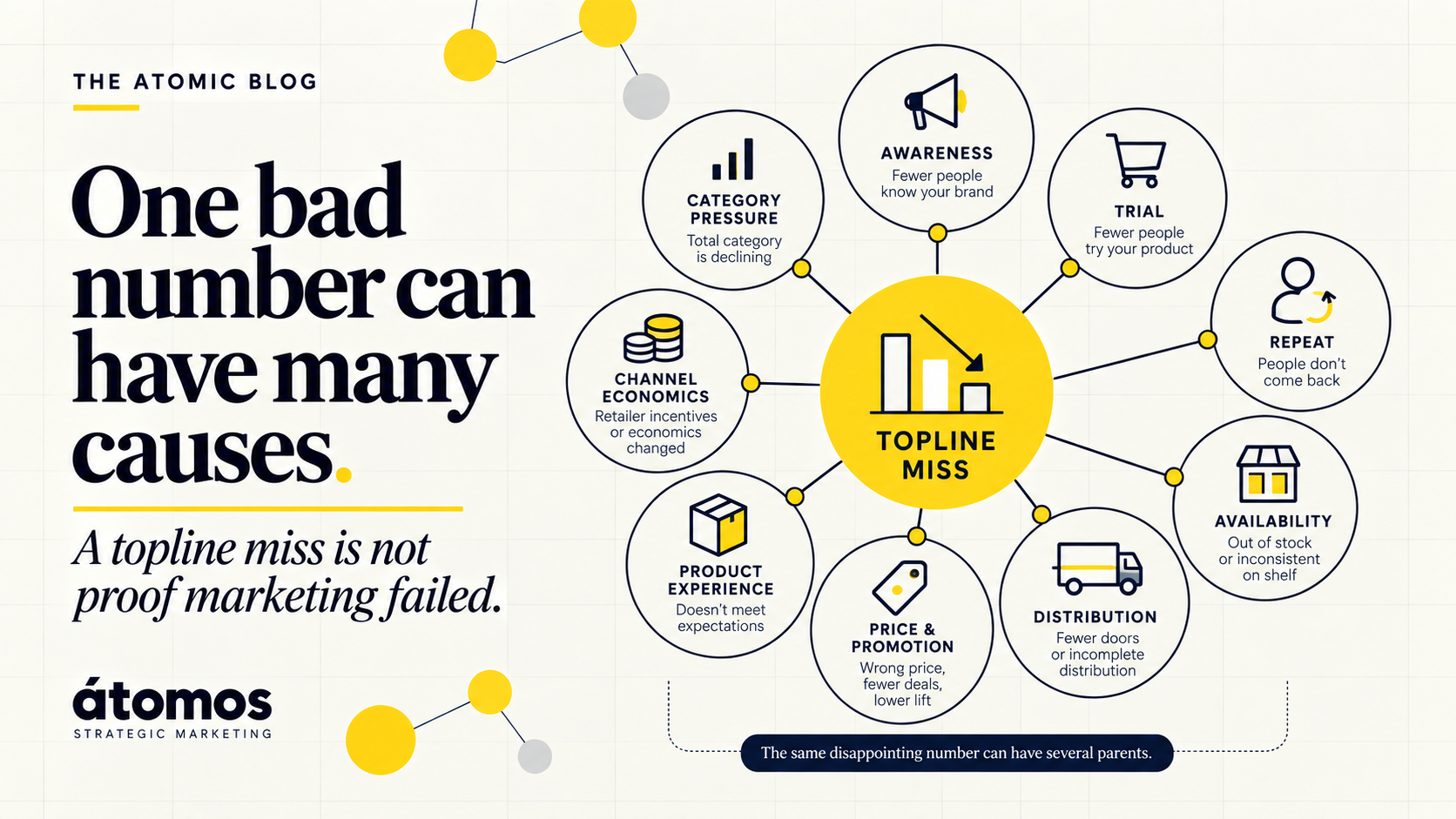
The first mistake is treating the topline miss as proof that the marketing investment failed.
A brand can execute well and still face a difficult market. Circana’s 2026 Food & Beverage outlook expected U.S. dollar sales to grow 2% to 4% while unit volume stayed flat or slightly negative; its mid-2026 update showed first-half performance tracking close to that pattern, with flat volume. That does not excuse weak execution. It does mean leadership has to separate category tide from brand-specific problems before assigning blame.
The same logic applies inside the business.
If sales are soft because shoppers are not aware of the brand, cutting reach may deepen the problem. If awareness is healthy but shelf conversion is weak, more media may simply send more shoppers toward a pack, price or placement that is not converting. If trial is strong but repeat is weak, the leak may be product experience or value. If a retailer is underperforming because the product is frequently unavailable, the marketing dashboard is not the place to start.
The same disappointing number can have several parents.
This is a different problem from building a marketing budget from zero. Once spend is already live, the question is no longer “where should the next dollar go?” It is “what job was this dollar hired to do, and did it do that job?”
Ask what each dollar was hired to do
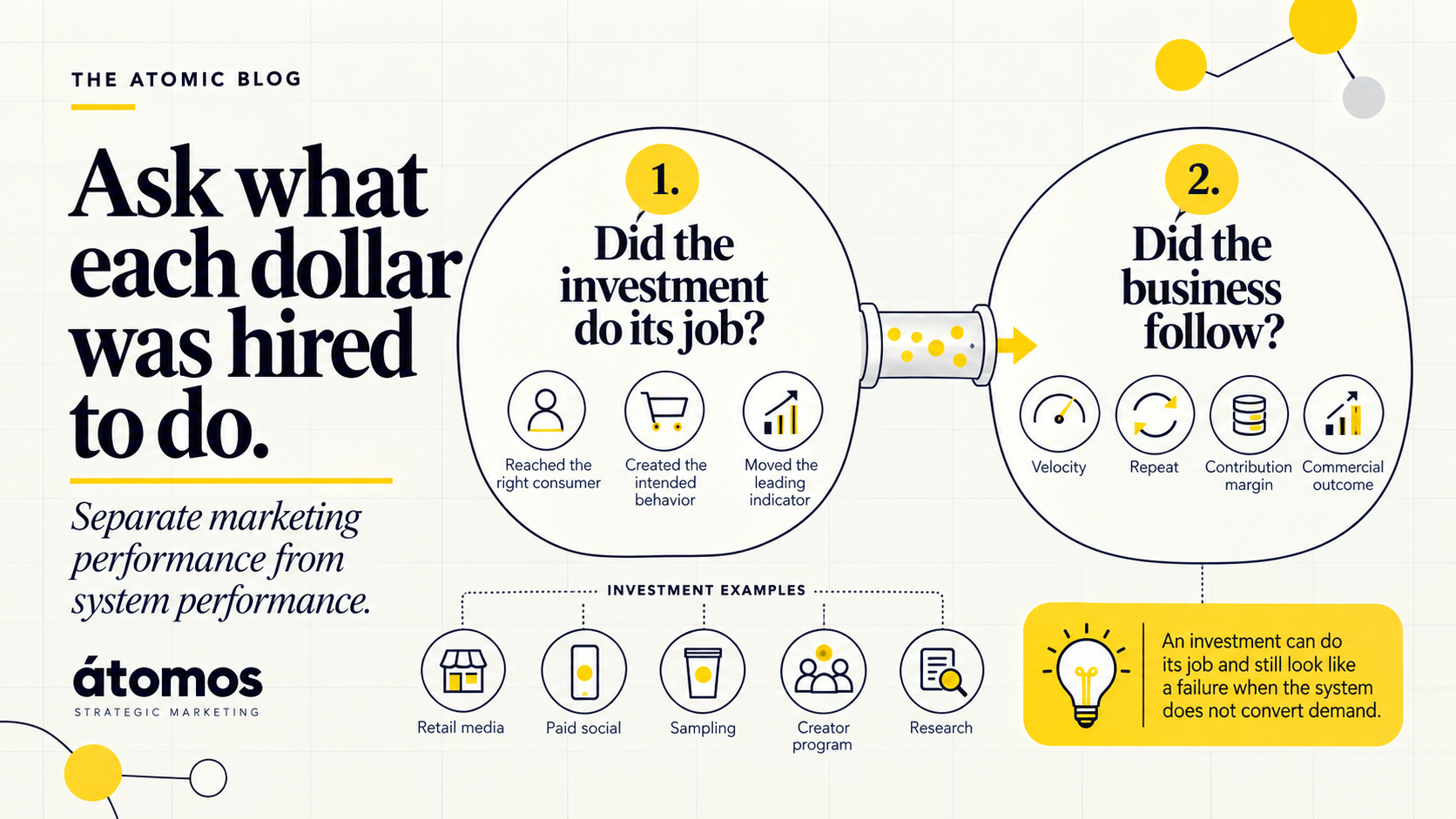
Every meaningful investment should have a primary job.
A retail media program may be there to drive trial at a specific retailer. Paid social may be there to recruit a specific consumer. Sampling may be there to turn awareness into first purchase. A creator program may be there to build salience around an occasion. Consumer research may be there to remove uncertainty from a high-stakes decision.
Judge the investment against that job before judging it against the total business result.
I would ask two questions:
1. Did the investment do its job?
Did it reach the right consumer, create the intended behavior or move the leading indicator it was designed to move?
2. Did the business follow?
Did that movement show up downstream in velocity, repeat, contribution margin or another commercial outcome that matters?
Those questions separate marketing performance from system performance.
If awareness rose among the priority shopper but trial stayed flat, the media may have done its job and the leak may be at shelf. If sampling recruited buyers but repeat stayed weak, the sampling may have worked and the problem may be product or value. If a paid channel reports strong return but a holdout test shows little incremental lift, the channel may be receiving credit for demand that would have happened anyway.
An investment can do its job and still look like a failure when the rest of the system does not convert the demand it created.
De-average before you decide
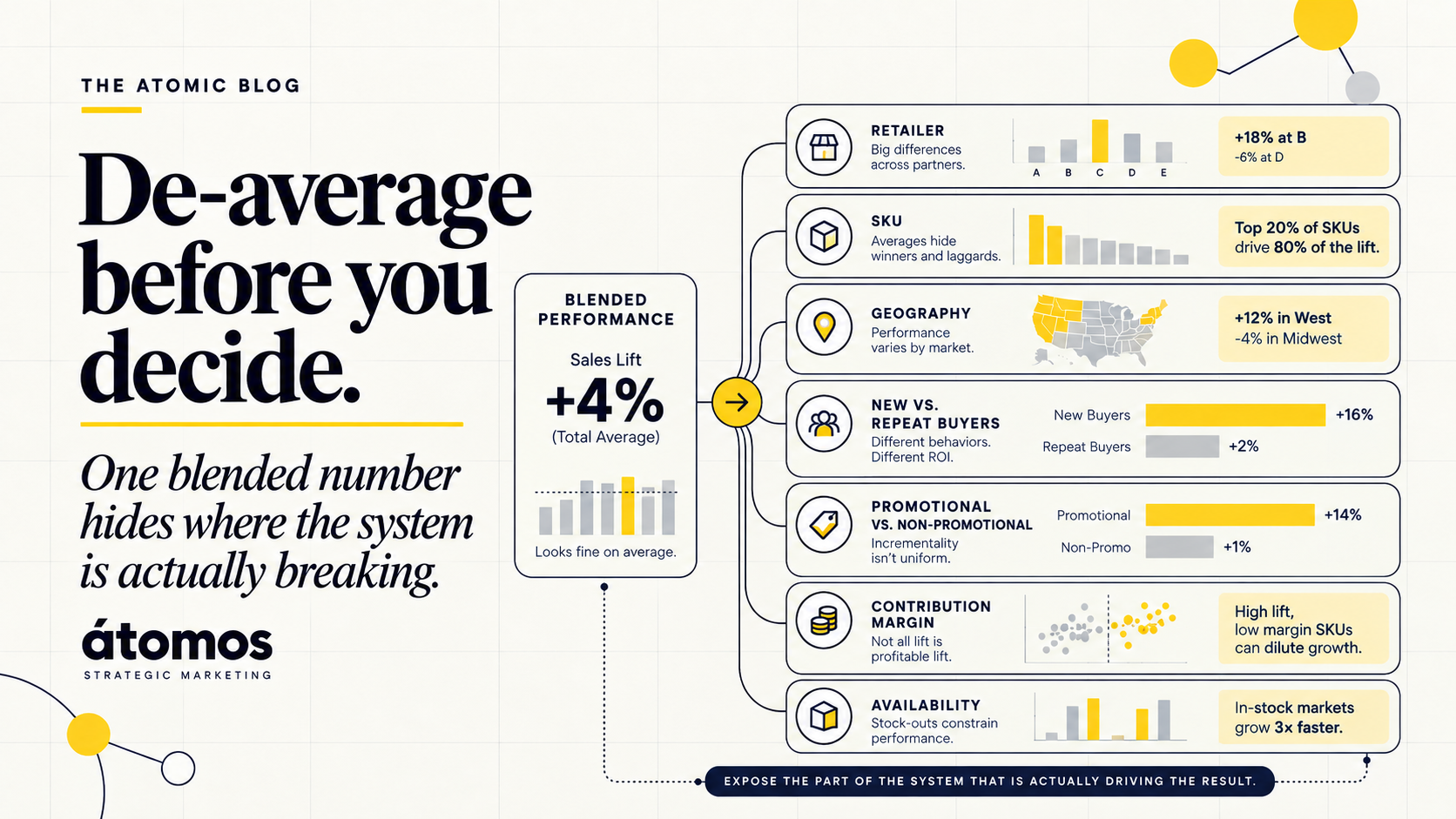
You cannot answer those questions with one blended number.
Before a budget decision, I would split performance by retailer, SKU, geography, new versus mature doors, new versus repeat buyers, promotional versus non-promotional periods and contribution margin. Then I would split the spend the same way.
A brand that looks healthy in aggregate may be one retailer carrying three weak ones. A portfolio that is “on plan” may be one hero SKU masking a long tail that is not earning its support. A channel with attractive reported ROAS may look very different once you separate new demand from demand that would have happened anyway.
Availability belongs in that diagnosis too. Circana’s current on-shelf availability work makes the basic point clearly: when the product is not available at the moment of decision, the sale is lost. Before blaming weak demand, confirm that shoppers could actually buy the product where the marketing sent them.
The goal is not to create more reporting. It is to expose the part of the system that is actually driving the result.
Use one gate before five decisions
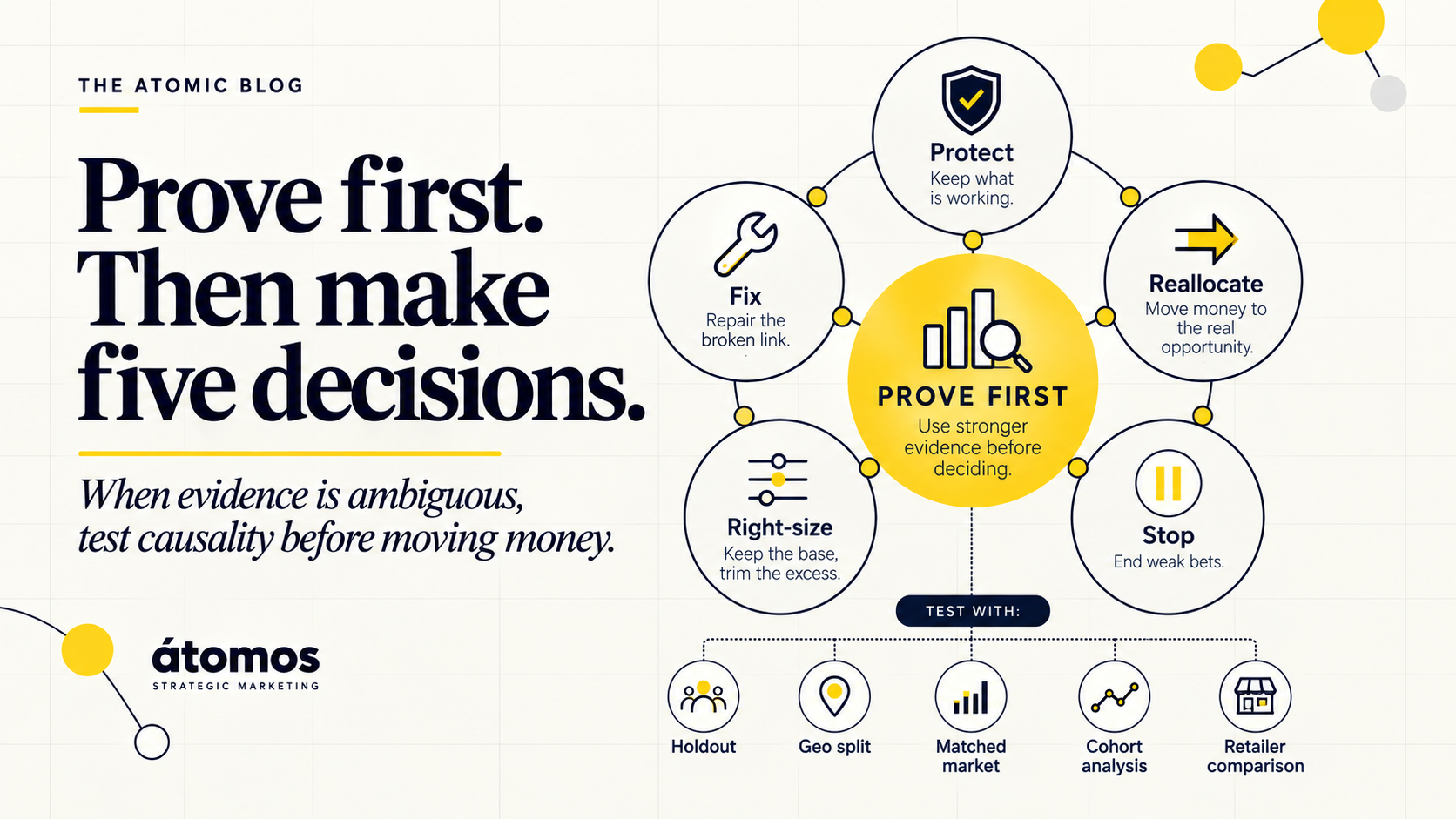
Once the diagnosis is clear, the budget decision gets much simpler.
There is one gate first: Prove First.
If you cannot tell whether the spend caused the result, do not force a Protect-or-Cut decision from attribution alone. Use the strongest evidence the business can reasonably support: a matched-market test, geo split, holdout, retailer comparison, cohort analysis or a time-bound test with clear success criteria.
This is increasingly normal practice. EMARKETER and TransUnion reported in 2025 that 52% of U.S. brand and agency marketers use incrementality testing or experiments to measure campaigns.
Not every line item needs a perfect experiment. But the larger the spend and the more ambiguous the evidence, the more dangerous it is to make a permanent budget decision from a dashboard that cannot tell correlation from causation.
After that gate, I would put established spend into one of five decisions:
Protect.
The investment is doing the job it was hired to do, and the business is converting that work. Keep the base intact. The fact that the overall quarter is soft is not enough reason to punish something that is working.
Fix.
The strategic job is still right, but a link in the system is broken. That may be creative fatigue, targeting, pack communication, price-value, placement, availability or product experience. Fix the broken link rather than automatically removing the investment that exposed it.
Reallocate.
The objective is right, but the money is in the wrong place. If the weakness is concentrated in two retailers, a national solution may be wasteful. If one region or SKU is doing the work, move resources toward the part of the business where the constraint and opportunity actually sit.
Right-size.
The channel or program works, but the marginal dollar no longer earns enough. Saturation does not mean a channel is “dead.” It may mean the base deserves to stay while the excess moves somewhere more productive.
Stop.
The bet itself is weak. After fair exposure and a reasonable test, the consumer response, economics or strategic role are not strong enough to justify more capital. More spend will not rescue every SKU, program or idea.
That is a very different conversation from “cut marketing by 15%.”
Do not solve the wrong problem with more acquisition
There is a mirror-image mistake to cutting too quickly: adding more demand generation to a system that is already leaking.
NIQ’s 2026 analysis of 2025 launches across five Western European markets found that only 17% of launches combined strong trial and strong repeat. The data is not a U.S. benchmark, but the pattern is useful: generating trial and earning the next purchase are different jobs.
If trial is healthy and repeat is weak, recruiting more buyers may simply scale the number of people who try once and leave. If shelf conversion is weak, more awareness sends more shoppers toward the same friction. If availability is the constraint, more demand generation does not put product on the shelf.
That does not mean “retention always beats acquisition.” Repeat should be judged against category norms, purchase cycle and brand maturity. The point is simpler: diagnose the leak before you pour more volume into it.
What cutting actually does
The evidence on budget cuts is more useful than the slogans.
Ehrenberg-Bass research on brands that stopped mass-reach advertising found sales declined 16% on average after one year without advertising. Smaller brands and brands that were already declining tended to fall faster. The researchers are careful not to claim causality, and the work covers mass-reach advertising rather than every CPG investment. It is a warning, not a forecast.
The warning matters because growth-stage brands have less insulation than large established ones.
At the same time, the evidence is not a defense of every marketing dollar. Some programs are saturated. Some channels are mismeasured. Some bets are weak. Some spending should stop.
The mistake is treating “easy to cut” as “safe to cut.”
That reflex is common. In the 33rd edition of The CMO Survey, executives said marketing would be cut over other expenses 44.6% of the time when profits miss targets.
A diagnosis can still end with a cut. It should just earn its way there.
Keep the ability to learn
There is one more failure mode I would watch for: cutting the tools that make diagnosis possible.
Measurement, consumer evidence, testing and strategic leadership often look less tangible than media or trade spend because they do not appear directly on shelf. That does not make them automatically sacred. If a research subscription informs no decision, stop paying for it. If a reporting stack creates dashboards nobody uses, simplify it.
But do not remove the evidence you need to understand why performance changed before you know what decision that evidence supports.
If incrementality testing is the only thing separating platform-reported return from causal lift, it may be more valuable during a pressured quarter, not less. If consumer research can tell you whether weak repeat is a product problem or a positioning problem, that evidence may prevent a much larger misallocation.
The point is not to defend infrastructure. It is to protect the ability to learn before making an expensive move.
CPG Budget Triage
Bring this diagnostic into the budget conversation:
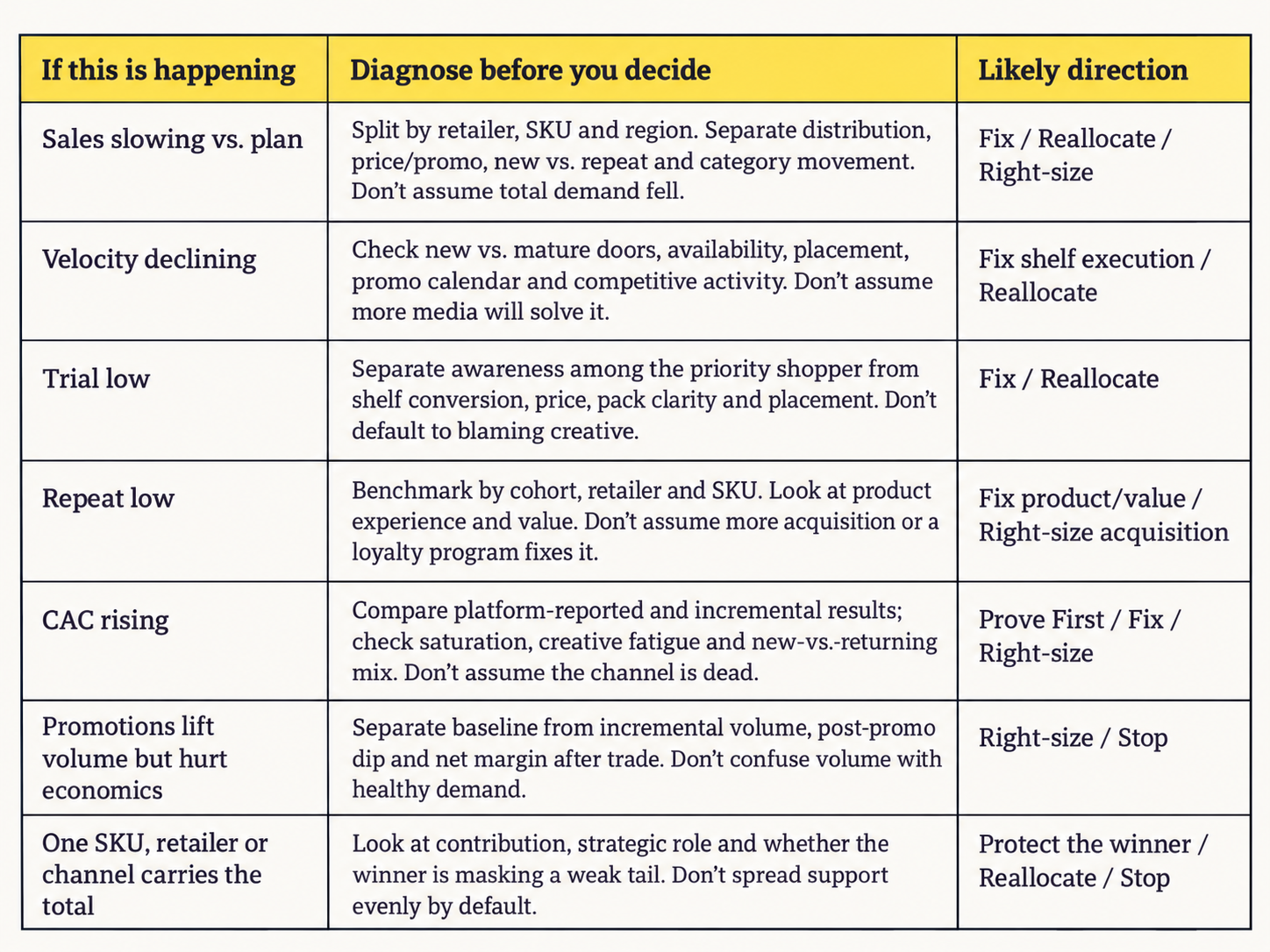
The budget decision should come last
When results soften, pressure arrives fast. That is exactly when the quality of the diagnosis matters most.
Do not start the meeting with a percentage.
Start with two questions: Did the investment do the job it was hired to do? And did the business follow?
From there, the decision can be Protect, Fix, Reallocate, Right-size or Stop. If the evidence is not strong enough, Prove First.
Cutting can be the right answer. So can protecting something that is working while fixing a problem somewhere else.
ÁTOMOS — FRACTIONAL CMO FOR FOOD & BEVERAGE
We bring big-CPG playbooks to growing food and beverage brands.
We embed inside your business, read your category the way large CPG does, and help you move with clarity and speed — without the full-time cost.
→ Let's talk: atomos.us/contact
-
Not by default. Sales can soften because of awareness, trial, repeat, retail execution, availability, pricing, product experience, channel economics or category pressure. Diagnose the cause first, then decide whether to protect, fix, reallocate, right-size or stop the relevant investment.
-
Ask whether the investment moved the indicator it was hired to move, then ask whether the business converted that movement into a commercial result. If marketing did its job but sales, repeat or margin did not follow, the leak may be downstream.
-
At minimum, de-average performance by retailer, SKU, geography and buyer type; separate new from repeat behavior; check availability and price/promotion effects; look at contribution economics; and distinguish incremental results from platform-reported attribution where possible.
-
Cutting removes an investment because the bet no longer deserves capital. Right-sizing keeps a productive channel or program but reduces spend when the marginal dollar is no longer earning enough.
-
Research from Ehrenberg-Bass found average sales declines after brands stopped mass-reach advertising, with smaller and already-declining brands generally more exposed. But results vary, and that evidence should not be generalized to every marketing activity. The decision should depend on the role and marginal return of the specific investment.