The Missing Layer Between Founder-Led and a Full C-Suite
What growth-stage CPG brands reveal about senior judgment, fractional leadership and the decisions that come before a full executive team.
FEATURED CONVERSATION
This article expands on a recent Startup to Scale conversation, where I joined Jordan Buckner, Beth Brown and Rachel Severo to discuss how growing CPG brands can access senior-level marketing, operations and finance leadership without building a full C-suite too early.
Episode 284: How CPG Brands Can Access Senior-Level Advisory, Strategy, and Execution Without Building a Full C-Suite
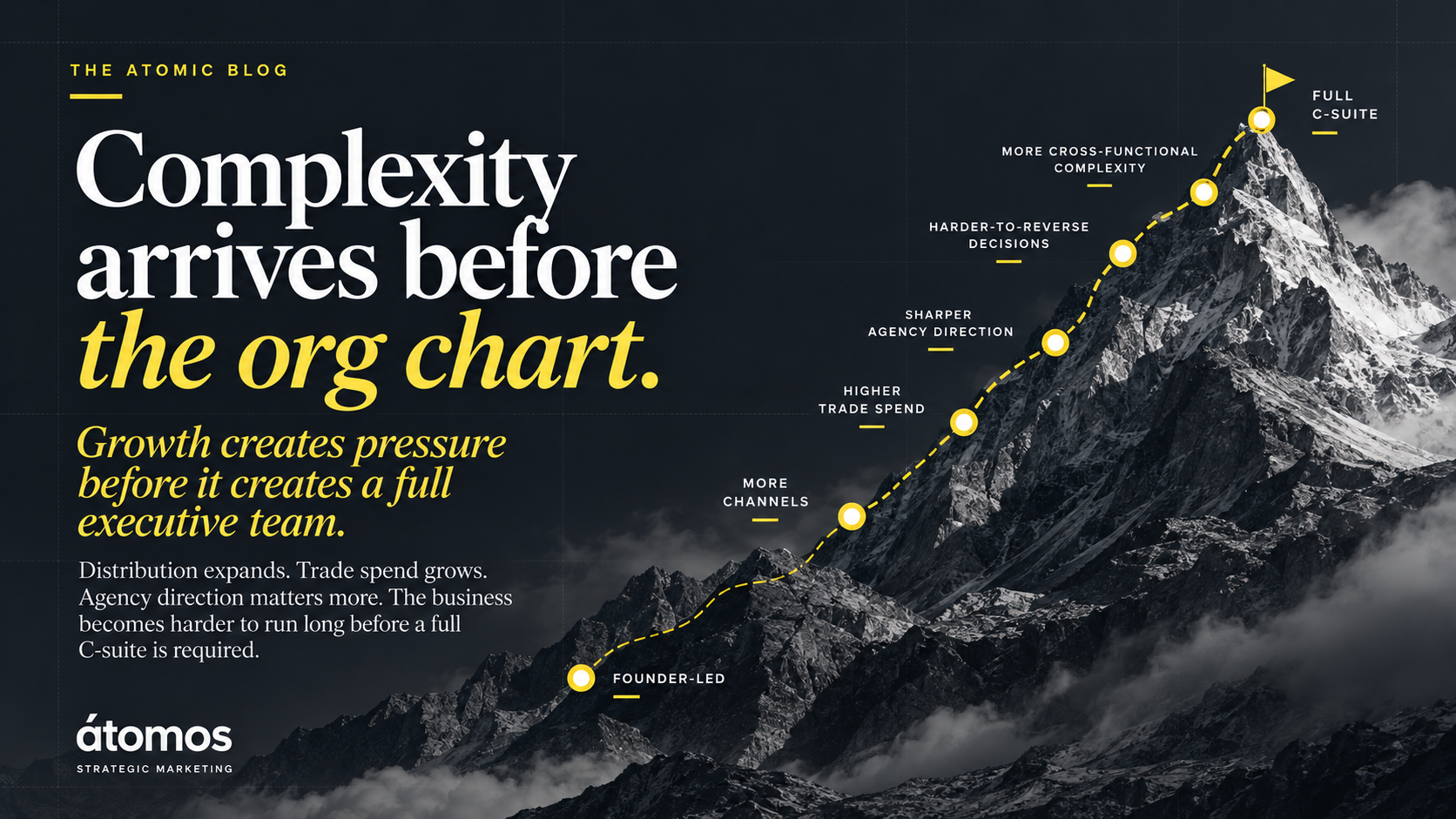
A growing CPG brand does not suddenly wake up needing a full C-suite. The need shows up first in the decisions.
Distribution expands. Trade spend becomes more meaningful. The agency needs sharper direction. Retailer commitments carry more weight. A packaging, pricing or channel decision can now create consequences that last well beyond the quarter.
The founder is still close to everything, but the business is no longer simple enough for every important decision to be figured out for the first time.
Most companies treat that moment as a hiring question: Who do we need to bring on full time?
I think there is a better question: Where does this business need senior judgment right now?
The missing layer is not always another executive seat. Sometimes it is experienced leadership applied precisely where the risk, ambiguity and leverage are highest.
Complexity arrives before the org chart
Growth creates complexity before it creates the economics for a complete executive team.
A brand can expand retail distribution, add new partners, increase marketing investment and take on more sophisticated financial and operational decisions while the leadership structure still looks much like it did one stage earlier.
That gap is normal. The problem is what happens when the company responds with only two options: the founder keeps absorbing every decision, or the business hires a full-time executive before the role truly requires full-time ownership.
Neither option is automatically wrong. But both can miss the more useful question: which decisions would materially improve if someone with deeper experience were in the room?
That is a leadership design question, not simply a headcount question.
"Flight hours" are different from capacity
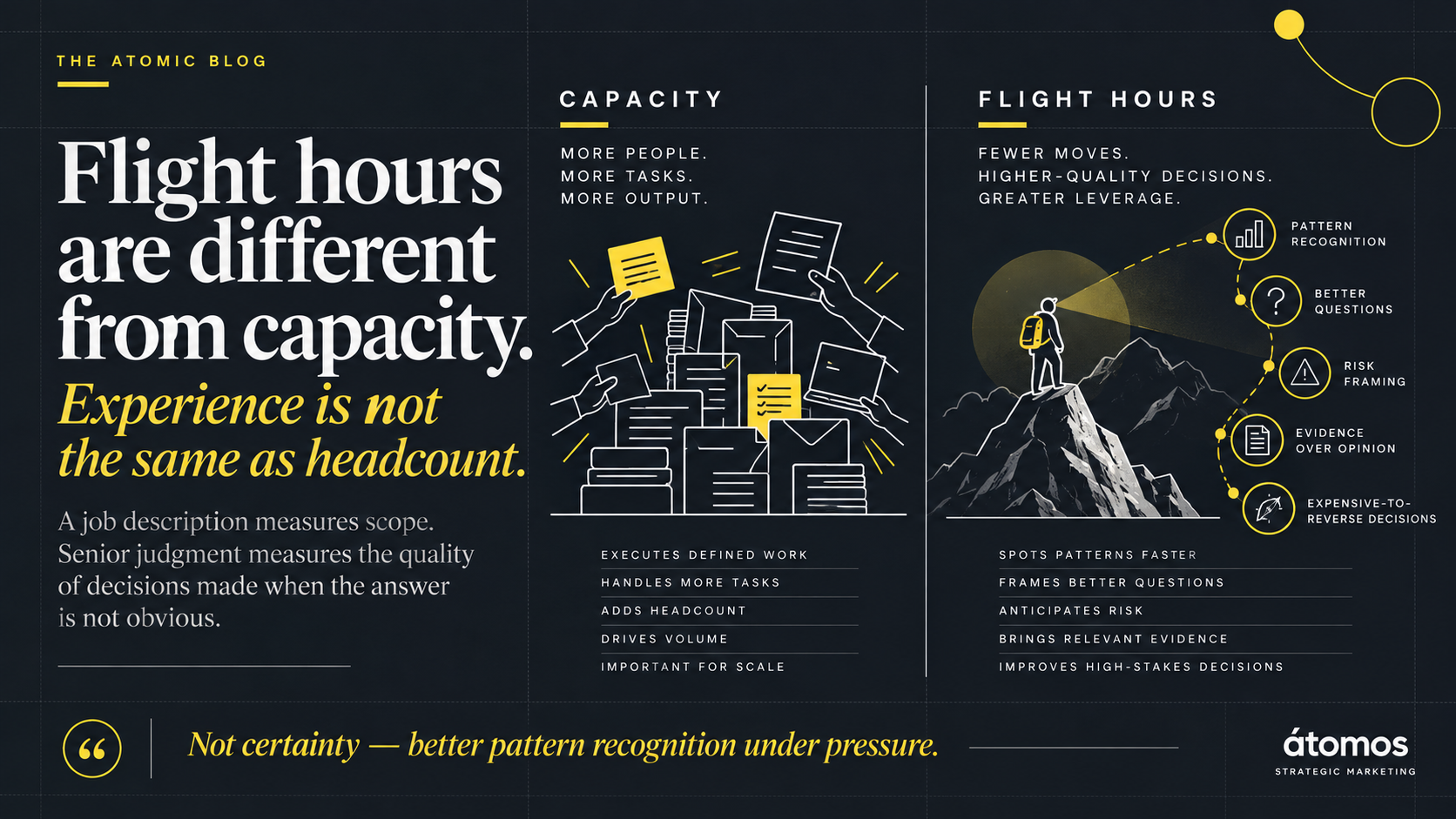
In the podcast, I called it "flight hours."
Experience is not valuable because a senior operator has seen the exact same situation before. CPG rarely repeats itself that neatly. It is valuable because experienced leaders recognize patterns faster.
They know which questions to ask before the company commits budget. They can distinguish a symptom from the underlying problem. They know when a partner is giving a reasonable answer and when the team should push harder. They have a better sense of what needs evidence, what can be tested and what is expensive to reverse.
Across the conversation, the examples were different: packaging, pricing, co-manufacturing and agency management. The pattern was the same. Founders were making decisions in areas where they did not yet have enough repetitions to know what they might be missing.
That is what flight hours buy: not certainty, but better pattern recognition under pressure.
A job description measures scope. Senior judgment is the accumulated quality of decisions made when the answer was not obvious. Those are different assets, and growth-stage companies should think about them differently.
STRATEGIC IMPLICATION
A growth-stage brand may not need a full C-suite yet. It still needs C-suite-quality judgment where the decisions are hardest to reverse.
Put senior judgment where risk is concentrated
The fractional model is often described as a cheaper way to get an executive. I think that framing misses the point.
The goal is not to buy fewer hours of seniority. It is to concentrate senior judgment where it creates the most leverage.
A senior marketing leader should not spend the week formatting social posts, chasing file versions or doing work that a strong specialist can own. The value is in the decisions that shape the system around that work: positioning, consumer priorities, channel roles, agency direction, investment choices, launch decisions and the tradeoffs that determine what the team will not do.
In the episode, I used the phrase "delegate ruthlessly." The point is not to push work down indiscriminately. It is to protect senior attention for the problems only senior judgment can solve.
The same logic applies across functions. Use the most experienced person on the decisions where experience changes the outcome. Build the right team and partners around them to execute the rest.
That is not cost cutting. It is leadership leverage.
When does a decision deserve senior involvement?
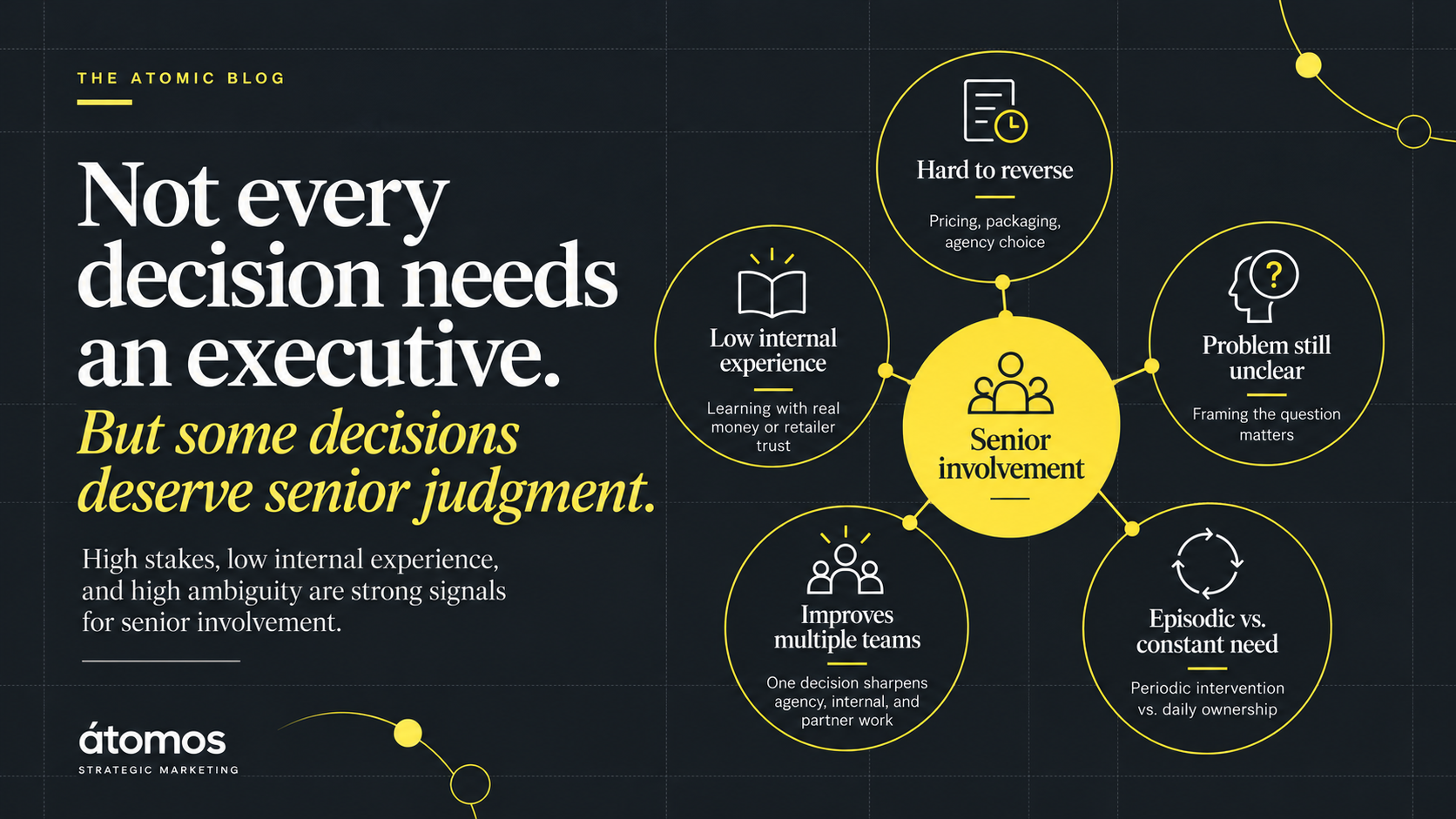
Not every decision needs an executive. The useful question is whether the decision carries enough consequence, ambiguity or leverage to justify senior involvement.
How hard is the decision to reverse? A retailer commitment, a major packaging change, a new agency relationship, a significant budget allocation or a pricing move has a different risk profile from a decision the team can adjust next week.
Has someone inside the company successfully handled this before? If the capability already exists internally, use it. If no one has navigated the situation before, the business may be learning with real money, retailer relationships or consumer trust on the line.
Is the problem clear, or is the team still deciding what problem it is solving? Execution can be delegated when the question is clear. Senior judgment becomes more valuable when the business is still framing the question itself.
Will better direction improve the work of multiple people? If one senior decision sharpens the work of the internal team, an agency, a broker and other outside partners, the leverage compounds.
Is the need episodic or constant? A high-stakes decision that appears periodically may not require a permanent executive seat. Daily ownership, team management and continuous decision volume eventually do.
A simple rule of thumb: high stakes, low internal experience and high ambiguity are strong signals for senior involvement. Clear, reversible, repeatable work should move to the appropriate execution owner
Senior leadership is an execution multiplier
The value of a senior operator is not limited to the work that person does personally. Good leadership improves the quality of the work around it.
Take an agency relationship. A founder can hire a strong agency directly. But the quality of the output still depends on the quality of the problem definition, the brief, the expectations, the feedback and the decisions made along the way.
A weak brief can create weak work from a strong agency.
Senior marketing leadership improves the inputs before it evaluates the outputs. It can translate a business problem into a sharper assignment, challenge work against consumer and commercial objectives, and give feedback that moves the work forward instead of simply adding another round.
The same principle appeared across the podcast in finance and operations. Experienced leadership raises the ceiling on the specialists and partners already doing the work.
That is a different kind of capacity. It does not add another pair of hands. It makes the existing hands more effective.
The goal is not to buy fewer hours of seniority. It is to concentrate senior judgment where it creates the most leverage.
Strategy has to survive reality
The difference between advising and leading becomes most visible after the recommendation is made.
A plan can be strategically sound and still encounter conditions no one modeled perfectly. A retailer reacts differently than expected. A launch timeline moves. Consumer feedback changes the assumption. Budgets tighten. A partner cannot deliver what was originally planned.
This is why strategy cannot end at the deck.
The value of strategy is the quality of the decisions that follow it. Senior leadership stays close enough to the work to know what should remain fixed, what should adapt and what should stop.
That proximity matters because execution is where assumptions become evidence.
The strongest leadership model is not the one that protects the original plan at all costs. It is the one that protects the strategic intent while allowing the plan to get smarter as the business learns
When fractional should become full time
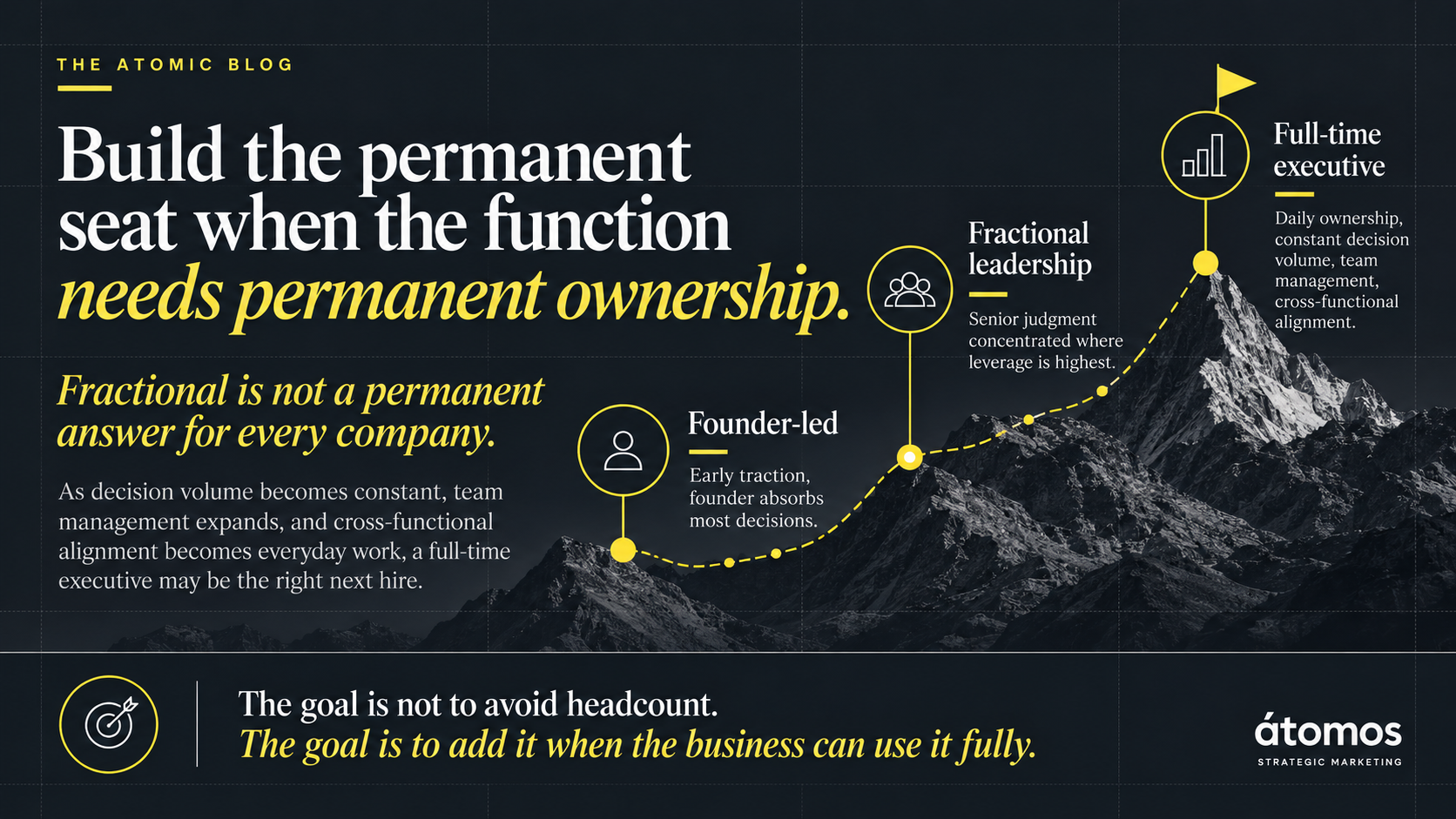
Fractional leadership is not a permanent answer for every company.
As the business scales, some needs stop being episodic. Decision volume becomes constant. The function requires daily ownership. Team management expands. Cross-functional alignment becomes an everyday responsibility rather than a periodic intervention.
At that point, a full-time executive may be exactly the right answer.
A strong fractional engagement should help the company reach that point with more clarity, not delay it. It should strengthen the function, build better processes and teams, and make the eventual full-time role easier to define and hire.
The goal is not to avoid headcount. The goal is to add it when the business can use it fully.
The right judgment at the right moment
Senior leadership is not only a headcount milestone. It is a judgment requirement.
A company can be founder-led, supported by capable specialists and still be under-led at the moments that carry the most risk. The solution is not automatically another full-time executive, and it is not automatically a fractional one either.
The better question is whether the right level of experience is present when the business makes decisions that are expensive to reverse, difficult to frame or capable of multiplying the performance of the entire team.
Build the permanent seat when the function needs permanent ownership.
Until then, make sure the business is not making its most consequential decisions without enough flight hours in the room.
Watch the full Startup to Scale conversation on YouTube →
If your brand is reaching this stage and the gap is specifically in marketing, átomos helps growth-stage CPG and Food & Beverage companies bring senior marketing leadership into the business before a full-time CMO is the right next hire.
ÁTOMOS — FRACTIONAL CMO FOR FOOD & BEVERAGE
We bring big-CPG playbooks to growing food and beverage brands.
We embed inside your business, read your category the way large CPG does, and help you move with clarity and speed — without the full-time cost.
→ Let's talk: atomos.us/contact